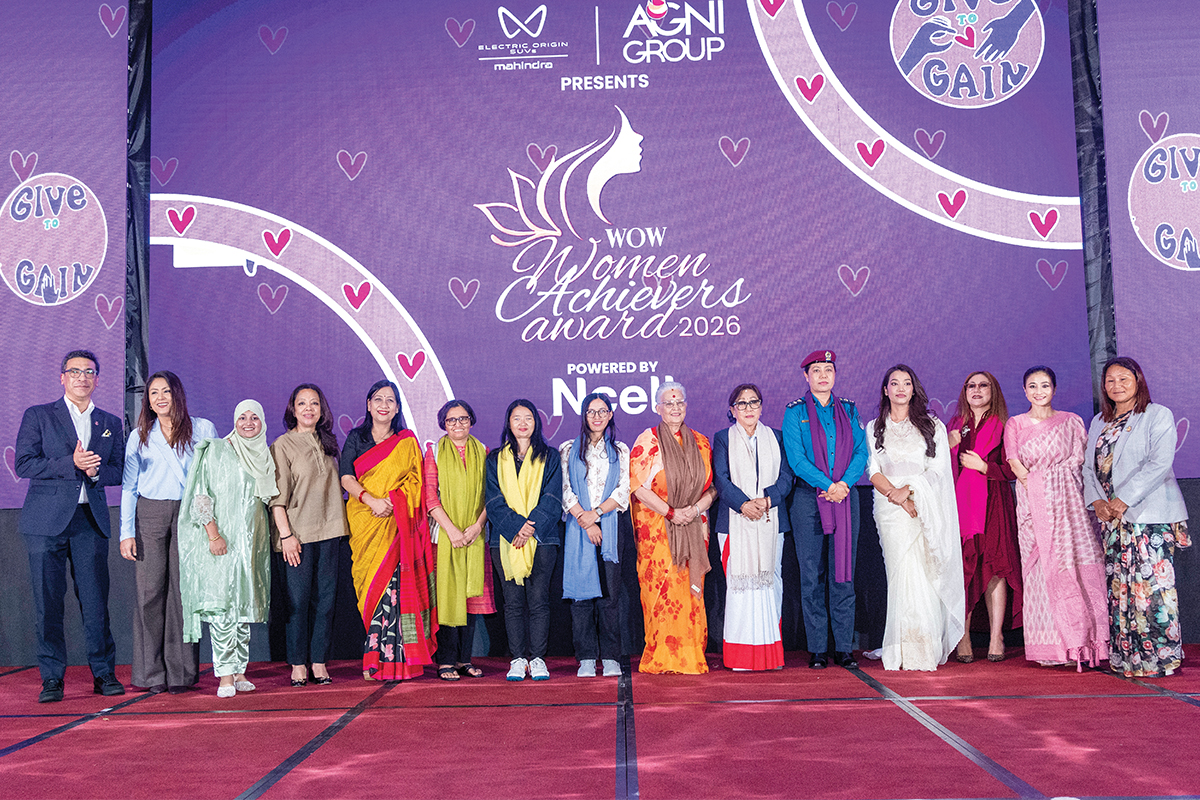
The WOW Women Achievers Award 2026 took place at The Plaza in Lalitpur on May 12.
This year’s theme, “Give to Gain”, highlighting the idea that true progress is built through collective upliftment, empathy and community-driven leadership. The event brought together inspiring women who are driving change and making significant strides in their respective fields, embodying the spirit of this year’s theme.
Honorees for WOW Women Achievers Awards 2026
More than 500 guests from Kathmandu’s political, corporate, creative and social sectors gathered at The Plaza for the WOW Women Achievers Awards 2026, an evening that celebrated women who are transforming society through leadership, creativity, service, courage and innovation.

Organised by WOW Magazine of Media 9 Pvt Ltd, the annual event carried forward this year’s Women’s Day theme, Give to Gain, highlighting the idea that true progress is built through collective upliftment, empathy and community-driven leadership.
The evening opened with welcome address by Ankita Jain, Editor of WOW Magazine where she reflected on the importance of compassion, purpose and women uplifting one another while celebrating those who create impact with both ambition and empathy.
A deeply emotional moment of the evening was dedicated to a tribute for the late Shanti Chadha. a pioneering leader who dedicated her life to advancing women’s economic independence and entrepreneurship and was the founding force behind the Federation of Women Entrepreneurs’ Associations of Nepal. She will be remembered for her strength, grace, resilience and contribution towards empowering women and grassroots communities while her legacy continues to inspire countless lives. Before the panel discussion, moderator, Sugarika KC invited the audience to rise for a minute of silence in her loving memory, creating a poignant moment of reflection, respect and collective remembrance.
This year’s edition also marked an important milestone with the introduction of a new award category: Sports. The inclusion reflected the growing recognition of women athletes and sporting communities who continue to challenge barriers while expanding conversations around representation, accessibility and resilience.
The annual awards celebration honoured women whose journeys have not only shaped their individual fields but also inspired a wider cultural shift in how leadership, service and success are understood in Nepal today.
The Arts

Abhaya Subba Weise
Award presented by Susan Vaidya Shrestha
Abhaya Subba Weise is widely regarded as one of the defining voices of Nepal’s contemporary rock and alternative music scene. Born in Darjeeling, India, she grew up surrounded by music and performance, developing an early fascination with rock, blues and soul genres. Her artistic identity was shaped by classic rock influences and a deep appreciation for expressive songwriting, elements that would later become hallmarks of her work as a vocalist and composer.
Her most significant artistic project emerged in 2003 with the formation of Abhaya & the Steam Engines, a band that began as an acoustic blues collaboration and gradually evolved into a dynamic rock ensemble. As the band’s frontwoman and primary creative force, Abhaya Subba Weise became known for her powerful vocals, emotionally charged performances, and thoughtful lyricism. “Having experienced setbacks many times in my life, I have discovered that I am no longer afraid of failure. I am afraid of not trying,” she says. The group quickly gained recognition for energetic live shows and a distinctive sound that expanded the possibilities of Nepali rock music.
Beyond the stage, Abhaya Subba Weise has played an influential role in nurturing Nepal’s music ecosystem. She has mentored emerging musicians through television music competitions such as the Voice of Nepal and founded the initiative Women in Concert, which advocates for greater visibility and opportunities for female performers. Abhaya Subba Weise stands as a celebrated musician and as an artistic leader who continues to shape Nepal’s evolving independent music culture.
Social service/Activism

Dr Radha Paudel
Award presented by Darshana Shrestha
Dr Radha Paudel is a nurse, author and feminist thinker whose work integrates healthcare, human rights and social justice. Born in western Nepal, she trained as a nurse and spent years working in government health services, including in conflict-affected and remote regions. These early experiences exposed her to deep structural inequalities in health access, particularly affecting women, marginalised communities, and rural populations. Over time, her practice evolved beyond clinical care into advocacy, writing, and public engagement centred on dignity, equity and peace.
Dr Radha Paudel is best known for her activism on menstrual equity and gender justice, challenging long-standing cultural taboos surrounding menstruation in South Asia. Her writing and campaigns emphasise the intersection of health, gender, and human rights, positioning menstruation not as a private stigma but as a public policy and dignity issue. Through her organisation and global advocacy work, she has engaged with international platforms promoting menstrual health management and the elimination of discriminatory practices.
As an author, she has contributed reflective and politically engaged works that draw from her lived experience in public health and conflict zones. Her narrative style blends testimony with critical observation, often highlighting how systems of power shape everyday bodies and lives. Dr Radha Paudel emphasises, “Menstruation is not just a biological process; it is a matter of dignity, rights, and justice.” She continues to be a prominent voice in feminist humanitarian discourse, connecting grassroots health realities with global conversations on gender, peace and human rights.
Entrepreneurship

Hajuri Bista
Award presented by Hon. Vidushi Rana
Hajuri Bista is widely recognised in Nepal’s food entrepreneurship landscape as the “Pickle Lady,” a title earned through her dedication to traditional Nepali achar production and small-scale food enterprise.
Her work is grounded in the preservation and popularisation of Nepal’s diverse pickle-making culture, where regional ingredients, seasonal produce, and indigenous techniques come together to create distinctive flavors. From timur (Sichuan pepper) and lapsi (Nepali hog plum) to radish, mustard greens, and local chilies, the pickles associated with her work reflect both cultural memory and everyday sustenance.
Beyond production, Hajuri Bista’s presence in local markets and community networks highlights the role of women in Nepal’s informal economy. Through small-batch production and direct engagement with customers, she has contributed to the visibility of homegrown food entrepreneurship, particularly among rural and semi-urban women seeking economic independence.
Her identity as the “Pickle Lady” represents continuity, carrying forward culinary heritage in a rapidly changing food economy where industrial processing often replaces traditional methods. In this sense, her work connects domestic knowledge with public livelihood, turning everyday preservation techniques into a form of cultural and economic expression. Today, she is a successful entrepreneur whose products are also exported while she sets industry benchmarks on what can be achieved.
“Winning awards such as this only pushes me to do more! Pickle-making is not just cooking for me, it is memory, survival and a way of sharing our culture,” Hajuri Bista reflects on her work and achievements.
Leadership

SP Basundhara Khadka
Award presented by Dr Reeta Gurung
SP Basundhara Khadka is a senior officer in the Nepal Police, serving as Superintendent of Police, and is part of a growing cadre of women in Nepal’s law enforcement leadership. Her career reflects the gradual but significant transformation of Nepal’s security institutions, where women officers are increasingly taking on command roles in operations, administration, and community policing.
Entering the Nepal Police through competitive national service selection, Basundhara Khadka has worked across multiple districts in roles involving crime prevention, public safety management, and coordination of field operations. Her professional journey reflects the structured discipline of policing as well as the evolving responsibilities of modern law enforcement, which now includes stronger emphasis on community engagement, gender-based violence response, and public trust-building.
As a Superintendent of Police, Basundhara Khadka’s responsibilities typically extend across both operational leadership and strategic oversight, supervising police teams, managing sensitive investigations, and ensuring coordination between field units and administrative command structures. Her presence in senior leadership also reflects the institutional shift toward greater gender inclusion within Nepal’s security forces.
Superintendent of Police Basundhara Khadka stands among the visible women leaders in Nepal’s security sector, contributing to a more inclusive and community-oriented policing culture. “Policing is not only about enforcing law; it is about protecting people’s trust and ensuring that justice is accessible to everyone,” she says about her approach to public service.
She came into public attention for her remarkable achievement in conducting the Jhapa national polls in a highly charged, risky and politically sensitive time.
Sports
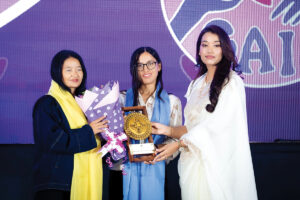
National Blind Women Cricket Team
Award presented by Hon Sabina Kafle
The National Blind Women Cricket Team stands as a powerful example of resilience and inclusion in sport. Recognised as the world’s first organised national team for visually impaired women cricketers, the squad brings together players from across Nepal who are students, teachers, mothers, and professionals united by their shared passion for the game. Their journey began in the early 2000s under the initiative of advocates for disability sports, eventually developing into a national programme supported by the Cricket Association for the Blind in Nepal.
The team includes players: Captain Gita Paudel, Former Captain Bhagwati Bhattarai, Muna Aryal, Vinita Pun, and Bimala Rai, Ashika Dagura, Mankeshi Choudhary, Aayushma Chhetri, Sushma Tamang and Rita Thapa. Many players began playing while studying in schools for the visually impaired, later competing in national tournaments and international series. The team has secured notable international victories, including series wins against teams from the United Kingdom and Pakistan.
Some team members say that initially they were unsure about playing the sport because of their blindness; they soon developed remarkable confidence and skill on the field. Today, the National Blind Women Cricket Team represents more than athletic achievement. By competing nationally and internationally, these players challenge social stigma and expand opportunities for women with disabilities in sport. Their presence on the field continues to inspire a new generation of athletes, proving that determination, teamwork, and passion can transcend even the most formidable barriers.
Lifetime Achievement Award

Indira Yakthumba
Indira Yakthumba is an educationist best known as the founder Principal of Gyanodaya Bal Batika School, one of Kathmandu’s long-standing private educational institutions. Her work in education reflects a broader post-1990s shift in Nepal’s schooling landscape, where private institutions began to play a significant role in shaping urban education, curriculum innovation, and early childhood learning frameworks.
Under her leadership, Gyanodaya Bal Batika School developed a reputation for structured academic programmes combined with co-curricular emphasis, particularly in foundational education for young learners. Her approach reflects an understanding of education also as character formation rather than just academic focus during formative years.
Indira Yakthumba’s legacy is closely tied to institutional continuity, where leadership is measured by innovation, sustainability, and consistency in educational standards over time. “Education is more about helping children grow into confident and responsible human beings than simply teaching them what is in the books,” Indira Yakthumba reflects her philosophy of schooling. She remains recognised for her foundational role in shaping
Gyanodaya Bal Batika School and contributing to the evolution of modern schooling practices in Nepal.
Inspiring Woman of the Year
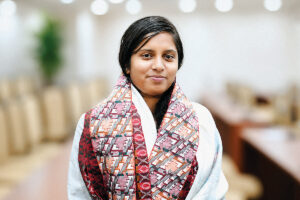
Hon. Rubi Kumari Thakur
Hon. Rubi Kumari Thakur is the Deputy Speaker of the House of Representatives, a grassroots leader known for her engagement in local governance, and social advocacy. Emerging from Nepal’s Terai region, her work reflects the increasing participation of women in civic leadership spaces that have traditionally been male dominated. Through her involvement in public service and community organisation, she has contributed to efforts focused on education access, women’s empowerment, and local development planning.
Her career trajectory is shaped by the everyday realities of community life, where governance is closely tied to lived experience. Working at the intersection of social mobilisation and public service delivery, Hon. Rubi Kumari Thakur has been associated with initiatives that support marginalised groups, particularly women and rural households navigating limited access to resources and institutional support.
In the broader context of Nepal’s evolving democratic landscape, figures like Hon. Rubi Kumari Thakur represent a growing shift toward localised leadership, where women are increasingly visible in decision-making roles, from municipal structures to community-based organisations. Her work reflects a form of leadership rooted not in distance from communities, but in proximity to their needs and challenges.
“Leadership begins with listening to people and understanding their daily struggles,” Hon. Rubi Kumari Thakur reflects on her approach to public service. She continues to be recognised as part of a new generation of women shaping Nepal’s grassroots governance and social development space, contributing to more inclusive and community-driven models of leadership.