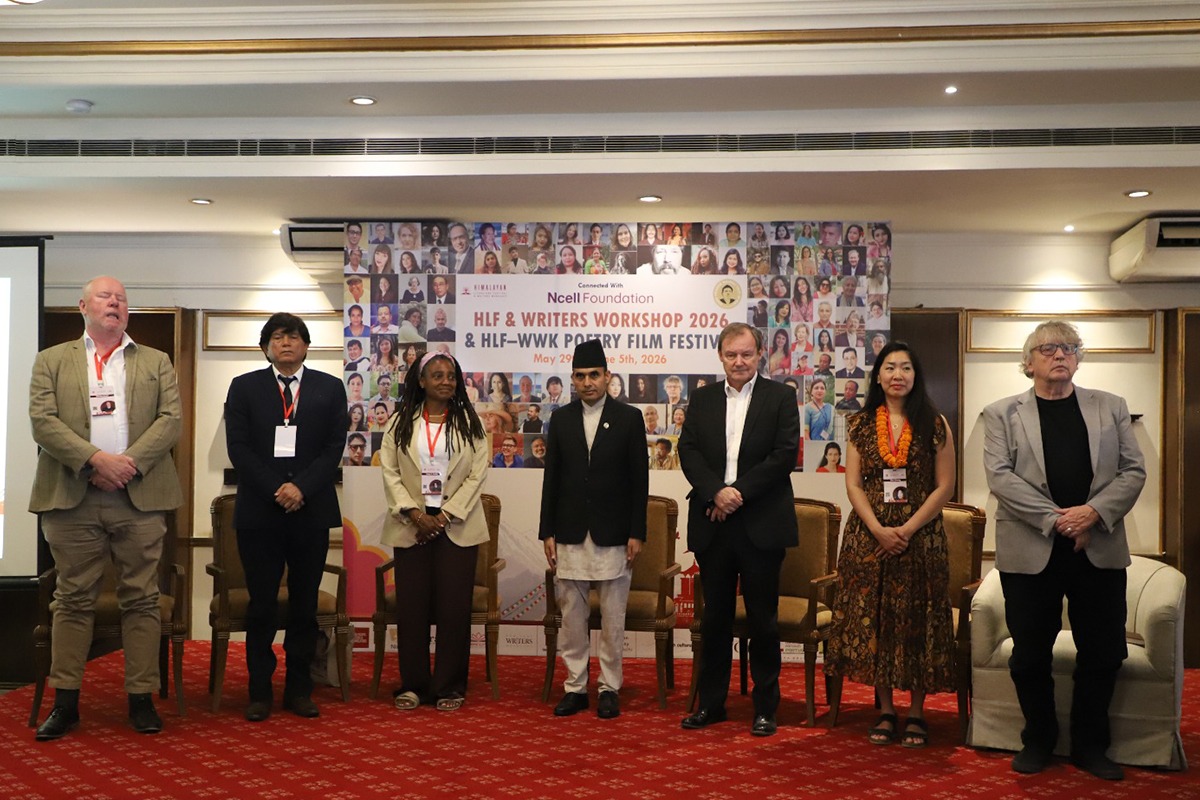
Kathmandu, Nepal — The Himalayan Literature Festival & Writers’ Workshop (HLF-WWK) 2026 concluded with remarkable success after eight days of literary engagement, cultural exchange, workshops, poetry readings, film screenings, and community outreach activities that brought together writers, poets, scholars, translators, filmmakers, educators, and students from Nepal and around the world.
Held from May 29 to June 5, 2026, at Hotel Malla and cultural venues across the Kathmandu Valley, the festival welcomed an extraordinary gathering of international literary voices, including Pulitzer Prize-winning poets Tracy K. Smith and Paul Muldoon, Brooklyn Poet Laureate Tina Chang, The Irish Times Books Editor Martin Doyle, acclaimed poet and translator Tony Barnstone, bestselling novelist Jean Hanff Korelitz, and Himalayan poet Yuyutsu Sharma, alongside more than seventy-five writers, artists, scholars, and cultural practitioners from Asia, Europe, North America, Africa, and Australia.
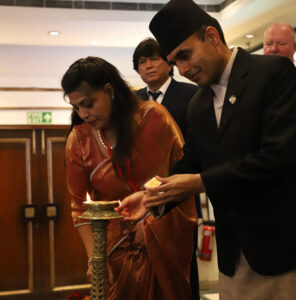
The festival’s inauguration on June 4 was graced by Hon. Bikram Timilsina, Minister for Communication and Information Technology, as Chief Guest, and His Excellency Rob Fenn, British Ambassador to Nepal, as Special Guest. Addressing participants from around the world, both dignitaries emphasized the importance of literature, cultural dialogue, and international cooperation in fostering understanding, creativity, and global citizenship in an increasingly interconnected world.
Organized around the theme “Ecstasy, Healing, and Creative Writing in the New World Order,” the festival explored the transformative power of literature, art, spirituality, and contemplative traditions. Participants engaged in master classes, creative writing workshops, panel discussions, readings, performances, and cultural excursions to Kathmandu Durbar Square, Patan, Boudhanath, Budhanilkantha, and Nagarkot, offering a unique immersion into Nepal’s cultural and spiritual heritage.
A landmark achievement of HLF-WWK 2026 was the successful launch of the HLF Poetry Film Festival, Nepal’s first international festival dedicated to exploring the dynamic relationship between literature, poetry, and cinema. The initiative expanded the festival’s long-standing commitment to interdisciplinary dialogue, creating a vibrant platform where literary imagination found new expression through moving images, conversations, and cross-cultural exchange.
Throughout the festival, screenings and discussions encouraged audiences to think beyond conventional boundaries separating artistic disciplines. Films rooted in literary traditions opened pathways for conversations on adaptation, symbolism, memory, and visual storytelling, while panel discussions examined how cinematic language often intersects with the rhythms, metaphors, and emotional landscapes of poetry.
Festival Director Yuyutsu Sharma, who founded HLF-WWK to foster international literary engagement, noted that the Poetry Film Festival reflects the broader vision of creating spaces where artistic traditions can interact freely.
“Poetry and cinema share a common language of image, rhythm, and imagination. Through the Poetry Film Festival, we hope to create a space where literature transcends the page and finds new life on screen, bringing cultures together through the power of storytelling,” Sharma said.
One of the festival’s highlights was a major panel exploring the relationship between poetry and cinema, featuring filmmakers Peter Salisbury and Carola Mair, alongside María Gil Burman, Director of Instituto Cervantes, who reflected on the ways filmmakers across traditions have transformed literary and poetic sensibilities into cinematic language. Discussions also examined the enduring influence of legendary filmmakers including Akira
Kurosawa, Luis Buñuel, John Boorman, Jean-Luc Godard, François Truffaut, Andrzej Wajda, Wojciech Has, and Krzysztof Kieślowski.
The international film programme featured literary and poetry-inspired films from Spain, Portugal, Austria, Poland, Ireland, and Mexico, introducing Nepali audiences to diverse cinematic traditions deeply rooted in literature.
Among the highlights were screenings of The Doll (Lalka), adapted from the celebrated novel by Polish master Bolesław Prus, In Desert and Wilderness based on the classic novel by Nobel Laureate Henryk Sienkiewicz, the Portuguese film Erros Meus, Má Fortuna, Amor Ardente inspired by the poetry of Luís de Camões, the Austrian feature Wide Awake, the Irish film Clouded Reveries, and the Spanish documentary El Laberinto de Octavio Paz.
The festival’s international film programme was presented in collaboration with distinguished cultural partners, including the Polish Institute New Delhi, Instituto Cervantes, the Embassy of Portugal, the Austrian Cultural Forum, and other international organizations committed to cultural exchange.
In a special recognition ceremony, Lokmanya Golchha, Honorary Consul General of the Republic of Poland for Nepal, was felicitated for his significant contribution to strengthening cultural ties and fostering friendship between Poland and Nepal.
The festival also celebrated the literary legacy of Guru Prasad Mainali, while hosting discussions on artificial intelligence and creative writing, memoir, translation, trauma and healing, indigenous literatures, and contemporary global poetry. Readings in Nepali, Nepal Bhasha, Maithili, Bhojpuri, Tharu, Urdu, Hindi, and English celebrated the remarkable linguistic and cultural diversity of Nepal and the wider Himalayan region.
Speaking at the conclusion of the festival, Festival Director Yuyutsu Sharma expressed gratitude to the participating writers, faculty members, volunteers, sponsors, educational institutions, diplomatic missions, and cultural organizations whose support made the event possible. He noted that HLF-WWK continues to evolve into a major international platform fostering literary dialogue and creative collaboration between Nepal and the world.
Director Shreejana Bhandari thanked participants for their enthusiasm, generosity, and spirit of exchange, emphasizing the festival’s commitment to building enduring friendships and meaningful collaborations across cultures, languages, and artistic traditions.
With record international participation, an expanded workshop programme, and the successful inauguration of the Poetry Film Festival, HLF-WWK 2026 further established Kathmandu as an important destination for international literary and cultural dialogue and reaffirmed its role as one of South Asia’s most dynamic platforms for literary and artistic exchange.
The organizers have announced that preparations for the next edition of the Himalayan Literature Festival & Writers’ Workshop are already underway, with plans to expand its international reach and interdisciplinary programming.