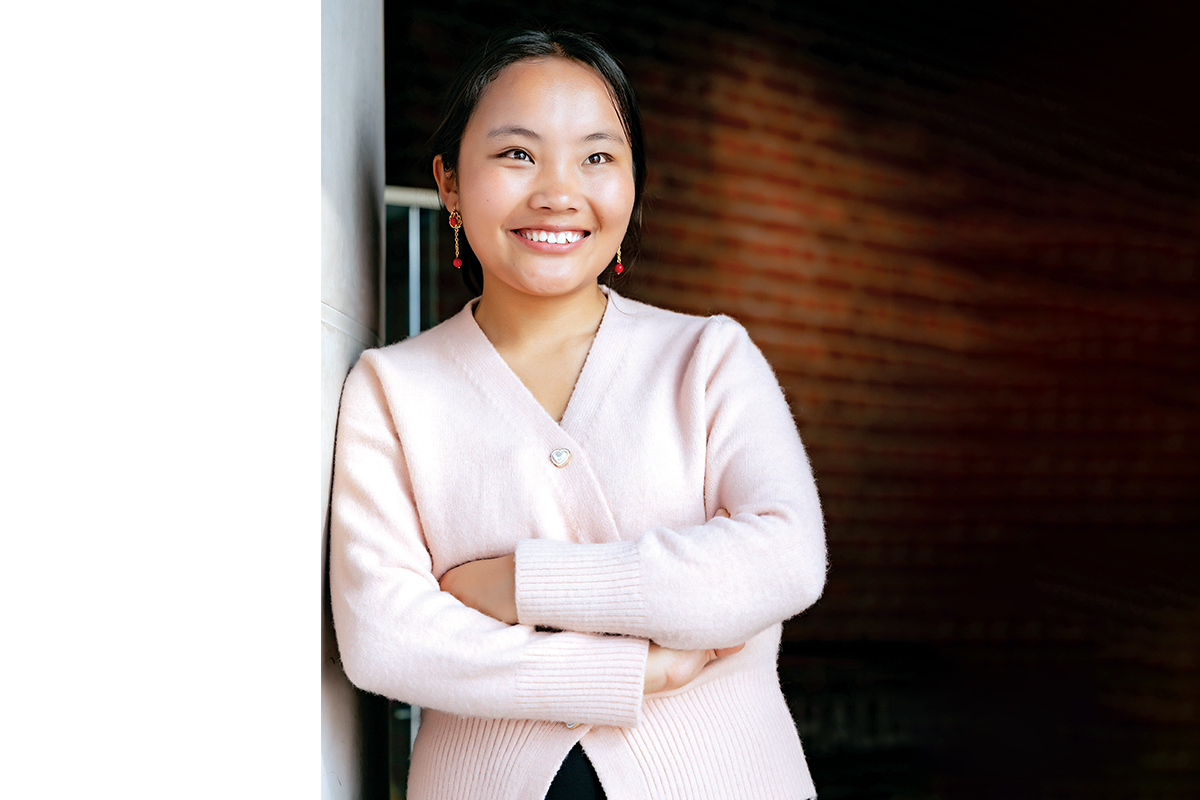
At 21, Sonam Bhuti Gurung is using a second-hand iPhone and an unshakable sense of purpose to tell stories from Upper Dolpa that Nepal has long ignored.
Education does not just mean certificates, you have to understand the real value of education. You need meaningful education that can actually help you in life. You have to be well read.
There is something quietly disarming about Sonam Bhuti Gurung. Perhaps it is the way she speaks about pain without bitterness. Or maybe it is because, at just 21, she already carries the emotional weight of someone who has lived many lives.
When her episode on Herne Katha went viral, people suddenly wanted to know who she was. Thousands discovered the young woman from Upper Dolpa who spoke with startling honesty about rural Nepal, women’s lives and the loneliness of growing up unheard. Overnight, the audience she had spent years trying to build arrived all at once.
“I was always amazed by the reach of social media, especially YouTube,” Sonam says. “People browse YouTube intentionally. There is less noise there. I used to watch a lot of YouTube content and I knew it had power. But I never imagined one episode would help me reach the masses overnight. It might have taken me a decade otherwise.”
Today, she posts almost every day. But behind the growing visibility is a girl who once stood alone in her village filming herself while people whispered that she had gone mad. “People used to see me talking to the camera and say, ‘She talks to herself. She is crazy.’ But I still continued,” she says with a soft laugh. “At that time, nobody understood why I was doing it. Even I did not fully know. I just knew I wanted to document life.”
The irony is almost cinematic. A child fascinated by old photographs eventually becomes someone preserving disappearing stories through videos. “Since childhood, I used to look at pictures of my parents,” she says. “My father loved taking photographs. After he brought my mother home, he took many pictures of her. We later found those photos through old photo rolls. Maybe somewhere from there, I developed this love for documenting moments.”
Sonam has been in Kathmandu since she was four. She studied here and is currently pursuing graduation. But emotionally, she has always remained tied to Upper Dolpa, a region she says most people speak about without truly understanding.

“I am trying to change the perspective people have about Upper Dolpa,” she says. “Many think Nepali people simply do not care about those regions because there is no infrastructure there. But these places matter. The people matter. I want the government to stop ignoring them. If I can become a voice, even a small one, I want to use it.”
Her own journey has been marked by emotional fractures that still linger. “My father was respected outside our home,” she says slowly. “But inside the house, there was not a single day without domestic violence. I was only around four years old but I clearly remember his behaviour. I was terrified of his voice. I could not even make eye contact with him.” Then came the tragedy that still remains unresolved.
“My parents were together for nine years before my father passed away,” she says. “Even today, nobody truly knows what happened. Some people say it was suicide. Others say he was killed and hanged from a tree. There were bruises and scars all over his body. He was involved in politics then.”
For a child, grief arrived tangled with fear, confusion and silence. Yet what stayed with Sonam most deeply was watching her mother endure. “My mother never fought for her dignity,” she says. “She treated my father like God.
Society teaches women to tolerate everything. Women are not even taught the difference between right and wrong when it comes to their own dignity.” Those memories shaped the way she now looks at women in rural Nepal.
“Women there are never introduced to financial independence,” she says. “They believe they simply have to work until they die for their family. Girls my age are already married with children. Some could not even say no to that life. When I see them, I realise at least I can take my own decisions.”
Education, she believes, is where everything changes. “Whenever I visit my village, I can clearly see what education does,” she says. “Educated people think differently. You can notice them from afar. Their choices are different.
The way they speak is different.”
But Sonam is careful not to romanticise degrees. “Education does not just mean certificates,” she says firmly. “You have to understand the real value of education. You need meaningful education that can actually help you in life. You have to be well read.”
Ironically, one of the moments that almost broke her belief in purpose came through education itself. In 2024, Sonam taught in Chharka Bhot School in Upper Dolpa and received her first teaching salary. Instead of celebration, she remembers crying. “The amount was so little it could barely cover my accommodation and food,” she says. “At the same time, I also had responsibility for my younger brother. That day I understood why so many Nepali people leave for abroad. For a few hours, I genuinely thought maybe I should leave everything behind too and go earn money somewhere else.”
But the thought did not stay. “Within hours, I came back to my purpose,” she says. “I realised I still wanted to serve my community.”
Purpose, however, has never come easily. It was built slowly through sacrifice. After Class 11, Sonam wanted to start a YouTube channel but did not own a decent phone. So, she began teaching at a monastery, earning Rs 12,000 a month.

“My goal was to save at least 50% of my salary no matter what,” she says. “I did that for one year and finally saved Rs 55,000. Then I bought a second-hand iPhone. Even today, I shoot everything from my phone.”
There was no fancy equipment. No studio. Not even proper internet. “In my village, there is no internet,” she says. “Only 2G works in the school.” Still, she kept filming, editing and teaching herself through free apps.
“I became interested in editing when I was in Class 10,” she says. “I learnt techniques from free apps. I watched creators like Dhruv Rathee from Grade 7 onwards and thought maybe I was not educated enough to make informative videos like him. So, I thought, okay, maybe I can make vlogs instead.”
Today, that honesty is exactly what draws people to her. But visibility, she admits, is complicated. “Some people meet me only to take pictures,” she says. “But many people are genuinely concerned about me too.”
For Sonam, the real success is not fame. It is self-discovery. “When I was alone, I discovered myself,” she says quietly. “That feeling is higher than success.” Then she pauses before adding the sentence that perhaps defines her entire journey. “I always say everyone has a passion. They just have not discovered it yet.”
Her dreams now stretch beyond content creation. She wants to work with UNICEF someday. She wants to become an entrepreneur promoting local products from her village. She wants to travel the world. But most importantly, she wants girls from places like Upper Dolpa to imagine larger futures for themselves.
Her message to them is simple, but urgent. “Educate yourself. Become financially literate. Discover your passion. Learn how to monetise your skills. Become capable of the life you dream about.”
Text: Ankita Jain
Photos: Sanjay Maharjan