
In Bhaktapur, where centuries-old temples stand watching over the bustling courtyards and artisans continue traditions passed down through generations, TUSA is quietly rewriting the story of Nepali cuisine. There is no menu to browse, no familiar list of dishes to order. Instead, diners place their trust entirely in the chefs, embarking on a seasonal five to seven-course tasting experience that celebrates one simple idea. Everything on the plate comes from Nepal.
For co-founders Parashuram Pathak, Sagar Shrestha and Rupesh Bohora, TUSA is not simply a fine dining restaurant. It is a tribute to a country whose culinary wealth has long been overlooked, even by its own people.
For Rupesh, that realisation came thousands of miles from home. After graduating from the Academy of Culinary Arts in Nepal, he spent years refining his craft in acclaimed kitchens across Dubai before moving to Australia where he worked with Merivale in Sydney. The experience exposed him to world-class techniques and ingredients, but it also left him with an unsettling thought. As Nepali chefs working abroad, they had become experts at preparing other cultures’ cuisines while rarely having the opportunity to represent the food that had shaped their own lives. “We were putting everyone else’s food on the table but we couldn’t tell the story of our own,” Rupesh recalls.
That shared longing eventually brought the three chefs together. United by the belief that Nepal possessed extraordinary ingredients worthy of international recognition, they returned home with a vision unlike anything the country had seen before. TUSA would become Nepal’s first chef-led tasting restaurant devoted entirely to reimagining local ingredients through contemporary culinary techniques while remaining deeply rooted in Nepali identity.
Before opening their doors, however, they first set out to rediscover Nepal itself. Beginning in 2018, holidays became research expeditions. Instead of travelling abroad, the chefs trekked through mountains, visited remote villages, and spent time with farmers, foragers, and local communities.

“Every journey revealed ingredients that international chefs prized but Nepalis often regarded as ordinary. One such discovery was the humble marigold. In Nepal, the flower is woven into garlands for festivals and religious ceremonies before often being discarded. Yet in the kitchens where we were trained overseas, edible marigolds were treated as precious ingredients used sparingly because of their rarity and cost. I remember looking at it and thinking, this grows outside our homes,” he says.
The same story unfolded again and again. Sea buckthorn flourishes in Mustang with its bright, citrus-like sharpness. Wild Guchhi mushrooms, among the world’s most sought-after fungi, grow naturally in Nepal. Yarsagumba is celebrated internationally for its medicinal value, while saffron cultivated in remote villages remains largely unknown beyond local communities. “These were not merely ingredients but symbols of a country that had yet to recognise the richness growing within its own borders,” they say. Their travels also challenged the narrow definition of Nepali cuisine.
Too often, they believe the country’s food is reduced to daal bhaat (lentils and rice) or momo. While those dishes remain integral to Nepal’s culinary heritage, they are only a small chapter in a much larger story. “By combining indigenous ingredients with the precision and creativity we developed abroad, we hope to reveal the remarkable diversity that stretches from the Himalayas to the hills and the Terai,” Rupesh adds.
Bhaktapur proved the perfect setting for that story to unfold. Housed within Basuki Ghar, a beautifully restored heritage building owned by UNESCO award-winning conservationist Rabindra Puri, TUSA sits naturally among the city’s living history. Every detail, from the Nepali textiles adorning the interiors to the locally crafted furnishings, reflects the restaurant’s commitment to celebrating homegrown artistry. That philosophy extends to every meal.
The menu changes with the seasons, shaped entirely by what the land offers at any given time. There are no compromises and no imported luxuries competing for attention. Instead, each course introduces diners to ingredients they may have encountered all their lives but never experienced in quite this way.
The meal begins with fish kachila (spiced raw fish) accompanied by crisp soyabean crackers. The fish is delicately seasoned, its bright acidity awakening the palate with remarkable restraint, while the crackers lend a gentle nuttiness and satisfying crunch. It is a dish that whispers rather than shouts, allowing the freshness of its ingredients to take centre stage.
A beautifully presented serving of niuro (fiddlehead fern), capturing the earthy, unmistakable flavour that generations of Nepalis have grown up with. Familiar yet refined, it demonstrates that sophistication need not come from imported ingredients but from understanding local ones more deeply. Additionally, even the tomatoes from the salad course are cooked with extraordinary care, timed so precisely that their skins slip away while their freshness remains intact.
Everything possible is crafted in-house. From roasted sattu (gram flour) to traditional gutpak, every component reflects painstaking research and experimentation. Between courses, a refreshing kafal shaved ice cleanser clears the palate, its vibrant sweetness echoing the wild berries found in Nepal’s forests.
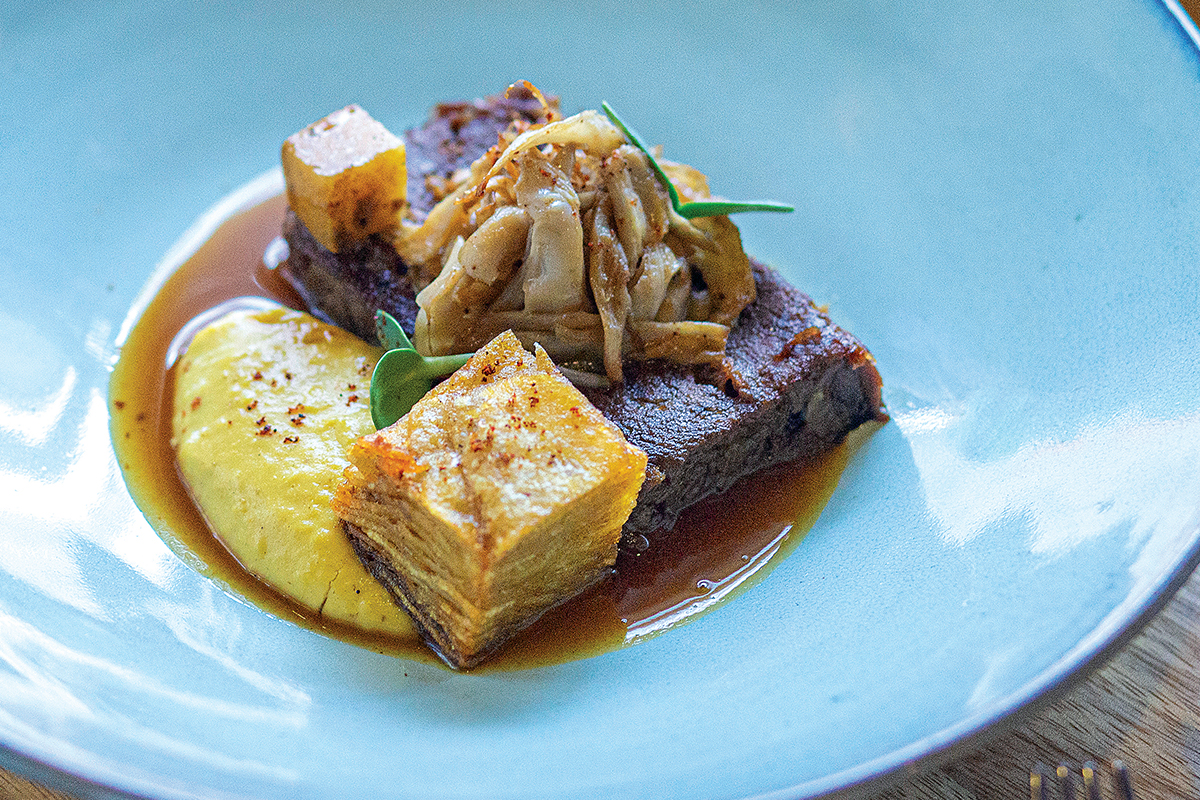
The highlight is undoubtedly the main course. Slow-cooked shredded mutton, gently bound together and served in an elegant rectangle, carries the deep comforting richness of traditional Nepali cooking while embracing the precision of fine dining. Creamed corn lends natural sweetness without overpowering the meat, while a vibrant mula ko achar cuts through the richness with welcome brightness.
Dessert is equally thoughtful. The restaurant’s now-signature sisnu (stinging nettle) cake transforms one of Nepal’s most humble ingredients into something unexpectedly indulgent. Earthy nettle powder is balanced with delicate cream and sweetened with jaggery instead of refined sugar, producing a dessert that feels at once nostalgic and entirely new.
For the chefs, however, the true achievement lies beyond the plate. During one of their journeys, they were offered saffron tea by a farmer who possessed only a modest harvest. A year later, remembering their shared conversation, he contacted them and generously sent a supply of saffron. Rupesh says, stories like these remind them that along with its remarkable biodiversity, the generosity of the people who nurture it is Nepal’s greatest resource.
“Today, TUSA has expanded to Canberra in Australia, marking an important milestone for a restaurant born from the desire to bring Nepali cuisine into the global conversation,” they smile. Yet the chefs remain firmly grounded in their original purpose. They speak less about awards than about learning, convinced that every journey across Nepal reveals another forgotten ingredient, another farmer, another story waiting to be shared.
In many ways, TUSA serves more than food. While diners have suggested that it deserves a Michelin star, Rupesh remains grounded. For him, international recognition can wait. He says, “The priority is to continue exploring Nepal’s culinary heritage and giving its ingredients the identity they have long deserved.” It serves memory, landscape and identity, reminding diners that the future of Nepali cuisine may not lie in looking elsewhere, but in finally recognising the extraordinary abundance that has always existed at home.
Text: Kreenjala Pyakurel
Photos: Ripesh Maharjan