
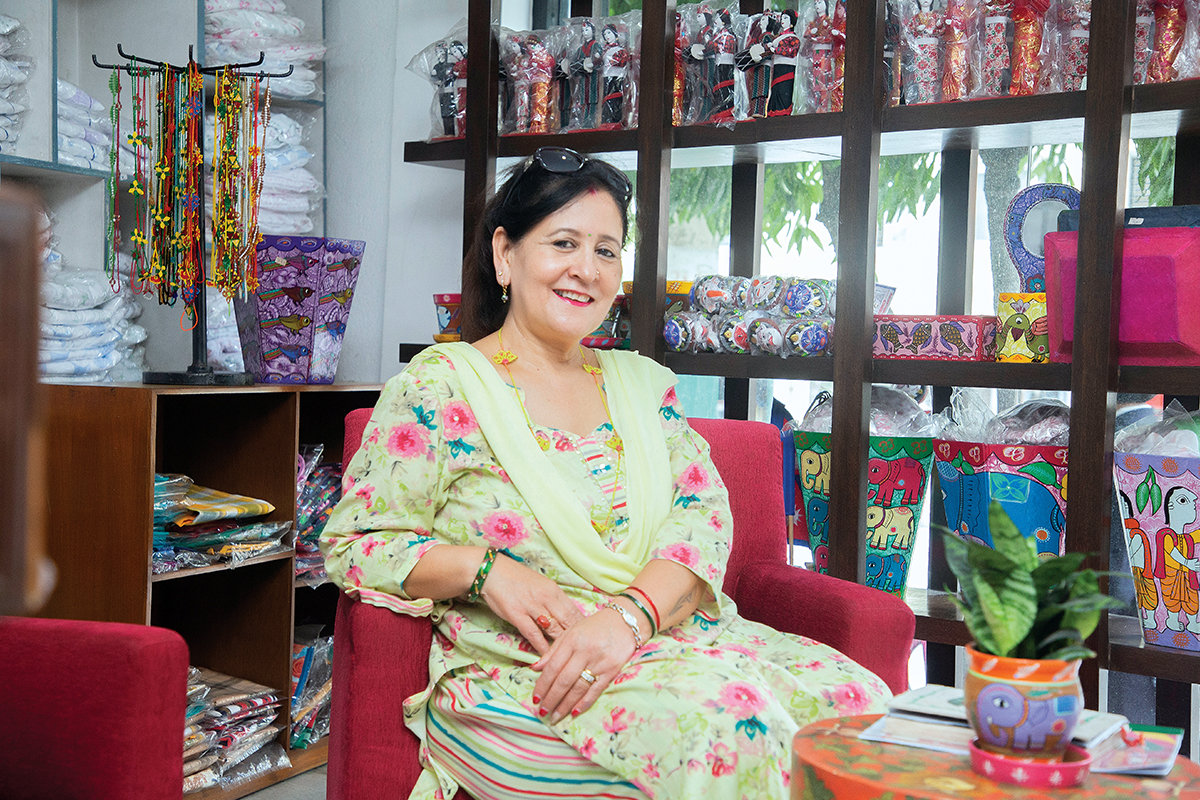
Milu Thapa has spent three decades turning women’s skills into livelihoods, and livelihoods into independence.
For Milu Thapa, empowerment has never been an abstract idea. It is a woman who learns to sew and begins earning from home. It is a mother who turns her craft into a small business. It is a woman who once doubted her abilities and eventually stands behind a stall, selling something she made with her own hands.
For nearly three decades, Milu has built her work around that transformation. As President of the Creative Entrepreneurs Women’s Centre, she has championed skill development, entrepreneurship and market access for women, particularly those from marginalised communities. What began more than 25 years ago as an initiative rooted in sewing and handicraft training has evolved into a platform connecting women not only with skills, but with customers and opportunities. The Centre has supported more than 500 women through training and market linkages, with more than a quarter of those trained going on to become entrepreneurs.
The idea sounds simple. Its consequences are not. “When we started, even finding the resources to begin was a struggle. We went everywhere, to the government, to families, to friends, asking for support. But we believed that if women were given a skill, they could create something with it, and if they could create something, they could earn. Over the years, I have seen that a skill is much more than a skill. It gives a woman confidence, identity and the courage to make decisions for herself and her family. That is why I have always believed that economic empowerment must begin with giving women the tools to stand on their own feet,” Milu says.
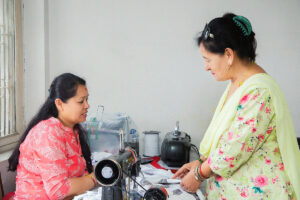
The Centre initially focused on sewing and handicrafts before recognising a crucial gap: making a product was only half the journey. Women also needed somewhere to sell it.
That realisation led to exhibitions and fairs that became an important part of the Centre’s work. The first exhibition had around 50 participants. In the years that followed, it expanded dramatically, reaching more than 200 stalls before the pandemic.
For Milu, the marketplace is as important as the classroom. “A woman can be extremely talented, but if nobody knows about her product, if she has no access to customers, if she does not understand how to present or price what she makes, her skill may never become an income. That is why our responsibility does not end when the training ends. We have to help create the bridge between skill and market. The moment a woman sells something she has made herself and earns from it, something changes inside her. She begins to see herself differently. She starts believing that she can do more.”
That philosophy also shaped the Centre’s now-recognisable Shrawan and Teej fairs, which created a commercial space around celebrations traditionally associated with women.
Rather than treating Teej only as a cultural festival, Milu and her organisation turned it into an economic opportunity. Women could showcase and sell clothing, jewellery, handicrafts and other products, bringing their creativity directly to consumers. Earlier editions featured everything from saris and kurta sets to bangles, jewellery and handmade products, while a portion of festival proceeds was directed towards women’s capacity building and skill development.
The concept was ahead of its time. The fair gave women something many small entrepreneurs rarely receive: visibility. “The idea was always to make Teej more than a celebration where women simply dress up, fast or gather together. We wanted it to become a celebration of women’s creativity and enterprise. When a woman makes a garment, creates jewellery or produces a handicraft, that work has value. We wanted to give her a place where people could see it, appreciate it and buy it. A festival can be joyful, but it can also create an economy around women’s work. That was the thinking behind the fair.”
Today, the Creative Entrepreneurs Women’s Centre continues to promote locally made products and women-led businesses.
Its recent Creative Entrepreneurs Fair brought together more than 80 stalls and attracted over 10,000 visitors, reinforcing the importance of physical marketplaces for small women-led enterprises.
Yet Milu believes the hardest barrier is not always financial. It is psychological. Across communities, she has repeatedly encountered women who have ability but lack confidence, information or family support. Education and awareness remain recurring challenges, particularly for women whose economic choices are still shaped by social expectations.
“Even after all these years, one challenge keeps coming back: women need awareness and education about their own potential. Many women have the ability to earn, but they have been taught to think that their role is only within the family. Sometimes the biggest obstacle is not a lack of talent or opportunity, but the belief that they are not capable. We have to change that thinking. We have to tell women that earning is not something to be ashamed of. Having your own income gives you a voice, and that voice can change the way a family makes decisions.”
Her work has taken the Centre beyond Kathmandu, reaching women in communities across Nepal. The emphasis remains practical: teach a skill, build confidence, connect it to a market and encourage the woman to take ownership of her economic future.
Milu is also clear-eyed about what Nepal still needs to do. Women entrepreneurs need more than motivational speeches. They need affordable finance, better market access, digital literacy, business training and an ecosystem willing to take their enterprises seriously.
“Training alone is not enough. We need a system that supports women after training. Women need access to finance, technology, markets and information. They need customers who are willing to choose locally made products. They need families who understand that a woman’s business is real work. And they need institutions that see women not as beneficiaries, but as entrepreneurs who can contribute to the economy. If we invest in women properly, the return does not stop with one woman. It reaches her family, her community and ultimately the country.”
After three decades, Milu’s definition of success remains refreshingly uncomplicated. “When we invest in women and empower them economically, they can sustain the livelihoods of their homes, their communities and their country. It is not optional. It is a must. Because when a woman becomes financially independent, we are not simply helping her earn. We are helping her build a future where she has choices.”
Text: Ankita Jain
Photos: Ripesh Maharjan