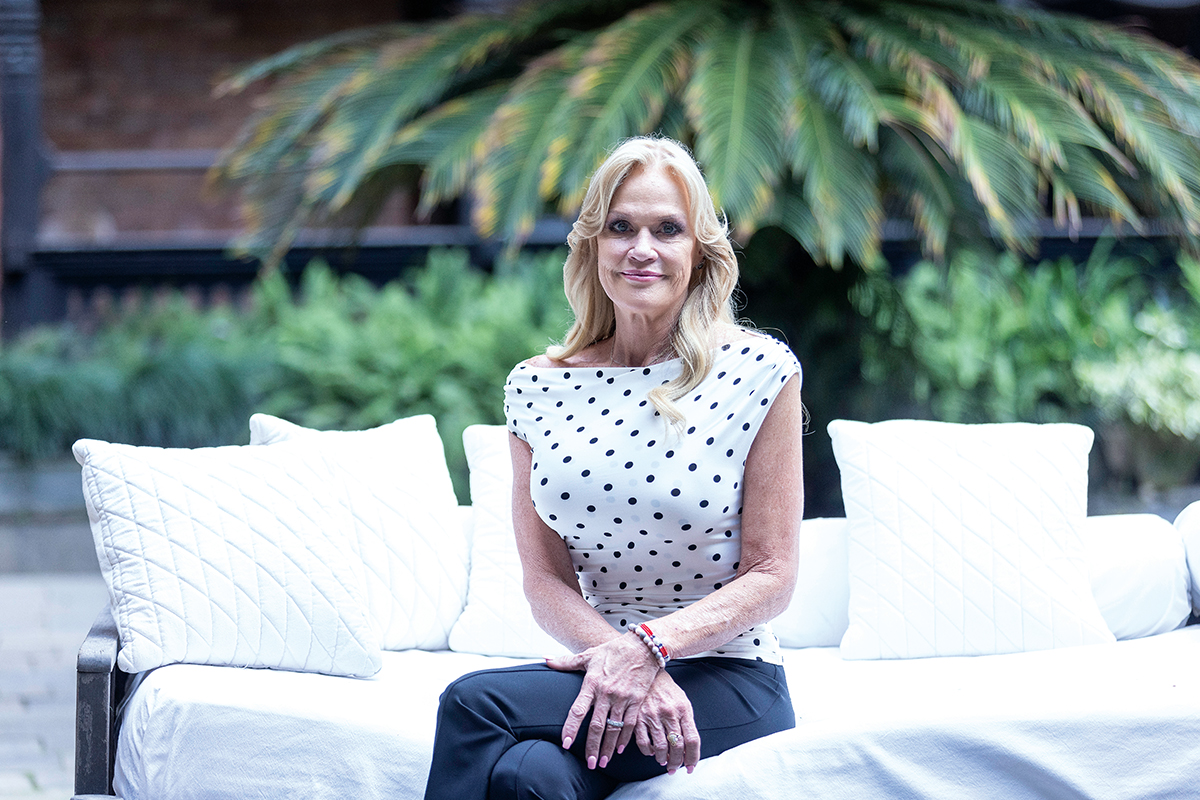
On her first visit to Nepal, philanthropist Kym Rapier is looking beyond a single project. An enduring connection with a school in Helambu brought her here, but the journey has quickly widened in scope, from scholarships and disaster relief to women’s economic independence and support for children who have lost their parents. At the heart of it all is a question that has increasingly shaped her philanthropy: what does meaningful support actually look like on the ground?
For Kym, the story of Nepal began some 15 years before she ever set foot in the country. A school in Helambu, established by her associate Peter, had long been trying to bring Kym and her team here. When the visit was finally planned, a disaster shifted its purpose. Alongside supporting children at the school through scholarships, her team began exploring opportunities in disaster relief, particularly for vulnerable children.
It is an introduction that reflects how Kym’s approach to philanthropy has evolved. After years of working across education, healthcare, women’s empowerment and support for children and seniors, she says travel has taught her one of the most important lessons of giving: never arrive with assumptions.
“I think it’s the travelling – actually going and visiting these countries and different cultures, talking to people and seeing what they need and what changes we can help make,” she says. “Every culture is different, and every place is different. It’s about listening and understanding what people need, and then giving them the appropriate help.”
That instinct – to listen before acting – has become central to the Kym Rapier Foundation which works with grassroots organisations and community leaders across countries, with a particular focus on women, children and environmental protection.
“The most sustainable projects are often those led by people who already understand the community they are working in,” Kym says. “We first listen and understand what actually works, because what works in one country might not work in another. What works in Africa doesn’t necessarily work here. The needs are different.”
Beyond the Scholarship
That philosophy has also reshaped the foundation’s approach to education. A scholarship may open a classroom door, but Kym has come to recognise that it means little if everything surrounding a child’s education makes it difficult for them to stay there.
“In Nepal, we will take the kids from a young age and sponsor them, scholarship-wise, all the way through college,” she says. “We won’t leave them halfway. We won’t just go for one year. We’ll take them from the beginning to the end – with food, financial needs, uniforms, everything.”
During the Nepal visit, her team has been examining the less visible barriers to education: food, accommodation and transportation among them. The idea is to look beyond tuition and understand the ecosystem that allows a child to learn.
“You would think you could just throw money at it and say, ‘Here’s a scholarship,’” Kym says. “But then you understand that if children don’t have meals provided or transportation, there are still barriers. Some kids walk miles, for hours, to get to school every day. We are looking at ways for that not to be the case.”
For her, it is about creating the conditions in which opportunity can become something more lasting. “You are helping fuel the ecosystem so that students can reach where they want to in life.”
Women, Work and Independence
Women’s economic independence is another area Kym and her team are exploring in Nepal. During the trip, she is due to meet an organisation that trains women in climbing and tourism-related services, creating pathways into an industry deeply connected to the country’s identity and economy.
Her interest in women’s empowerment has also been shaped by years of travelling and witnessing the often-unseen weight women carry within families and communities.
“Mostly, the women have empowered me more than anybody,” she says. “Seeing their resilience and the struggles they go through. Every country is different, but women often end up doing so much of the work. A lot falls on their shoulders – the children, the basic work, everything.”
Sometimes, the issues reveal themselves in seemingly ordinary details. At the school in Nepal, Kym’s team saw women cooking over firewood, exposing themselves daily to smoke that can affect their eyes and lungs over time. It is the kind of observation that might sit outside the parameters of a conventional aid programme, but for Kym, it is precisely why being physically present matters.
Giving Stories a Wider Life
Her work also brings together philanthropy and storytelling. Kym sees filmmaking and documentation not simply as a record of the foundation’s work but as a resource for grassroots organisations that may have powerful stories and ideas, yet little infrastructure to communicate them to a wider audience.
“When we go to a country – say, we come to Nepal – we hear directly from the people who have been trying to change things but haven’t had the resources to do so,” she says. “When we tell their stories, they are able to use that for their own social media, to reach other donors, and to let people hear it in their own words.”
Yet the mechanics of giving are often far more complicated than the impulse behind it. One recurring challenge, Kym says, is simply getting resources to the people and organisations that need them. International funding can become entangled in banking requirements, administrative processes and layers of red tape.
“It’s mostly about resources and the ability to be heard,” she says. “There can be so much red tape around getting funding from outside partners.”
In some countries, the foundation has responded by creating local structures to make the process more efficient. In South Africa, for instance, Kym says a local branch was established partly to facilitate scholarships and other payments without prolonged banking and administrative delays.
The Measure of Impact
After years of philanthropy, Kym has also reconsidered what “impact” really means. Beneficiary numbers, funding totals and outcomes may be useful measures, but they cannot always capture what happens to a community after an intervention ends.
“Actually, it’s not just a number,” she says. “It’s hard to look at something and simply tell the impact. That’s why we travel back to these places – to see how people are doing and see the progress.
It’s about being hands-on and involved with each of the communities. That’s what we do.”
It is perhaps why her first trip to Nepal feels less like the culmination of a 15-year connection and more like the beginning of something new. Helambu may have provided the starting point, but conversations around disaster relief, education and women’s empowerment are already opening other possibilities. Her team is identifying organisations and communities they can return to, building relationships intended to continue beyond a single visit.
There are more journeys ahead, including plans to travel to Sri Lanka and elsewhere in Asia. But for Kym, scale does not appear to be the ultimate measure of what she has built. The entrepreneur and philanthropist speaks instead about success as something valuable largely for what it allows her to do for others.
Her definition is strikingly simple. “Success for me is a tool to help other people.”
Text: Ankita Jain
Photo: Ripesh Maharjan