
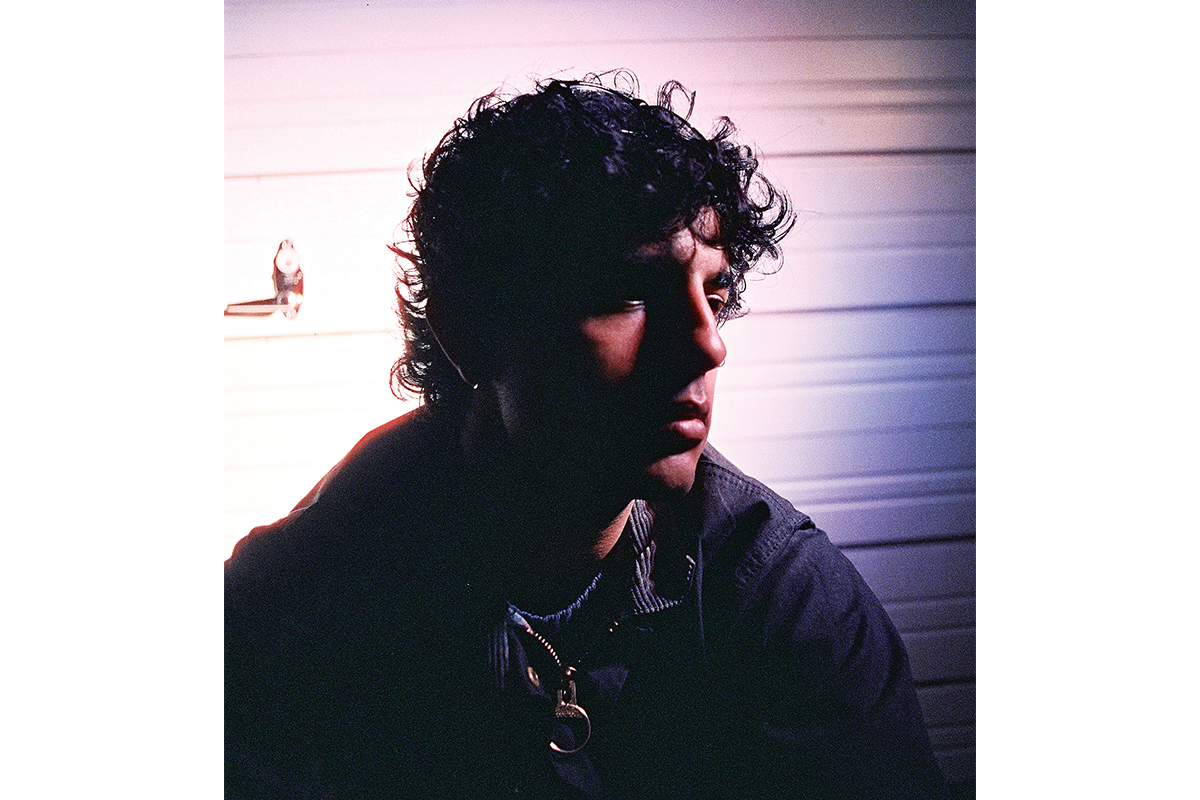
For Curtis Waters, music began long before there was an audience listening.
At 14, Abhinav Bastakoti was experimenting with FL Studio on the family computer, fascinated by the possibilities of making beats. This was years before he would become known as Curtis Waters. Creativity, even then, was never confined to music. He played around with Photoshop, drew comic-book characters inspired by Scott Pilgrim, and slowly began constructing a world of his own.
A few years later, after producing for other rappers, he found the courage to put his own voice over the beats he had been making. Today, that early curiosity has become an international music career, from the breakout success of “Stunnin’” in 2020 to his recent EP, Last Days of Disco.
The name Curtis Waters arrived when he was 16 and looking to create an identity separate from his own. He combined references to two artists he admired at the time: Ian Curtis of Joy Division and Frank Ocean. What began as an invented persona eventually became the name attached to his music, while the many places he grew up in continued to shape the person behind it.
Moving from Nepal to Canada and later to the United States meant becoming accustomed to constant change. There was never really another version of life against which to measure it. “I am not sure because it’s the only life I have known,” he says.
With every move came the ritual of settling into somewhere new, becoming comfortable and, eventually, leaving again. Through it all, the internet remained a constant: a portal into music, ideas and identities from across the world.
The different versions of himself formed along the way have never entirely disappeared. “I always miss the life I could have had in Nepal or Germany or Canada or any other place,” he says. “I think a lot of my identities in those countries are stuck at a certain age, so when I make music, sometimes I think those characters come out subconsciously.”
That sense of gathering fragments of himself mirrors the way Waters creates. His process is less a prescribed method than a constant act of collecting.
He makes beats, scribbles stray thoughts into notebooks, learns instruments, shoots videos and draws characters. Most of these fragments never become finished pieces. Occasionally, though, one begins to reveal something bigger.
“I think of it like collecting puzzle pieces and as you keep working, eventually the pieces start to form an image, then you can finally start guiding it towards a goal.”
Some puzzles take years to resolve; others fall into place within days. And sometimes, he simply has to put one aside and play with another until he understands where it wants to go.
That instinct, to create without necessarily knowing the destination, was already there when “Stunnin’” became his unexpected breakthrough in 2020. The track travelled far beyond anything
Waters had imagined, arriving at a moment when he was still learning what it meant to make music professionally. “I still haven’t fully been able to process what happened to my life because I was still just learning how to make music,” he says. “It sort of just happened out of nowhere, way bigger than I ever imagined, and because of Covid I was just stuck at my mom’s house for most of it.”
Since then, Waters has grown both as a musician and visual director, although he resists framing that growth as a neat, linear evolution. Technical proficiency, he has discovered, comes with its own contradictions: knowing more can sometimes mean losing the instinctive freedom that comes with not knowing the rules at all.
It is a tension that runs through his recent EP, Last Days of Disco – between refinement and instinct, ambition and uncertainty, the dreams of childhood and the person who has grown up alongside them.
The project emerged during a period when Waters began questioning whether the dreams he had spent much of his life pursuing still felt the same.
“This EP is inspired by the feeling that I had given up on my dreams,” he says. “I am not sure if I have given up out of fear or if I have outgrown a lot of my desires naturally. I have been pursuing this vision since I was a kid but there’s been this really uncomfortable and mundane existential angst that doesn’t really leave me.”
Last Days of Disco became, in part, a way of inhabiting that uncertainty rather than trying to resolve it, and continuing to create regardless.
The project has also opened unexpected doors. “Sleep Talking”, from Last Days of Disco, was featured in the Netflix film Best of the Best after his manager submitted an early demo. Waters also produced Rehma’s “Zero”, with his synths and drums appearing in a major dance scene. He admits that his instinct can be to scrutinise himself even during moments of success, but seeing how proud his parents were allowed the significance of the opportunity to land differently.
Collaboration, meanwhile, offers another way out of his own head. His work with ElyOtto on “SugarCrash!” came through their respective teams, with the connection made more personal by the fact that both artists grew up in Alberta. Waters produced his own beat for his section of the remix and relished seeing his ideas absorbed into the finished track.
Working with other artists, he says, forces him to create in service of something beyond himself. Inspiration can come from the smallest detail. “Even something simple like the way someone pronounces a certain letter can inspire a whole new song for me.”
For all the international dimensions of his career, Nepal remains woven closely into Waters’ creative identity. He does not feel compelled to consciously “represent” the country with every release.
Instead, his thoughts return to the younger version of himself who grew up there: a child who wanted to become an artist, but was afraid to pursue a life that seemed impossibly distant.
Nepal surfaces in his work almost instinctively. His album BAD SON includes recordings of his parents speaking Nepali, while “SELF DESTRUCTION”, from Last Days of Disco, was written during a visit to his mother’s village in Lamjung.
But the connection extends beyond what can be heard in the music. Staying in touch with listeners in Nepal and across the Nepali diaspora has become another way of maintaining that relationship. “I do have a decent amount of people from the Nepali diaspora who engage with me and my art, which is very nice and fulfilling,” he says. “It’s cool to be heard and understood in that way.”
Being heard by listeners back home has also given his platform a purpose beyond music. Recently, Waters donated all proceeds from his Bandcamp music sales towards flood relief in Nepal, translating that sense of connection into something tangible. “It’s a blessing to be able to share information or raise money for the community in that way.”
For Waters, music has never been entirely about finding his place within an industry. At heart, he still sees himself simply as someone making songs and videos,alone or with friends,and sharing them with whoever wants to listen.
Along the way, he has also found a close creative community among South Asian artists, including Indian, Bangladeshi and Pakistani creatives. Their shared experiences have fostered both camaraderie and a genuine desire to see one another succeed.
Perhaps that is why Waters is reluctant to prescribe what anyone should feel when listening to his work. He would rather the music become whatever the listener needs it to be. If his own journey offers anything, he hopes it is permission,particularly for young Nepali artists, to begin creating before they have the resources, answers or certainty they think they need.
Text: Sujana Dongol