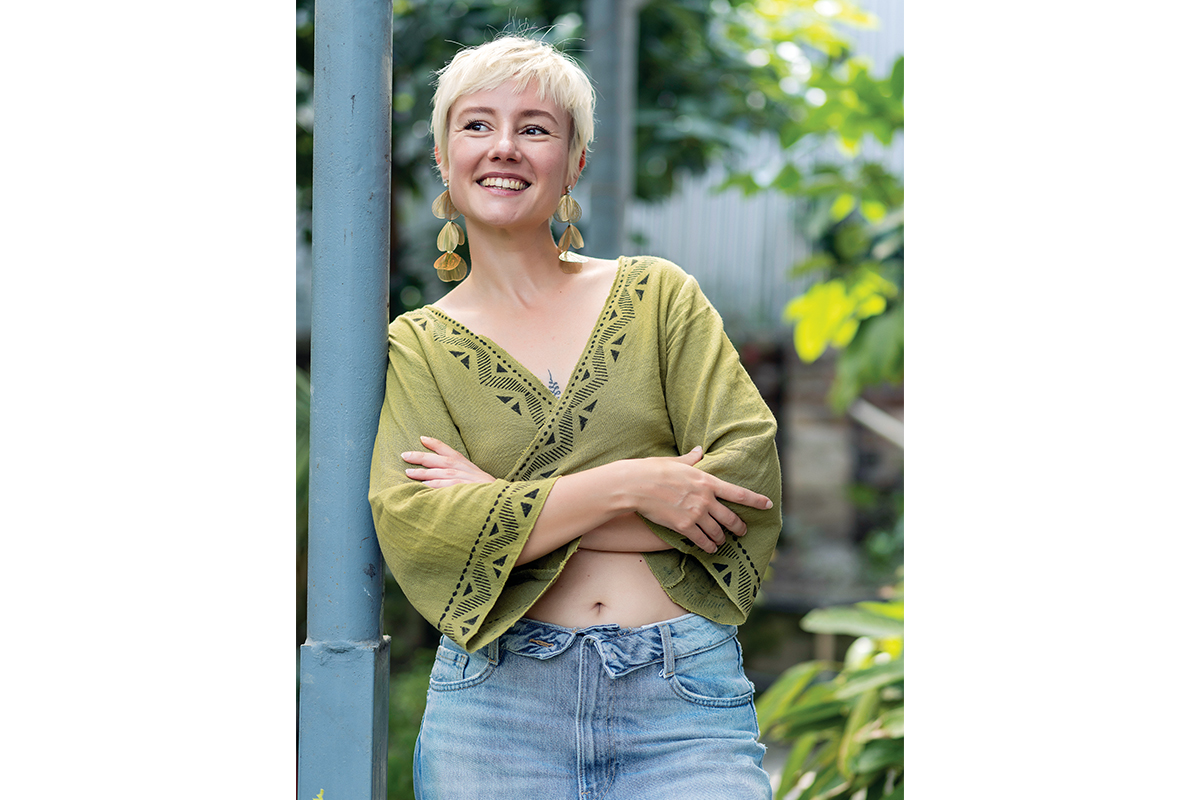
Ukrainian creative Yulia came to Nepal looking for answers. Instead, she found a community dancing barefoot at 8 am.
At 8 o’clock on a Saturday morning, while most of Kathmandu is still easing into the day, more than a hundred people are dancing barefoot. There are no phones in sight. No cocktails. No small talk. Just music, movement and the quiet permission to be fully present.
At the centre of it all is Yulia, a Ukrainian creative whose journey to Nepal began not with a business plan, but with a question about how to live. “It was a very random decision, if you look at it from the outside,” she says, laughing. “The universe had some plans for me that I was not aware of.”
Before Nepal, Yulia was living in New York, having relocated there after the war in Ukraine. When her visa situation became uncertain, she found herself at a crossroads. “I had two options,” she says. “I could either go to Peru and learn more about psychedelic therapy, or I could come to Nepal and learn more about Buddhism.” Nepal won. At the time, she was fascinated by Vajrayana Buddhism and had even entertained the idea of becoming a Buddhist nun.
“I was so tired of my life,” she admits. “I thought maybe I would just renounce everything.” She arrived in Nepal knowing almost no one and with no clear plan. “It was calling me,” she says. “And I guess I just answered the call.”
What happened next was unexpected. After spending time between Pokhara, Kathmandu and Bali, an idea arrived almost fully formed. “I was half asleep when it came to me,” she recalls. “The thought was just, ‘You have to organise this in Nepal’.”
That idea became Joy Riot, a series of alcohol-free morning gatherings that blend breathwork, movement, music, meditation and community. For Yulia, the concept emerged from personal experience. Three years ago, after attending a yoga retreat, she began questioning her relationship with alcohol. “I realised I never really liked the taste of it,” she says. “I didn’t like how it felt in my body. The only reason I was drinking was because everyone else was.”
After completing a sober year and occasionally revisiting alcohol while travelling, her conclusion remained unchanged. “I don’t like losing the next day. I don’t like hangovers. I realised I don’t actually need it.” Yet Joy Riot is not an anti-alcohol movement. Instead, it asks a different question: What happens when people gather without it? The answer surprised even her.
Before launching the first event, Yulia posted a video explaining the concept online. Her goal was modest. “I told myself if 50 people came, I would be happy.” Instead, 150 people showed up. For many, the appeal lies in the unusual structure. The three-hour experience begins with guided breathwork, followed by exercises designed to help strangers connect beyond surface-level conversation. Then comes 90 minutes of barefoot dancing. No phones. No talking. No performance.
“I looked at everyone dancing from the balcony,” Yulia recalls. “A lot of people had their eyes closed. They were allowing the movement to happen instead of performing the movement.” In a culture increasingly dominated by screens and distractions, she believes those moments matter.
“Everything is trying to pull our attention outward,” she says. “Our phones, social media, advertising. Creating moments where we can go inward feels very important.”
The event closes with a guided sound meditation, followed by breakfast and conversation. For Yulia, the experience is less about entertainment and more about emotional processing. “When you are left without your phone, without conversation, without a way to escape, you become present with whatever is happening inside you,” she explains. “Sometimes I arrive feeling sad, lonely or angry. Movement helps me process those emotions.”
She is quick to challenge one of the biggest misconceptions around sober living. “People think sobriety is boring,” she says. “But I think it’s the opposite.” Then she laughs before adding her favourite line. “Sobriety is the hardest drug you can ever take.”
Behind the joyful atmosphere, however, lies a deeper personal philosophy shaped by her experience as a Ukrainian living through a time of global uncertainty. The name Joy Riot itself emerged alongside the concept. For her, joy is not simply happiness. It is something more radical. “Because of the war in Ukraine, I often felt guilty for enjoying my life while other people were suffering,” she says. But over time, she began to see joy differently. “We are constantly bombarded with bad news. Marketing tells us what’s wrong with us. Social media tells us who we should be.
Radical joy is an act of resistance.” It is a phrase that has become the movement’s unofficial manifesto.
Joy is an act of resistance. The sentiment feels particularly poignant coming from someone whose homeland continues to endure unimaginable hardship. When asked what she thinks about Ukraine today, Yulia pauses. “I feel a lot of anger and grief,” she says quietly. Then she shares stories of cafés reopening after bombings and neighbours gathering around fires during power outages in freezing winter temperatures. “That’s the essence of Ukraine,” she says. “There’s so much suffering, but there’s also so much beauty.”
Perhaps that same resilience is what she is building in Kathmandu. Not just a party. Not even a wellness movement. But a reminder that joy does not have to wait for perfect circumstances. Sometimes it begins with taking off your shoes, putting away your phone and dancing with strangers at eight in the morning.
As Yulia puts it, “Freedom.” For a few hours every month, that is exactly what Joy Riot offers.
Text: Ankita Jain
Photos: Ripesh Maharjan