
The Culinary Journey of Hari Chapagain
In Lisbon’s thriving culinary scene where the world’s flavours mingle, one Nepali chef is making an extraordinary mark. At Oven, a warm, brass-toned space that seats just 32 guests, Hari Chapagain is rewriting Portugal’s palate with soulful Nepali flavours. His journey is not the kind that unfolds overnight; it begins in Syangja and stretches across continents, kitchens and countless hours of grit. Today, Oven stands proudly in the Michelin Guide 2025, a milestone that marks both a personal triumph and a cultural celebration.
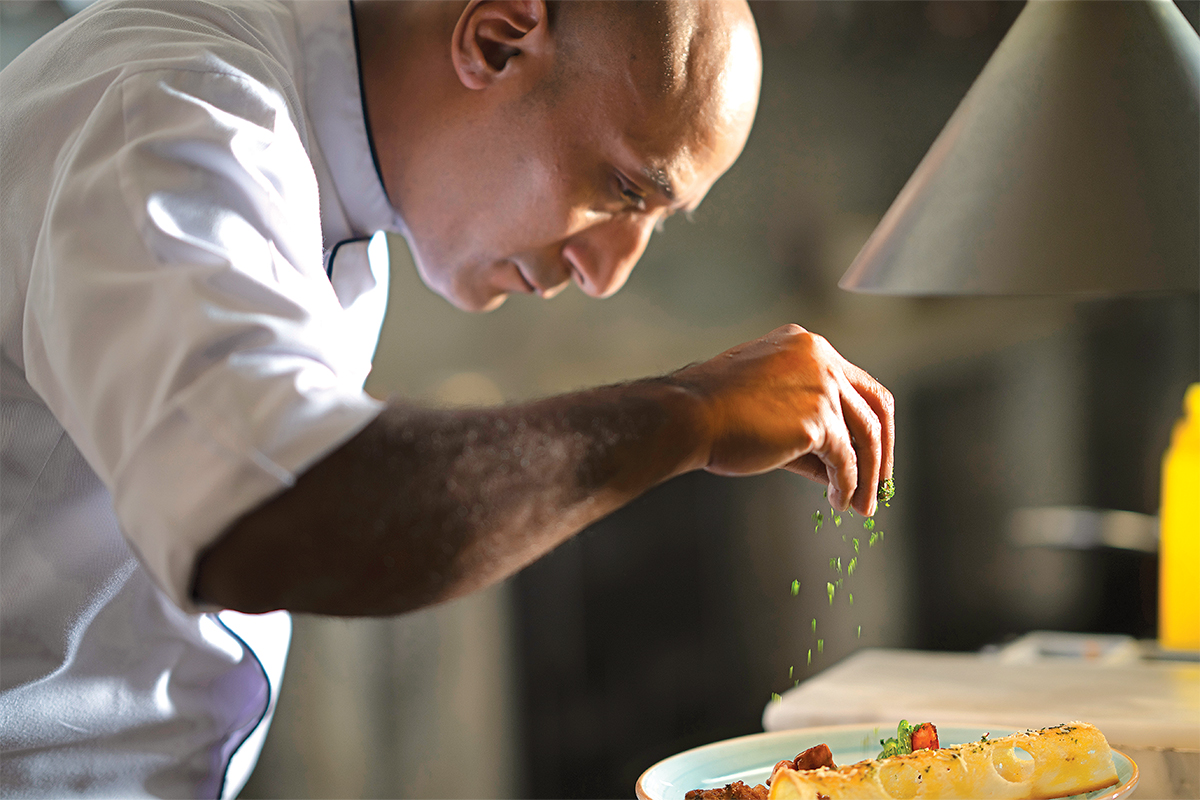
Hari’s success in Europe is rooted in something deeply personal. “My Nepali heritage shapes everything from the flavours to the discipline I hold in the kitchen,” he says. The rhythm of rural life, the aromas of childhood meals and the quiet rigour with which food is prepared back home, all find their way into his dishes. At Oven, this sensibility manifests as momo that tastes like home yet looks strikingly contemporary, goat curry presented with delicate balance and choila that carries both fire and finesse.
The dream of building a life abroad did not appear suddenly. “I am from Syangja, Pindikhola. I spent my childhood there,” he recalls. The idea of getting into the food busines first took hold in 2007 when he was researching eateries in the busy lanes of Thamel. After completing his plus two in 2011, he imagined opening a restaurant in Baneshwor. “But my parents did not support saying I was too young,” he reminisces. Around this time, Europe was becoming a popular destination for Nepali youth seeking work abroad, and Hari’s sister, based in Spain since 1999, had already opened three restaurants. Her journey became the blue print for his own.
He moved to Spain in 2014 after completing his Bachelor’s degree and entered the kitchen as a young chef. The move to Portugal soon followed. “The market there loves Indian food and consumes it at least once or thrice a week,” he explains. He worked across various restaurants, learning, absorbing and refining his skills. In 2017, he took the first leap introducing momo to the menu as a festive tasting addition. “I added other Nepali cuisine too and people loved it,” he says.
By 2019, Portugal’s gastronomy scene was booming and Hari had saved enough to open his own restaurant. That dream became Oven. “The market was more inclined towards Indian cuisine so my menu was 80% Indian and 20% Nepali,” he says. But even then, his focus was clear. “My focus was always on the flavour and presentation of the food.”
The name Oven came from the brass tandoor he ordered from India. “People became curious about it. It became a conversation starter, so I named the restaurant Oven,” he says. But just as the restaurant was taking shape, Covid hit. “My real struggle started then. The high rent with no income tested me,” he admits. The restaurant officially opened in 2021 and quickly became a hit. Hari began silently shifting the menu, letting Nepali flavours shine. Today the ratio is boldly reversed. “It is now 80% Nepali and 20% Indian food,” he says proudly. The best sellers speak for themselves, from sekuwa and goat curry to khichadi, tawa curry, fish curry and momo.
Then came the call that changed everything. In 2024, Michelin inspectors reached out but Hari held back. “I was not ready then. It was my goal but I did not want to rush it,” he says. In 2025 the inspectors returned anonymously. They asked for photographs and invited him to Porto for the annual ceremony. “At first, I did not believe it. I had to see for myself,” he says. When his name was announced, he describes the moment simply, “I was in shock.”
The honour transformed Oven overnight. Pre bookings soared from one week to 90 days. In Europe, people take the Michelin Guide seriously and the recognition placed Nepali cuisine on the global spotlight. “There are other Nepali chefs who have made the list, but Oven is the first Nepali owned restaurant to be included,” he says. The milestone came with expectations. Hari takes these as motivation. “It reminds me about quality every day,” he says. Oven has also become a favourite stopover for celebrities in Lisbon.
The Michelin recognition has shaped his aspirations too. He is ready to grow, and grow mindfully. “I am planning to open two more restaurant outlets, all named Oven,” he shares. The first is a fine dining concept set to open in February 2026. The current space will evolve into a fire-based kitchen called Aago by Oven. The third will open inside a luxury food court expanding access to his distinct Nepali flavours.
For young Nepali chefs dreaming of a bright future, Hari offers straightforward advice. “Do not underestimate Nepali food,” he says. “Give it a modern touch. Be market driven. Be hardworking.” His own career is proof that authenticity paired with innovation can travel far.
Success, to him, remains grounded. “Passion and hard work define success,” he says. And his vision for Oven’s future is just as clear. “I want Oven to be synonymous with richness in flavour.” His personal favourite, the lamb chop, is a homage to his roots. “It reminds me of my village, my childhood. I have given it a twist with a tangy chutney,” he says.
Hari returns to Nepal twice a year, not out of nostalgia but commitment. “I visit Nepal to learn Nepali delicacies and show them to the world in Europe,” he says. This ongoing exchange of tradition and innovation keeps his menu alive. Oven has also been honoured by the Mayor of Lisbon for gastronomy excellence in 2024 and 2025, cementing its place as a cultural ambassador.
From Syangja to being on Portugal’s most respected culinary lists, Hari Chapagain carries Nepal with him, not as a memory but as flavour, philosophy and identity. And through Oven, the world is finally tasting it.
Text: Ankita Jain