

Women leaders are still subjected to stereotypes that frame them as emotional rather than rationale, and often in a way that undermines their leadership capabilities. Why do you think this perception persists in 2025?
Bhushita: There is no inherent hierarchy between rationality and emotion. The idea that women also possess rationality should not even need validation. Blaise Pascal once said, “The heart has its reasons, which reason knows nothing of,” a statement that is both intellectual and rational. This highlights a key critique: reason itself has multiple dimensions and layers, yet we continue to perceive it as a monolith. Even from a strict scientific point of view, we have moved beyond deterministic, mechanistic physics to quantum calculations, which accept truth as a set of dynamic, underminable and subjective probabilities.
The traditional notion of rationality is outdated. Intelligence must be multifaceted, and emotional intelligence is a crucial domain that modern leadership cannot ignore. Take figures like Elon Musk and Donald Trump -dealmakers who demonstrate efficiency. However, pure rationality alone does not lead to a better or happier life. Profit-making, as Adam Smith emphasized, contributes to wealth creation, but wealth alone does not equate to happiness. Research consistently shows after a certain point, there is no proportional relationship between prosperity and well-being. If our goal is merely profit, then rationality suffices. But if we aspire to build an equitable, happy society, emotional intelligence must be recognized and integrated into leadership. Women do not need to alter their language or approach—rather, men, and leaders in general, must embrace emotional intelligence as an essential part of decision-making.
Ekata: Even in 2025, the perception that women are ‘too emotional’ to lead persists because of deeply ingrained societal norms. Historically, leadership has been associated with traits like decisiveness, assertiveness, and dominance, qualities traditionally linked to masculinity. When women display these traits, they are often labeled as ‘bossy’ or ‘difficult,’ while men are praised for the same behaviour. On the other hand, if women show empathy or emotional intelligence – both of which are strengths in leadership – it is often misinterpreted as a weakness.
The media also plays a role in reinforcing these stereotypes. Women in power are frequently scrutinized for their tone, expressions, or personal choices rather than their work or achievements. Meanwhile, in business and politics, the ‘likeability’ factor still disproportionately affects women, forcing them to walk a fine line between being strong and being perceived as ‘approachable.’ Until we redefine leadership to include emotional intelligence as a strength rather than a liability, this bias will continue to persist.

Women do not need to alter their language or approach—rather, men, and leaders in general, must embrace emotional intelligence as an essential part of decision-making.
Bhushita Vasistha
Writer, Researcher of Sanskrit Prosodies
Nisha: I feel that the bias that women are emotional overlooks that men have not had the same space for vulnerability, and such stereotypes exist because people do not think of how emotions and rationality aren’t opposites as they are often portrayed. The ability to empathise, adapt, and make nuanced judgements is often what defines strong leadership.
Yet, women in power are scrutinised for qualities that, in men, are praised as passion, conviction, or decisiveness. The world has come a long way since women fought for voting rights and equal pay. Yet women are told – sometimes subtly, sometimes cruelly – where they belong. They are encouraged to serve; I mean, we love educated, independent mothers, sisters, and wives, but they are discouraged from leading. Just like how a working woman must make a twofold adjustment to accommodate her professional and personal life, an ambitious woman has to go through another set of biases to prove herself worthy of it. Even when they rise, they must navigate the unseen forces of bias.
Rajeshwari: This perception persists because capitalist patriarchy uses gendered stereotypes to devalue women’s leadership. Framing women as “emotional” delegitimises their authority, ensuring that leadership remains a male domain that upholds hierarchies. It distracts from systemic critiques by reducing structural issues to individual traits, ultimately protecting the status quo.
What historical or societal structures have contributed to the idea that leadership, authority and expertise are more naturally suited to men than to women?
Bhushita: The word authority comes from a Latin root ‘auctor’, which among other things, denotes father. As a writer I am fascinated by the linguistic biases embedded in our understanding of power. Historically, leadership has been associated with pure reason, a notion rooted in outdated mechanistic and deterministic thinking from the Newtonian era. Women played a foundational role in civilization, pioneering agriculture, the bedrock of early societies. Will Durant, in The Story of Civilization, narrates this beautifully.
The Industrial Revolution entrenched gender inequality by separating paid labor (productive labor) from unpaid domestic work (reproductive labor), stripping women of financial independence. This division was a watershed moment that deprived women of financial independence and reinforced systemic gender inequality, a bias that persists today. We are trying to mould women to fit into the structure, which by design, has been unfair to her. Therefore, unless we acknowledge the domestic labour as a bonafide work, we will only add to her burden in the guise of progressiveness. It is not like women have not been working. In average, worldwide, women work longer hours than men. But we have distorted the definition of work and authority to befit male gender.
Ekata: The enduring belief that leadership, authority and expertise are inherently male traits is deeply rooted in historical and societal constructs. The “Great Man” theory, popularised in the 19th century, posited that exceptional leaders are born with innate qualities, naturally predisposed to lead. This perspective not only emphasised inherent traits but also predominantly highlighted male figures, reinforcing the notion that leadership is a masculine endeavor. Patriarchal social systems have further entrenched this belief by positioning men as primary authority figures in both public and private spheres. Such structures have historically limited women’s access to leadership roles, perpetuating the association of leadership with masculinity. Additionally, cultural narratives have often celebrated male leaders while overlooking or minimizing the contributions of women. This selective recognition reinforces the stereotype that leadership is predominantly a male attribute. These intertwined historical and societal factors have collectively contributed to the persistent perception that men are more naturally suited to roles of leadership, authority, and expertise than women.
Nisha: Historical and societal structures that have long preserved the visibility of men as primary earners and women as the primary rationale for it, requiring men to step out in the benevolent pursuit while women stay indoors awaiting mercy, have to be on top. This, I believe, has created a divide between the “man’s world” and the “woman’s world,” as if the skills needed for managing a household were any different from those required to run a business. The idea that women aren’t suited for leadership also stems from a deep lack of recognition and economic value placed on women’s skills. Domestic skills aren’t tied to economic value. Even in this day and age when everything is monetised.
Women in leadership on top of women coming out of their homes is much like the initial shock of pineapple on pizza – something people aren’t used to. It challenges familiar norms, causing discomfort, a reaction reinforced by the repetition of men in those roles, and highlights the slow, cautious entry of women into the visible economy.
Rajeshwari: These structures can be traced to patriarchy and capitalism. Private property required the control of women’s labour and reproduction, relegating them to domestic roles while men claimed public authority. Patriarchal norms then codified this divide into culture, politics, and economy, equating masculinity with rationality and leadership to justify exploitation.
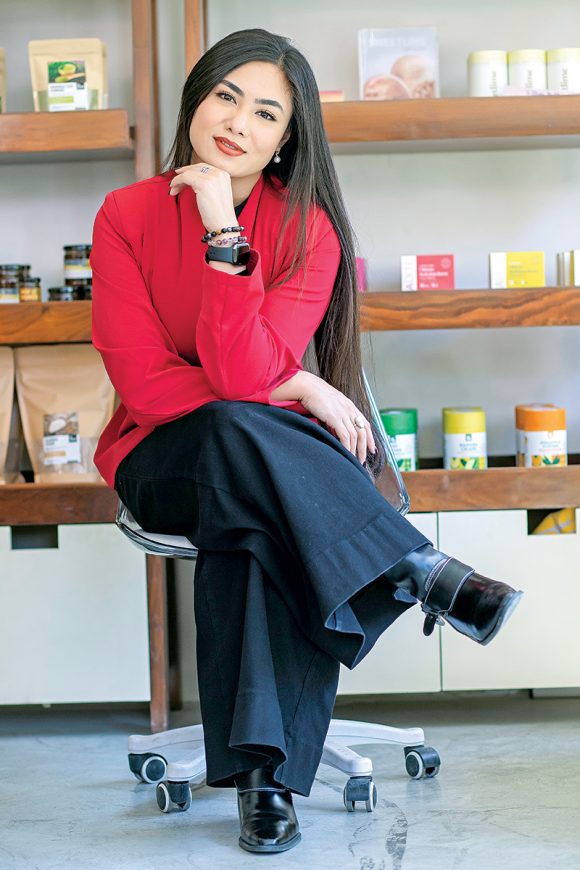
Women in power are frequently scrutinised for their tone, expressions, or personal choices rather than their work or achievements. Meanwhile, in business and politics, the ‘likeability’ factor still disproportionately affects women, forcing them to walk a fine line between being strong and being perceived as ‘approachable.’.
Ekata D. Tandukar
Co-founder, Jina Alchemy
Women who assert themselves or challenge biases are often labelled “too aggressive” or “difficult.” How does this perception discourage women from taking leadership roles or advocating for themselves?
Bhushita: A diplomat, it is said, can tell you to go to hell in a way that makes you look forward to the journey. A leader should possess that skill – persuasion over force. Leadership is about inspiring and influencing, not aggression. Men or women, aggression, brutality, is a no-no for me. Given women’s historical suppression, I am more forgiving of their aggression today than I would be of men’s. Women are still reclaiming their voices, but this should be a transitional phase. As access to leadership and resources equalizes, assertiveness will naturally replace aggression. I do not believe in role reversal as the template of progress. Yesterday, men were aggressive so women will be counter aggressive now, or vice versa. Aggression is a psychological tendency that tells the agent it is okay to bully others to get what you want. It is not. We do not live by such brute forces anymore. We must rethink leadership. Now that ultra-nationalism is on the rise, we must understand that aggression and a show of power are not the way to lead – not for men or women. A leader must be kinder and wiser. I corroborate Socrates’ idea of a Philosopher leader who leads by example.
Ekata: This double standard arises from societal expectations that align leadership qualities with masculinity, creating a “gender double bind” where women are judged harshly regardless of their approach. Consequently, many women hesitate to take on leadership roles or advocate for themselves, fearing negative evaluations or social repercussions. This reluctance not only limits their professional growth but also perpetuates gender disparities in leadership positions.
Nisha: Punishing women for having a voice will have the same impact that a teacher has on a student who asks them a question they do not know the answer of and labels them “oversmart”. The dismissal will always scar them in different ways.
Rajeshwari: These labels are tools of alienation. Patriarchy punishes assertive women by applying these labels, which suppresses collective challenges to patriarchy. It isolates women, forcing them to internalize oppression rather than organize. This ultimately results in the persistence of patriarchy.
How do ingrained gender roles shape the types of jobs and leadership positions women are encouraged or discouraged from pursuing?
Bhushita: Indra Nooyi, the former CEO of PepsiCo, once spoke about the difficult choices women in leadership often face. When we read the biographies of women leaders, a recurring theme emerges – they frequently have to sacrifice their familial responsibilities to hold high-ranking positions. This issue is deeply tied to ingrained gender roles.
Women are expected to juggle multiple responsibilities simultaneously -managing their careers while shouldering the emotional and physical labour of running a household. They bear stress not just from their jobs but also from their roles as mothers, daughters-in-law, and caregivers. Neo-Marxist economists argue that if a woman steps away from her home duties, she must hire a cook, a nanny, and a babysitter – services she has been providing for free. This uneven distribution of responsibilities limits women’s ability to focus on leadership roles. Unlike the pressures of business, which often revolve around financial risks – such as a company’s stock dropping by 5% – the stress women endure is far more personal and insidious. If a child has a fever of 104 degrees, that stress is immediate, emotional and high-stakes. Yet, this kind of emotional burden is rarely acknowledged or measured.
The reality is that women are already managing multiple jobs, yet society continues to question their capacity to handle stress in leadership roles. The real issue is not women’s ability but the unequal distribution of emotional and domestic labour, which prevents them from fully engaging in professional growth and leadership opportunities.
Ekata: Traditionally, roles that involve nurturing and caregiving, such as teaching and nursing, are deemed “women’s work,” leading to their devaluation and lower compensation. Conversely, fields like engineering, economics, and other STEM areas are often seen as male domains, deterring women from entering these high-earning professions. While certain physical labour jobs, such as construction work requiring significant strength and stamina, are predominantly performed by men, it is essential to recognize that women’s underrepresentation in these fields is not solely due to physical suitability but also stems from societal perceptions and limited access to training and opportunities. Encouraging women to pursue a diverse range of careers, including those in leadership positions across various sectors, is crucial for achieving gender equality in the workforce.

Punishing women for having a voice will have the same impact that a teacher has on a student who asks them a question they do not know the answer of and labels them “oversmart”. The dismissal will always scar them in different ways.
Nisha Giri
Vice Principal, Kavya School
Nisha: The implicit bias and unfair conditioning create a world where girls grow up believing leadership is not meant for them. They will be encouraged to pursue “soft” careers, nurturing, supportive roles that align with society’s expectations, like teachers while positions of power and decision-making like education minister, remain male-dominated. Women will have to constantly prove their worth in spaces where men are accepted without question. The boardroom and the highest offices of governance, these will remain distant dreams.
Rajeshwari: Capitalism profits from segregating labour. Feminized jobs are underpaid and devalued, while male-dominated fields offer higher pay and more political and cultural power. Gendered roles normalize this exploitation, ensuring a reserve of cheap labour and fragmenting worker solidarity.
What’s one change – whether in mindset, workplace policies, or leadership – that you believe would make the biggest difference in ensuring women are taken seriously in all fields?
Bhushita: What truly inspires society are individuals who rise above societal expectations without being defined by them. Yes, gender shapes our identity, but we are more than just our gender, we are body, mind and, some might say, spirit. Rather than being weighed down by labels like feminism, patriarchy or race, we should focus on writing our own narratives instead of following predefined scripts. The real key to fulfillment lies in the courage to transcend limitations, embrace new horizons, and seek growth beyond imposed boundaries.
For me, the goal is simple – to play the music my heart longs to hear. So, be fearless. Life will always present challenges. But we must refuse to be defined by our challenges, we must want to be remembered for what possibilities we brought instead.
Ekata: To ensure women are taken seriously across all fields, implementing comprehensive leadership development programs tailored for women can make a significant impact. These programs should focus on mentorship, skill-building, and networking opportunities to prepare women for leadership roles. For instance, organisations like ‘HeForShe’ have initiated global efforts to engage leaders in promoting gender equality. World Athletics has launched action plans to empower women in coaching and officiating roles. Additionally, policy reforms such as implementing gender quotas and adopting electoral reforms like ranked-choice voting have been advocated by organizations like Represent Women to increase women’s representation in political offices. We can challenge existing biases and promote a more equitable representation across all sectors by fostering environments that actively support and cultivate women’s leadership.

Feminised jobs are underpaid and devalued, while male-dominated fields offer higher pay and more political and cultural power. Gendered roles normalise this exploitation, ensuring a reserve of cheap labour and fragmenting worker solidarity.
Rajeshwari Subedi
National Coordinator
Scientific Socialist Women’s Organisation, Nepal
Nisha: I think, world should just let a woman finish her sentence when she is speaking.
Rajeshwari: Collective ownership of workplaces and dismantling the profit motive is the way forward. Democratizing workplaces will help to challenge gendered exploitation.
What advice would you give to young women aspiring for leadership roles?
Bhushita: Seek greatness that humbles you every day. With such humility and searching, life becomes a never-ending adventure. Then you will not be bothered by what people say, because if only we look around, the cosmos is far too marvellous to be tied down to the opinions of people around us. And only a person who can silence the noise of opinions around achieve greatness.
Ekata: For young women aspiring to leadership roles, building a strong support network through mentorship is crucial. Establishing connections within and outside your organization can provide valuable guidance and open doors to career advancement. Additionally, engaging in small, everyday actions that challenge gender stereotypes can foster an inclusive environment and empower women in the workplace. These practices collectively can help women navigate challenges and progress into leadership positions across various fields.
Nisha: Three things,
- Read the pedagogy of the oppressed, read in general, stay informed
- Exercise empathy in decision making, even in persuasion
- Make conscious efforts to empower women in your family
Rajeshwari: We must reject individualism. Leadership is political. We must build solidarity with working-class women. We should believe in the power of collective liberation, not capitalist meritocracy. Ideology is what matters the most. We should align with movements that strive to end patriarchy and capitalism, not reform them