
VOW Media, in partnership with Kaalo.101, is transforming public spaces in the Kathmandu Valley through a vibrant mural initiative under the She is the Story programme. Created by seven women artists across seven communities, the murals celebrate the history, progress and resilience of Nepali women. More than art, they are bold statements of empowerment, amplifying women’s voices in public spaces.
VOW Media’s Executive Director, Pooja Pant, explains that the murals create dynamic spaces where women’s stories and futures are made visible. Programme lead Nagma Mali adds that by placing these works on village walls and school grounds, the project challenges who gets to be seen and heard while sparking dialogue and belonging.
Each mural is deeply rooted in its community. Saru Prajapati, from Khokana, painted her piece in her childhood neighbourhood. She began by inviting local women to discuss the changes they longed to see. Many spoke of limited opportunities with agriculture becoming a constraint rather than a choice. This inspired her mural, Doko ma sapana atcha ki atdaina? (Can dreams fit inside a doko?). It reflects how women, burdened by responsibilities, feel they have little freedom to pursue their aspirations.
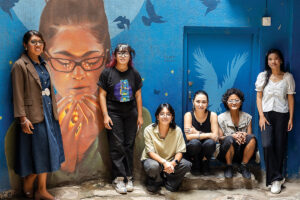
Pooja Duwal painted near the Siddhiganesh Temple in Nagadesh, giving back to the community that shaped her. Her mural explores generational exchange, honouring the sacrifices of older women while embracing the agency of younger ones. The base shows women in traditional roles like pottery and farming, lifting the younger generation into new fields like tailoring and music. “I have also painted my mother,” she shared. “She runs a fertiliser shop, and my art would be incomplete without her.” The mural ends with a child writing “Us” in Newari, reflecting the community’s value of education.
In Indrabinayak, Anjila Manandhar created KMC 19 centered on the local deity Kanga Ajima and the fading tradition of playing the Narsingha, a ceremonial instrument once played by lower-caste communities. Instead of human faces, she used native Nepali flowers to represent identity and culture symbolically.
Mitchelle Lama’s mural in Tokha, Women of Tokha, highlights everyday women who quietly uphold traditions and communities; running shops, practising healing and passing down ancestral knowledge.
Her mural honours these contributions often left unacknowledged.
In Sankhu, Blu painted Knitting the Dreams, inspired by women who gather to knit. “They created spaces to just sit and knit,” she said. “It brings them together, allowing them to share stories and experience.” Her mural celebrates this act of bonding and preservation of culture through craft.
Mrigaja Bajracharya, who painted Stitching Stories in Thecho, brought to life the wisdom and resilience of older generations. Her mural is a tribute to women whose struggles paved the way for future freedom and progress.
In Panga, Promina Shrestha’s mural reflects the emotional and economic journeys of local women. “Their voices gave the artwork meaning and reminded me of the power of shared experience,” she said. The mural centers on community and resilience, past and present.
Creating these murals came with challenges. For Saru, it was her first mural and first time collaborating with a community. “Explaining how their ideas shaped my vision,” she said. The community’s appreciation of a local artist uplifted her and gave her confidence. For Pooja, the scale was daunting but rewarding. “It was my first time painting a mural this large in public. I learnt so much.” Anjila faced both technical and social hurdles – mastering the drip painting technique and defending her choice to depict flowers instead of faces. “One day, a woman shared a childhood myth that gods once had flowers for faces. It gave people, and me, a new perspective. That’s what art should do.”
Mitchelle faced a different kind of challenge: encouraging women to speak up. “From a fish seller to a healer, these women have incredible stories. But many didn’t think their experiences mattered.” Her mural seeks to change that narrative.
Blu’s challenge was the mural’s location, a busy street. “It was my first time painting in public, which didn’t help my nerves,” she said. “But I ended up having a blast.” For Mrigaja, the project was enriching. “Just watching the women and girls here taught me so much. Their bold, carefree spirit moved me.”
These artists have powerful messages to share. Saru sees murals as mirrors, reflecting society’s truths and inviting change. Pooja believes murals are most powerful when created through community collaboration. Anjila hopes her work helps preserve fading traditions and highlights forgotten cultural elements. Mitchelle celebrates women who break norms through quiet perseverance. Blu wants people to recognise their mothers’ resilience in these artworks. Mrigaja hopes viewers see their own mothers and grandmothers reflected in her mural.
Now handed over to local governments, these murals stand as public commitments to gender equity proving that women aren’t just part of the story; they are shaping it.
Text: Kreenjala Pyakurel