Violence is noticed only when it leaves marks. Only when it is visible, undeniable, impossible to ignore. But so much harm happens quietly, behind closed doors, shrouded in stigma, dismissed by society, and buried under judgement.
For women and gender-diverse people who use drugs or live with HIV in Nepal, intimate partner violence is not an exception. It happens repeatedly. And worse, it often goes unrecognised. Pareen
Limbu refuses to let that silence continue. Through her work with Dristi Nepal, she is forcing a conversation many would rather avoid. One that sits at the intersection of gender, drug use, and deeply ingrained social prejudice. One that exposes how violence is not only inflicted, but also enabled.
“We are punished twice,” Pareen says. “First by the violence itself, and then by a society that refuses to see us as victims.” Abuse in these communities is rarely limited to physical harm. It is emotional manipulation, financial control, coercion, and isolation. Partners use stigma as a weapon, knowing that the world outside is unlikely to offer support. “People assume that if you use drugs, you have no dignity left to protect,” she adds. “So when violence happens, they think it is normal. Expected. Even deserved.”
Women who use drugs are rarely seen for who they truly are. Their experiences become cautionary tales, their pain questioned, their voices doubted at every turn. For those living with HIV, the vulnerability deepens. Disclosure becomes a threat. A tool of control. A reason to stay silent. “I have met women who stay because leaving feels more dangerous than the violence,” Pareen says.
“Where do they go? Who believes them?” The answer, too often, is no one.
This is where Dristi Nepal steps in, not as charity, but as resistance. Founded in 2006, the organisation has created spaces where survivors are heard, not judged. Where their experiences are validated, not questioned.
Counselling becomes a way to reclaim voice. Legal assistance becomes a path to justice. But beyond services, the organisation is doing something far more radical: shifting power. “Support is important,” Pareen says softly, “but without dignity, support means nothing.”
At the core of this work is a simple but urgent truth: those most affected must be at the centre of the conversation. Not as subjects, but as leaders. “For too long, decisions have been made about us, without us,” she says. “And that is why they fail.”
Placing the voices of marginalised communities at the heart of the conversation isn’t just about inclusion. It is essential, it’s how real change begins. “When we speak for ourselves, the narrative changes,” Pareen says. “We are no longer seen as problems. We are seen as people.”
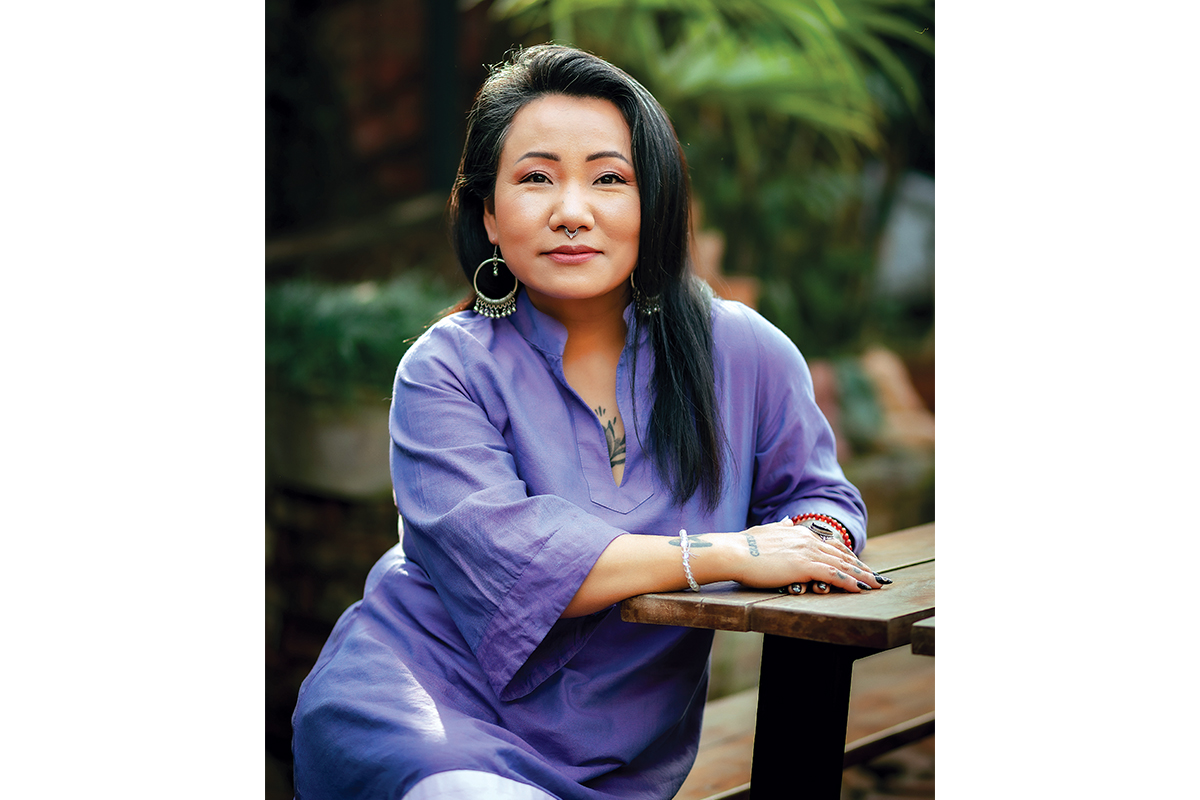
This work has not gone unnoticed. Pareen Limbu was one of the recipients of the Kamla Bhasin Awards 2023, recognised as the founder of Dristi Nepal, the first organisation in Nepal led by and for women who use drugs. The honour reflects not just her leadership, but the urgency of the voices she amplifies.
But the journey to being heard has not been easy. “Dristi Nepal began when we received support of 50k from Lee Fitzgerald during a meeting where no one else supported us. That support showed that people could trust, love, and understand us if they chose to, and it helped them connect with our journey,” Pareen shares.
The moment is telling. In a room full of doubt, belief came from one person. And that was enough to begin. “We were not seen as credible,” she says. “Not as leaders. Not as people worth investing in.” That disbelief is something she continues to confront, not just in institutions, but in everyday attitudes.
“Society is comfortable ignoring us,” Pareen says. “Because acknowledging us means questioning its own bias.” And that is precisely what her work demands. A reckoning.
Intimate partner violence does not exist in isolation. It is shaped by power, by stigma, by the systems that decide whose pain matters and whose does not. “Violence thrives where silence is accepted,” she says. “And silence is easier when the person suffering is already marginalised.”
There is nothing comfortable about this truth. And that is the point. Pareen is not here to make the conversation easier. She is here to make it impossible to ignore. Through every story amplified, every survivor supported, and every system challenged, she is redefining what justice looks like. Not selective. Not conditional. But universal.
“Dignity isn’t something we need to earn,” she says softly. “It’s ours already. The world simply needs to see it.” And until it does, she will continue to speak.
Text: Ankita Jain
Photos: Sanjay Maharjan