
Nepal’s democratic history holds the stories of pioneering women who entered politics when female leadership in public office was still an exception. Their journeys were not only personal achievements but also signals of a gradual social shift within a political culture long dominated by men.
One of the earliest figures was Dwarika Devi Thakurani, who in 1959 became Nepal’s first woman cabinet minister.
Serving as Deputy Minister of Health in the democratic government led by Bishweshwar Prasad Koirala, her appointment marked the first time a Nepali woman entered the executive structure of government. At a time when women’s participation in politics remained minimal across South Asia, her presence suggested that new possibilities were beginning to emerge.
Yet that breakthrough did not immediately transform the system. For decades, women continued to contribute through activism, party organisations and social movements, while relatively few reached senior leadership positions.
Another milestone arrived in 2015, when Bidya Devi Bhandari was elected as Nepal’s first female president. Her rise followed decades of political involvement and carried symbolic weight far beyond the presidency itself. It suggested that the barriers that had long confined women to the margins of politics were beginning, slowly, to shift.
A year later, in 2016, Sushila Karki became Nepal’s first female Chief Justice. Her tenure demonstrated how women could reach the highest constitutional positions through professional merit and institutional credibility. Known for her firm defence of judicial independence, her leadership expanded the public imagination of what female authority within governance could look like.
These milestones are important chapters in Nepal’s political story. Yet they also reveal a paradox. While individual women have broken historic barriers, the broader political system has struggled to translate those moments into widespread female leadership. That tension formed the central theme of a public dialogue organised by WOW Magazine earlier this year.
A platform to examine exclusion
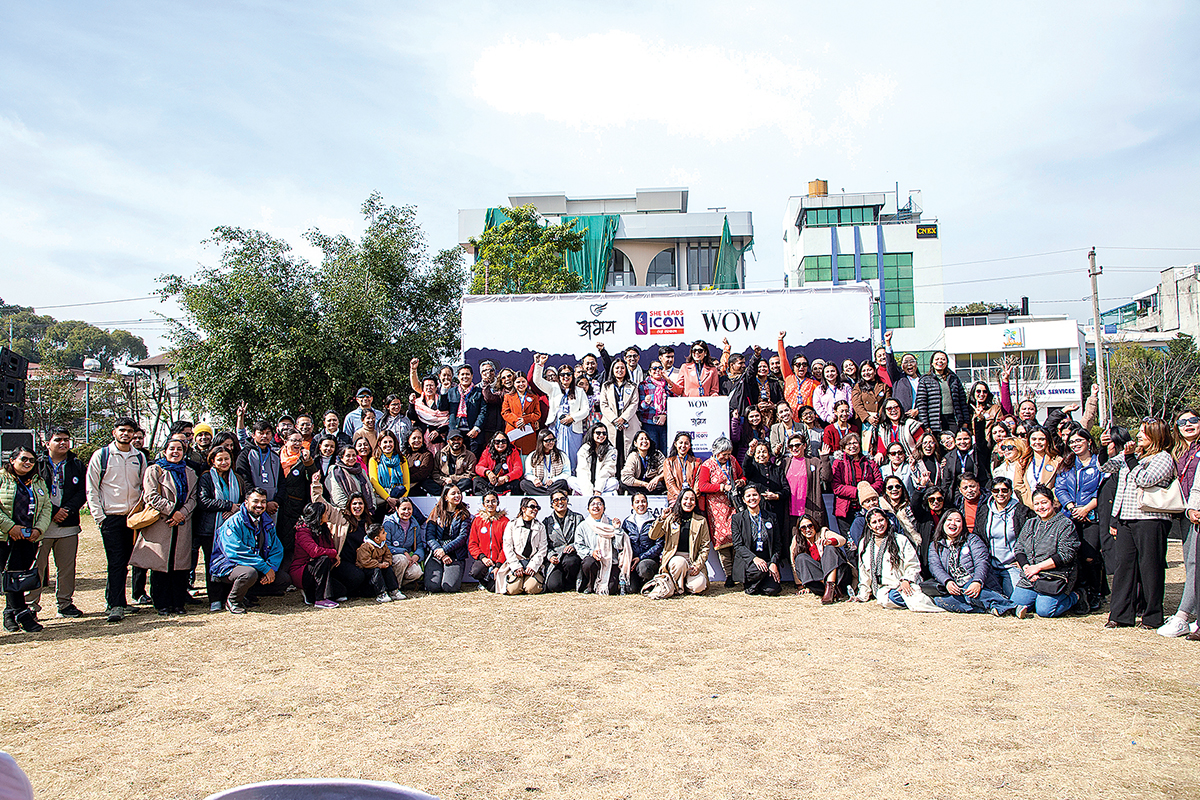
Under the title Excluded by Design: Women, Politics, and Ethical Failure, WOW Magazine convened an open political forum at Narayanchaur in Naxal, Kathmandu. The gathering brought together politicians, youth leaders, scholars, activists and members of civil society to examine the structural barriers that continue to shape women’s participation in Nepal’s political system.
Held between 7 AM and 11 AM, the forum encouraged open dialogue and public participation. The goal was not merely to discuss representation as a statistic but to explore the institutional dynamics that determine who ultimately gains access to political power.
The event was formally opened by Charu Chadha, Founding Editor of WOW Magazine, who emphasised the need to move beyond symbolic narratives of empowerment and focus instead on meaningful participation in decision making. The numbers from Nepal’s most recent election cycle illustrate the gap between aspiration and reality. Out of 3,484 candidates who contested under the direct electoral system, only 388 were women. The statistic highlights how candidate selection processes within political parties often shape electoral outcomes long before voters cast their ballots.
She emphasised the need for industry building and systems that do not exclude.
Voices from the political arena
The forum brought together women who have navigated these structures from within. Among them were senior political figures such as Hisila Yami and Asta Laxmi Shrestha, whose careers span decades of political activism and governance.
Reflecting on the search for new political alternatives, Hisila offered a pointed observation. “The word ‘alternative’ echoes loudly in politics today. But if there is any true alternative power, it is a woman. As we gather here searching for new structures, we must realise the alternative power has always been within us.”
A younger generation of political individuals also contributed to the discussion, including Sumana Shrestha, Mamata Mahato, Ranju Darshana and Sharmila Pariyar. Their political journeys reflect a changing landscape where civic activism, grassroots engagement and digital platforms increasingly intersect with formal party politics.
Sumana Shrestha addressed the language that often frames women’s participation in politics. “Equality cannot exist as long as rights are framed as something one gives and another takes. An election ticket is not a gift from a party or a president. It is earned. Until we change this language, women will always be seen as receiving power, not claiming it.”
For Ranju Darshana, the barriers women face in politics are often deeply personal. Speaking about the criticism she received while contesting elections during pregnancy, she said, “A recent ‘researched’ article criticised me for running in elections while pregnant, as if motherhood disqualifies women from public life. I do not know what research that was, but it was meant to push women back. This election is not just about votes. It is a fight against a system that demands population growth while refusing to support mothers.”
Beyond politics
The dialogue extended beyond elected representatives. Civil society leaders and youth activists also shared their perspectives on governance and social responsibility.
Rakshya Bam highlighted the stark inequalities faced by women outside the capital. “I want to remember the women who give birth on the roadside, the women who cannot even access medicine for common illnesses. As we sit here in the capital, we must recognise our privileges. We have platforms to question and protest. Opportunities they have never had. We must speak about them and become their voice.”
Reshu Aryal Dhungana addressed the tendency to dismiss discussions about gender as trivial. “Some say that what we are gathered here for is merely ‘women’s drama’. But how, then, have our families and societies flourished? How are the next generations born? These are not just women’s issues or women’s drama. They concern all of us.”
Business leader Suraj Vaidya offered a perspective from outside formal politics. Reflecting on leadership and legacy, he noted, “Behind every great legacy is a strong woman.
My father’s achievements were built with my mother, and my business thrived when my wife joined. Women, like Hon. Sushila Karki, know how to build sustainable systems, not just meet political demands. Nepal needs more than money or politics. We need more women who understand people and their demands.”
Historian and commentator Tika Ram Yatri situated the conversation within Nepal’s broader political journey. “We have taken great leaps in our history, from Sadhana Devi Pradhan, the first elected woman representative in Nepal, to Dwarika Devi Thakurani, the first Nepali woman elected to parliament and appointed as a cabinet minister. Yet that legacy has not been fully sustained today. We must celebrate how far we have come, but also ask where we are headed next.”
The architecture of political exclusion
Throughout the discussion, speakers emphasised that political exclusion is shaped not only by elections but by the internal mechanisms of political parties.
Candidate selection remains one of the most significant barriers facing women who wish to contest elections. Party leadership structures are often dominated by senior male figures who control nominations for winnable constituencies.
Women are frequently encouraged to participate through proportional representation lists rather than direct electoral contests. While these mechanisms have increased numerical representation in legislative bodies, they rarely offer the same visibility or constituency level engagement that direct elections provide.
The result is a structural imbalance. Women appear within political institutions, yet the pathways to leadership remain constrained. The statistics from the recent election cycle illustrate this clearly. Out of more than 3,000 candidates in the direct electoral system, fewer than 400 were women.
Democracy as public conversation
One of the most distinctive aspects of the forum was its interactive format. Spoken word performances and artistic expressions explored themes of representation and social justice. Audience members engaged through digital tools, including QR based petitions and feedback platforms. The event became more than a panel discussion. It evolved into a participatory civic forum.
Such formats reflect a broader shift in democratic discourse. Political conversations are increasingly unfolding beyond parliamentary halls, moving into public spaces, community gatherings and digital networks.
The unfinished project of representation
Nepal’s political landscape has changed significantly over the past several decades. The country has produced pioneering women leaders and adopted constitutional provisions that encourage inclusion.
Yet the statistics from the most recent election cycle demonstrate that structural barriers persist.
Participants concluded that meaningful inclusion requires more than representation alone. It requires reforms within party structures, transparent candidate selection processes and sustained civic pressure for institutional change.
Nepal’s democratic journey remains unfinished. The pioneering women who first entered the political arena proved that change is possible. The task now is to ensure that their legacy evolves into a system where women’s leadership is no longer exceptional, but expected.