
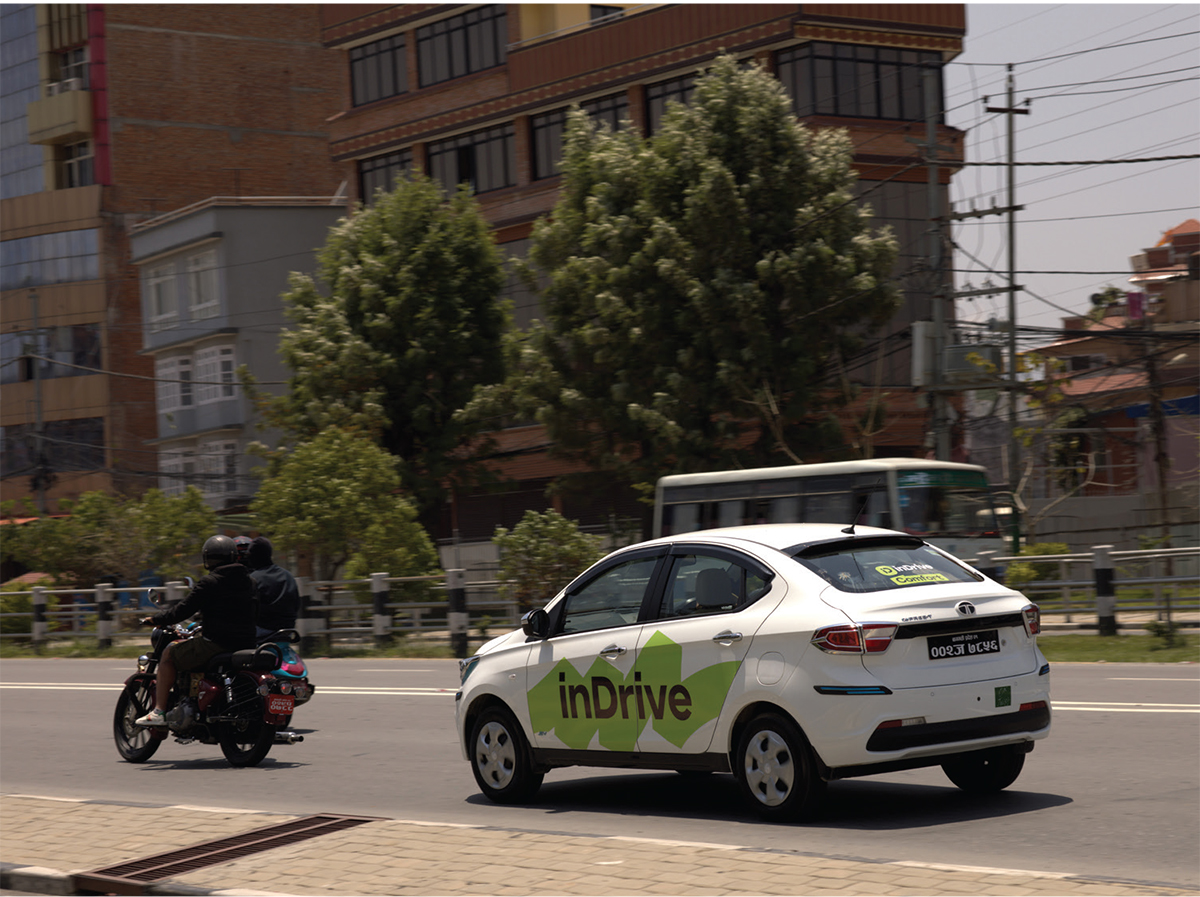
In a city where ride sharing has quietly reshaped everyday mobility, a new group of women is changing something deeper than traffic patterns. They are changing perception. Women drivers and riders on inDrive Nepal are stepping into a space long considered male territory, navigating not just roads but judgement, curiosity and expectation. For many of them, this is not simply a job. It is independence. It is dignity. It is the confidence of choosing work on their own terms.
Among these women are Keshari Tamang, Sachita Khadka and Ishwori Thapa whose journey behind the wheel is as much about courage as it is about survival.
Keshari Tamang, 33, Cab Driver, inDrive Nepal
Keshari Tamang did not grow up imagining herself as a cab driver. Life, however, had other plans. At 33, she is a mother of two and the primary support system for her family. She has been driving with inDrive Nepal for the past eight to nine months, and for her, the decision has been life changing.
“I needed an income that could actually run my household,” she says. “Driving gave me that stability.” Keshari learned how to drive just a year ago, with a clear goal in mind. She wanted to enroll as a driver on a ride sharing app. The idea was simple but the execution was not. In the initial months, technology felt like a bigger hurdle than traffic.
“At first, I did not even know how to use Google Maps,” she admits. “Location tracking was the biggest problem for me.” There were moments of frustration and self-doubt. But Keshari persisted. With time, she learned to navigate routes, read maps and trust the screen guiding her through unfamiliar streets. Today, Maps has become her most relied upon tool. “Now it is the most useful app for me,” she says with a smile.
Her days begin early. Keshari starts work at 7 am and usually drives until 8 or 9 in the evening. She consciously avoids night shifts, balancing work with her responsibilities as a mother. “My children need me,” she says simply. “That is why I choose my hours carefully.”
Despite the long days, she genuinely enjoys her job. Driving has given her confidence, independence and a sense of purpose. She also finds joy in the reactions of her passengers. “Many passengers are surprised to see a lady driver,” she says. “They find it amazing, and some even encourage me.”
For Keshari, the road ahead feels open. She sees a future in this profession, one where she continues to grow, support her family and inspire other women to believe that they too can take control of the wheel and their lives.

Sachita Khadka, 29, Rider, inDrive Nepal
For Sachita Khadka, being on two wheels has never been unfamiliar. At 29, she has been riding a scooter for nearly 15 years, long before riding became a statement or a source of income. What began as a daily skill slowly turned into a form of freedom.
Sachita has been working as a rider with inDrive Nepal for the past year. Before that, she was part of Nepal Can Move Courier Service, a job that taught her discipline. However, flexibility drew her to inDrive. Sachita now works 4-5 hours a day, earning between Rs 1000 to 1500 daily, a rhythm that fits seamlessly into her life as a single mother. “These hours suit me best,” she says. “I can work and still be present for my child.”
Sachita works entirely on her own terms. She chooses to take only female passengers; a decision rooted in comfort and safety for both rider and passenger. “I feel more comfortable, and so do they,” she explains.
Her decision to become a rider was deeply personal. Sachita was among the first users of the inDrive Nepal app, and her early experiences as a passenger were not always pleasant. “I struggled with uncomfortable bikes and riding styles,” she recalls. “That made me think, why not be on the other side of this journey.”
Today, she is the rider passengers’ trust. Most of her trips end with top ratings, compliments and relief. “They tell me they feel safe,” she says. “They praise my riding, and that means everything to me.”
Sachita treats this work as freelance, knowing it may not be permanent. Like many young Nepalis, she plans to move abroad in a few years. Until then, she rides with purpose. Her family and close circle fully support her decision. “They tell me no work is small or big,” she says with quiet pride.
What Sachita loves most are the conversations. During each ride, stories unfold. Women speak of struggles, dreams and everyday resilience. “Talking to them teaches me so much,” she says. “These small stories show the strength of Nepali women in Kathmandu.” For Sachita Khadka, every ride is more than transport. It is solidarity in motion, carried forward on two steady wheels.
Ishwori Thapa, 40, Cab Driver, inDrive Nepal
Ishwori Thapa has been behind the wheel longer than many of today’s drivers have been on the road. At 40, her relationship with driving spans nearly two decades, shaped by experience, instinct and an unshakeable sense of confidence.
She has been working with inDrive Nepal since its inception in Kathmandu, but her journey began much earlier. Ishwori has been driving taxi since 2006, a time when women drivers were rare and often questioned. The road, however, never intimidated her. “Kathmandu roads are completely safe,” she says firmly. “I have been driving for two decades and I have never faced any incident.”
Her workdays are long and demanding. Ishwori often begins as early as 4 am and continues until 8 pm, and on some days, even drives until 1 midnight. The hours never deter her.
“There are men drivers who discourage women,” she says. “They say we will be looted or harassed. But that is not the reality.” According to Ishwori, passengers have consistently been respectful and encouraging. Many express appreciations when they see a woman behind the wheel, trusting her driving and her presence. “Passengers have been too kind,” she says. “They appreciate women drivers, and that gives me strength.”
For Ishwori Thapa, driving is not just a profession. It is proof. Proof that women belong on every road, at every hour, and with every right to demand dignity, respect and fair pay for their labour.
Text: Ankita Jain