There is a particular beauty to something made by hand. A line falls just shy of perfect. Colour deepens unexpectedly at the edge of a motif. One impression differs, almost imperceptibly, from the next. These are not flaws to be corrected, but traces of the human hand – small, beautiful irregularities that make each piece its own.
At Maa:Yu Creative, this philosophy is woven into the very fabric of the brand. Hand-block printing lies at the heart of its practice, alongside an appreciation for wabi-sabi – the Japanese philosophy that finds beauty in imperfection, impermanence and the marks of time and touch.
Yet Maa:Yu’s story did not begin in a design studio. It began with two people whose professional lives existed far from the world of craft. Siddhartha was a Team Manager at Samsung; Samasty worked in Disaster and Livelihood Management. Both had built careers in their respective fields, but gradually found themselves questioning the pace and politics that came with them. There was a desire for something more tangible, more personal, and ultimately, more meaningful.
Then, almost serendipitously, came an old notebook. While looking through memories, Siddhartha discovered one Samasty had kept during her time in Finland, where she studied Community Development Work. Inside its pages was an idea she had once mapped out: a creative platform that would bring different forms of handcrafted art together.
“The idea was closely connected to my upbringing,” Samasty says. “I was raised in a family of master artisans, where craft was understood beyond its aesthetic value. It was part of my family’s heritage and livelihood.”
Siddhartha’s response was simple: “Let’s do it.”
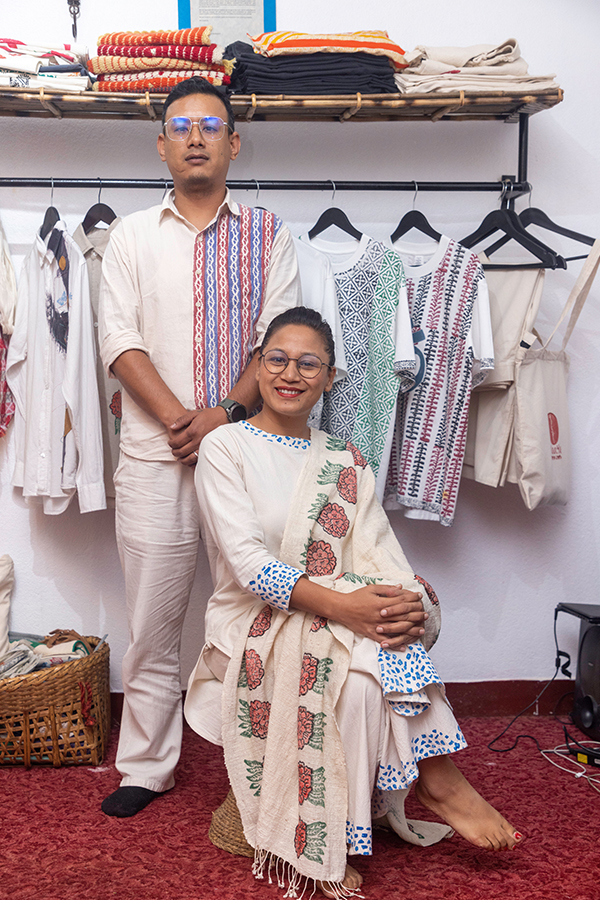
There was no elaborate business plan, no carefully engineered launch strategy. Instead, Samasty left her career and returned to something much closer to home: her mother’s workshop. Siddhartha would eventually step away from Samsung too.
By 2018, they were laying the foundations of Maa:Yu Creative, formally registering the company the following year. Hand-block printing was still so unfamiliar within the contemporary local marketplace that, they recall, registration officials classified the business under screen printing.
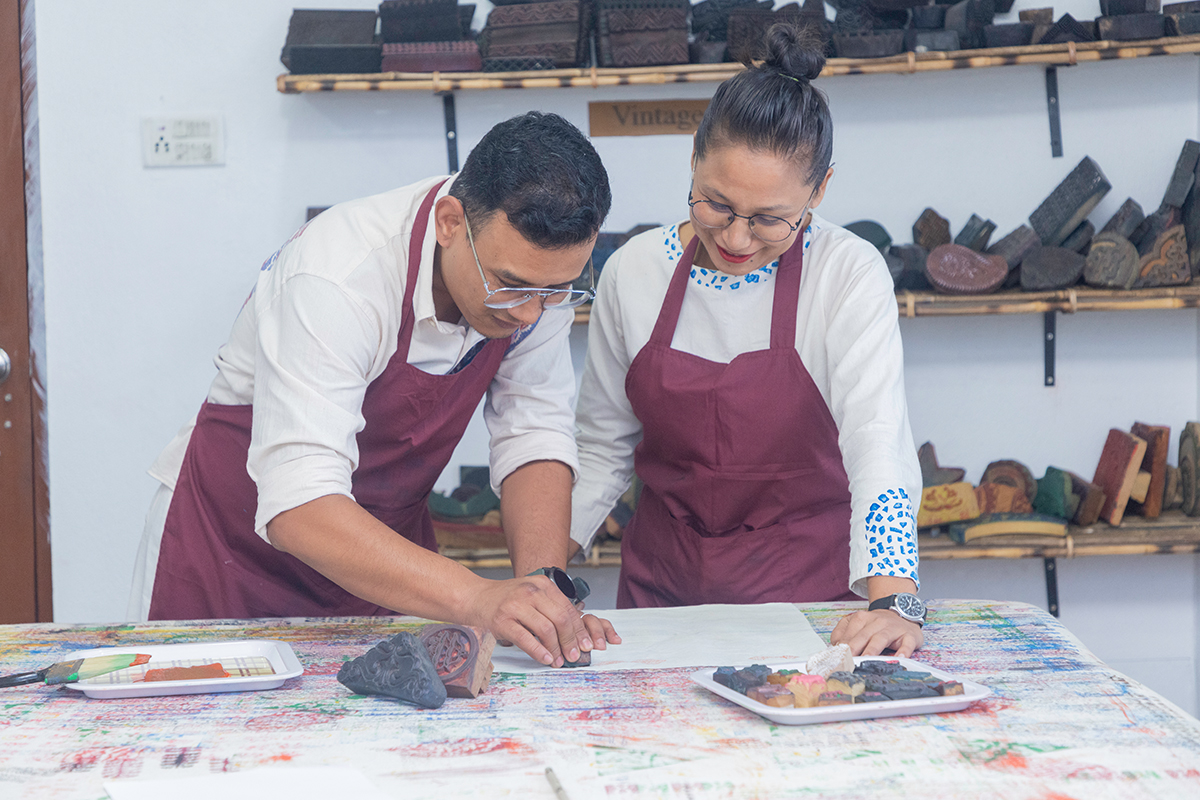
But for Samasty, the craft itself was anything but unfamiliar. Its lineage runs directly through her mother, Meera Dangol Shakya, for whom block printing had been both craft and livelihood, a way of supporting her family while continuing a practice she knew intimately. Her workshop became Samasty’s classroom, a place where knowledge was not simply explained but absorbed through repetition: preparing colour, understanding fabric, positioning the block, applying pressure, learning when to trust the hand.
That inheritance remains central to Maa:Yu. Because behind every printed motif is something that cannot easily be seen: knowledge learnt, practised and passed from one generation to another.
The story would later expand with Archana Tamang Lama, affectionately known as Aamu, whose background in global human rights advocacy brought another dimension to the brand, informed by ideas of dignity, equality and empowerment. What began with a family connection to craft gradually evolved into a creative space where heritage, livelihood and contemporary design could meet.
The Poetry of Imperfection
Inside the Maa:Yu process, everything begins with wood. Raw timber is carved by hand into blocks before being dipped in colour and pressed onto fabric, one impression at a time. Pressure changes. Alignment shifts. Colour behaves differently from one print to another. No two impressions are ever entirely identical, and that is precisely the point.
Maa:Yu works with handwoven and traditional local textiles, including cotton, heavy cotton, unbleached Kora, hemp cotton, Allo and linen, paired with eco-conscious, AZO-free colours.
The result has a tactile quality that industrial perfection cannot quite reproduce. Look closely and the evidence of making remains visible. “A repeated pattern does not mean an identical result,” Samasty explains. “Each piece carries small differences created during production.”
It is an idea that feels particularly resonant in an age obsessed with uniformity.
Where machines can reproduce an object endlessly and flawlessly, the handmade offers something different: evidence that someone was there.
Someone carved the block. Someone mixed the colour. Someone positioned the fabric. Someone pressed down. And somewhere within that repetition, variation became beauty.
Made by Mothers
Even Maa:Yu’s visual identity carries the imprint of family. Its logo takes inspiration from the traditional tikas worn by the founders’ two mothers. A crimson-red bindi signifies a beginning; the black mark at its centre represents creative spirit and the deeper roots from which the craft emerges.
The symbolism is fitting. Maa:Yu itself grew from the knowledge, labour and influence of women whose relationship with craft existed long before the brand did.
Today, that inheritance is also becoming the subject of scholarship.
Having completed the fourth semester of her MA in Nepal Bhasa, Samasty is researching traditional block printing for her thesis, tracing the technique beyond the workshop and into Nepal’s broader cultural history. “My interest in the technique extends beyond using it,” she says. “I am now examining its history and place within Nepal’s cultural landscape.”
Siddhartha, meanwhile, works largely behind the scenes, building connections, finding platforms and creating opportunities for Maa:Yu’s work to travel beyond the workshop and reach new audiences.
“For Maa:Yu, continuing the practice means allowing it to exist in the present rather than treating it only as something inherited from the past,” the founders say. “It means working with traditional methods, examining where they come from and finding ways to keep them in use.”
Text: Shriyukta Basnet
Photos: Ripesh Maharjan