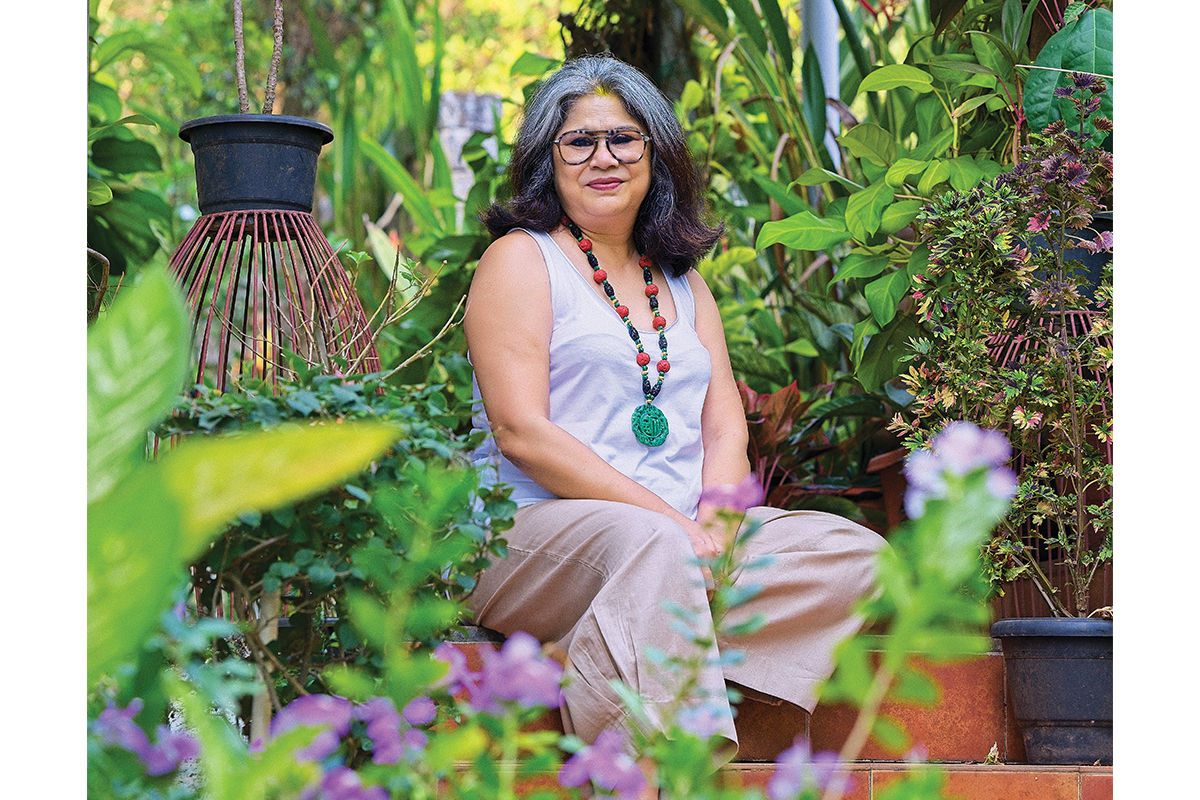
What happens when a mother chooses herself, not quietly, but unapologetically? In Mother Mine, author Sheeba Shah dares to ask a question that still unsettles society. Known for her emotionally layered storytelling, Sheeba returns with a novel that explores ambition, identity and the complicated, often unspoken tension between mothers and daughters. For WOW, she opens up about evolving as a writer, centering urban Nepali women, and why flawed women make the most honest stories.
There is something quietly radical about the way Sheeba writes women. They are not perfect, not self-sacrificing to the point of invisibility, and certainly not easy to define. With Mother Mine, her fourth novel following The Other Queen, Facing My Phantoms and Beyond the Illusions, Sheeba leans deeper into emotional complexity, while allowing something unexpected to emerge.
“For the first time, I was a bit surprised that readers are also noticing some wit and a sense of humour in my writing amidst all the intense emotions,” she says. It is a shift that feels organic rather than deliberate, a reflection of a writer growing more confident with every story she tells.
Born and raised between Kailali and Kathmandu, Sheeba’s work carries the textures of both rural and urban Nepal. Her characters are rooted, but never confined. “In all my novels, I have made sure to depict strong yet complex Nepali women,” she shares. From tracing political and personal transformations in Facing My Phantoms to exploring the psyche of an ambitious queen in The Other Queen, her narratives consistently centre women navigating layered identities.

With Mother Mine, that lens sharpens around a contemporary woman who crosses borders in pursuit of her ambitions. The story moves through Kathmandu, Mumbai and Goa, each city shaping the emotional rhythm of the narrative. Kathmandu feels insular, almost watchful. Mumbai is relentless, fast and overwhelming. Goa, by contrast, softens everything. “Life in Goa unfolds in unhurried conversations,” Sheeba says, describing a space where both her protagonist Priya and her daughter Medha begin to slow down, to breathe, and perhaps to understand each other a little better.
At the heart of the novel lies a provocative choice. Priya, a mother, steps away from the roles that have defined her for years. It is not an act of rebellion as much as it is an act of recognition. “She is a woman first and then a mother,” Sheeba says, cutting through the expectations that often flatten women into singular identities.
This decision, however, is not without consequence. Priya is judged, dismissed and even ridiculed by those closest to her. Sheeba draws a stark comparison. If a man were to leave home to chase a dream, he would likely be supported. When a woman does the same, she is questioned. Through Priya’s journey, Mother Mine exposes this imbalance with quiet clarity.
Yet, Sheeba is not interested in creating a victim. Priya is vibrant, flawed and deeply human. She laughs, sings and embraces life even as her trauma lingers beneath the surface. “Trauma does not need to be exaggerated,” Sheeba explains. “It can seep in with a glance, a gesture, a word or even a sigh.”

It is this restraint that gives her storytelling its power. Pain is not always loud. Sometimes it exists in what is left unsaid, in the distance between a mother and a daughter who are still trying to recognise each other as individuals.
Sheeba also brings attention to a less explored space in Nepali literature. While many narratives have rightly focused on rural and marginalised women, she chooses to spotlight urban, middle and upper-class women. “They too have ambitions, they too have restrictions, and they too are judged and exploited,” she says. It is a reminder that privilege does not erase struggle. It simply reshapes it.
What makes Mother Mine particularly compelling is its emotional duality. It is not just about a woman reclaiming her identity, but also about a daughter learning to accept that her mother exists beyond her. Sheeba captures this tension with striking honesty. One moment, there is conflict intense enough to feel like a battle. The next, there is intimacy, laughter and familiarity. It is a relationship that feels real because it is not simplified.
If Priya could speak directly to readers, Sheeba believes she would ask for something simple yet profound. “Understanding. Not approval, not sympathy, but the space to be seen as a whole person. A woman who has spent years fulfilling roles, and who finally chooses, even if late, to honour her own desires,” she says.
Text: Ankita Jain
Photos: Shashang Iyer