
Is changing your surname after marriage a pressure or preference for most women?
Nepal has taken steady steps towards solidifying women’s legal rights with the Muluki Civil Code of 2074 (2017). Section 81 of the Code, to an extent, legitimises women’s autonomy and reads that she can use the “surname of her father, mother, husband, or a combination thereof.” But rights are often easier for governments to pen on paper than for women to assert.

Bhawana Shah, Legal officer, Prime Law Associates
Advocate Bhawana Shah is a legal officer at Prime Law Associates in Kathmandu. She recalls the story of a woman from her village who desired to keep her maiden name after marriage. “People perceived her as arrogant, overly attached to her natal family, or unwilling to fully integrate into her husband’s household,” shares Bhawana.
Like several others, the woman lugged emotional baggage that was not hers to carry. As Lily Thapa, Founder and Strategic Advisor at Women for Human Rights (WHR) and member of the National Human Rights Commission of Nepal, explains, this “heavy pressure” stems from a “traditional belief that a wife’s identity must be defined through her husband.”
Upasana Rana, prominent activist and Executive Director at WHR, echoes the sentiment. She poignantly adds that when it comes to decisions on last names, “Women carry the question within themselves, even if they don’t always voice it openly.”
“Even today, a daughter-in-law is often expected to ‘carry the family name forward’, uphold the lineage, and agree to whatever her in-laws decide,” Bhawana emphasises.
A Question of Autonomy
Many Nepali women have gone to great lengths to push for fair rights. Activism had led to the progressive sections now seen in the Muluki Civil Code of 2074 (2017), including the enforcement of equal property rights for both sons and daughters.
Even then, the law is subtly biased. According to the Code, “If a question arises as to the surname of a married woman, except as otherwise proved, she shall be deemed to have used the surname of her husband.”
Clearly, maiden names hold more personal history. “A surname is deeply connected to a woman’s identity, history and dignity. Keeping one’s maiden name gives continuity and a sense of independence,” shares Lily.
In recent times, women have also been opting for hyphenated or compound last names for their children. For Upasana, this decision meant recognising the “reality of motherhood” and honouring both sides of her children’s identities.
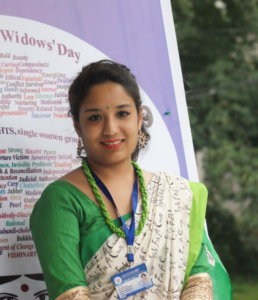
Upasana Rana, Activist, Executive Director, WHR
Upasana had a complicated pregnancy, which she recounts as being “filled with pain and struggles that only a mother can truly know.” However, the burden of proof still lies with her. “There have been situations where I’ve had to explain myself, whether at school, while travelling, or in government offices. Sometimes I have been asked to prove the obvious that I am my children’s mother. Those moments can feel deeply frustrating, as if my role and identity as a mother need external validation,” she reflects.
“Carrying that burden alone, I felt strongly that when my children were born, giving them only their father’s surname would erase the part of me that had carried them, nurtured them, and suffered for them. It would have felt unfair, not just to me, but to the truth of their story,” she shares.
A Tale of Hurdles
“The existence of a law does not automatically ensure its seamless implementation in practice; while the law has been established, society has not adapted as quickly,” notes Bhawana.
WHR’s powerful work is deeply rooted in strengthening and empowering the lives of single women. Lily recalls several cases from her experience where “mismatched surnames” caused issues with “citizenship, passports, and property papers for women or their children.”
Bhawana points out that “discrepancies” between last names have affected children’s school registrations and academic certificates.
One key reason is that the system has not caught up with the law.
“…in practice, people behind the counters in schools, banks, and offices often assume that a married woman must adopt her husband’s surname. That assumption makes the process harder than it needs to be,” Upasana explains.
Before reforms, Bhawana notes, women’s “existence” and “identity” were far more overlooked. “Many were married at a young age, and their citizenship and legal documents were automatically issued under their husband’s name and surname,” she elaborates.
For some women dependent on their spouse’s income, the question of choice may be moot. “Women who are financially independent and contribute to their household are less likely to face criticism or control, and their voices are more respected,” Bhawana reflects.
Economic and gender inequality reinforce each other.
“It sometimes feels as though their (women’s) individuality is treated like an object purchased from the market, where the complete ownership rests with the in-laws and society,” she continues.
Lily shares that, when it comes to last names, several women raise issues related to family and social norms, “yet, a large number remain silent and accept the pressure without expressing their preference.”
The Way Forward
Aligning with the Convention on the Elimination of All Forms of Discrimination Against Women, the Muluki Civil Code explicitly stipulates legal protections for women.
However, Nepal still lags in its obligations to address associated social stigma and barriers.
Like other social issues affecting women, there is also a strong need for awareness among women on the law governing last names.
“Honestly, the law already permits women to use their maiden surname, and anyone who pressures or forces them to change it is subject to legal action,” notes Bhawana. “…the focus should be on effective implementation of the existing law and on simplifying administrative processes to make it easier for women to retain their surname in practice,” she continues.
As with most patriarchal systems, societal hurdles are considerably lowered for those who agree to fall in line.
“Gender-sensitive training for local-level officials and clear legal enforcement are necessary. Culturally, the mindset that surnames belong only to men must be challenged through education and awareness,” Lily explains.

Lily Thapa, Founder and Strategic Advisor, Women for Human Rights (WHR)
The practice of taking a husband’s last name is not widespread among several communities in Nepal. Among many indigenous and ethnic communities, women traditionally retain their father’s last name, reflecting their clan and ancestral lineage.
But for many women in Nepal today, taking the husband’s family name is equated with “loyalty” and “respect”.
“Many women I know feel torn between what they want and what they are told is right,” Upasana reveals.
“If more institutions treated women’s choices as normal, and if more families encouraged it, the process would feel less burdensome,” she adds.
The normalisation of choice requires awareness, dialogue, and empowerment. According to Bhawana, these efforts support women’s confidence in asserting identity. “Building this social and cultural acceptance is, in my view, just as important – if not more so – than any legal or administrative reform,” she shares.
Upasana also encourages women to “openly share their decisions”. “It helps others feel less alone in making theirs,” she reflects.
A Matter of Choice
“Your surname is your identity; whether to keep or change it is your decision alone. Choose based on your own will, not on social pressure, as that is the path to dignity and freedom,” Lily advises thoughtfully.
Upasana’s children are now seven. “The most beautiful affirmation comes from them. When relatives or friends ask why they have two surnames, they confidently explain that it’s because their names carry the identity of both their mother and father,” she shares. “Hearing them say that makes me realise that my choice wasn’t just about me; it gave them a sense of pride, belonging and completeness in who they are,” she adds.
Bhawana believes the choice should lie in what makes women feel “confident, respected, and happy”.
“Today, it is far more common to hear women openly question and resist the expectation of changing their surname,” she reflects.
She advises weighing the legal and administrative implications of one’s decision. Bhawana’s personal choice is to retain her name as is. “This name represents my identity, and I have worked hard to establish it,” she shares.
“I would say, listen to yourself. Your name carries your history, your identity, and your sense of self. Marriage is about building something together, not erasing who you are,” Upasana notes.
“For me, keeping my surname and giving my children both surnames felt right because it honoured both parts of their heritage. Whatever decision you make, let it come from you, not from pressure,” she concludes.
Text: Satvika Khera; She is a South Asia based freelance journalist and social worker.