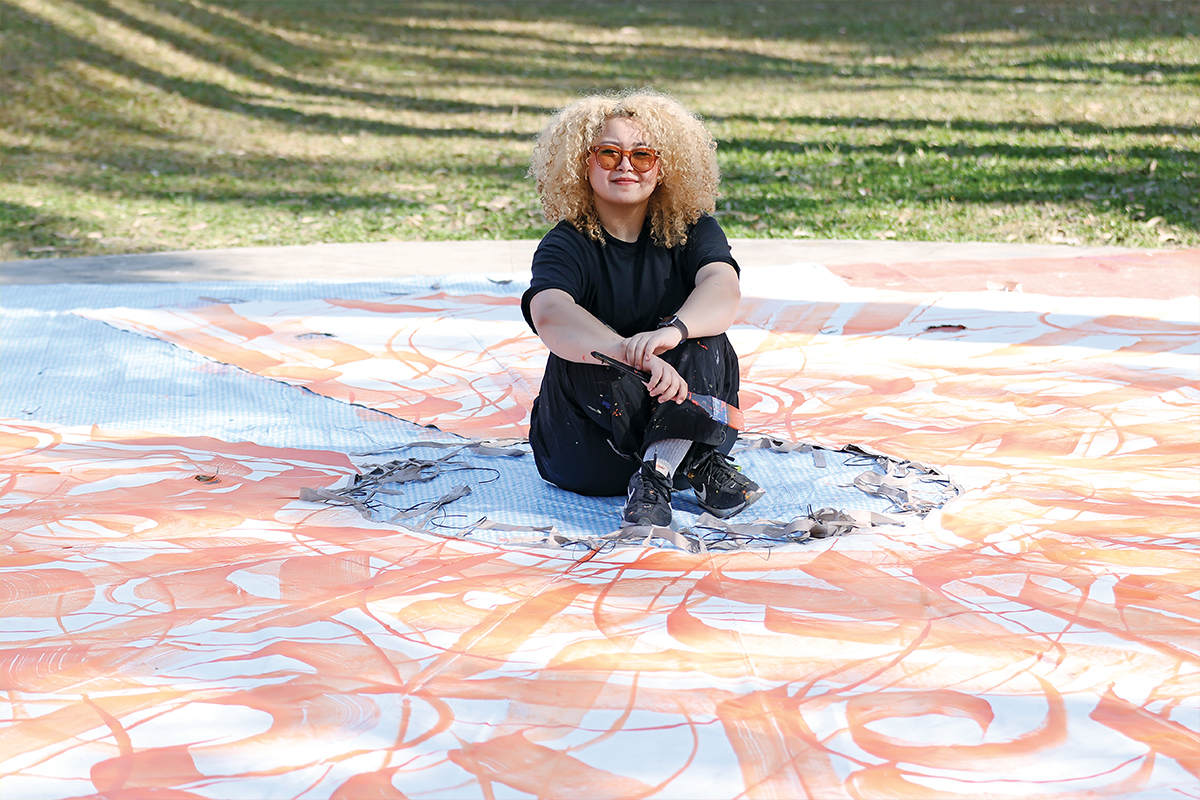

In a quiet studio practice shaped by observation and introspection, Nepali visual artist Sangee Shrestha has spent more than three decades examining the emotional landscape of human life. Working across painting, ceramics and mixed media, her practice often circles around a simple but complex question. What lies beneath the expressions people present to the world?
Her work frequently features geometric forms such as rectangles, squares and polygons that intersect, layer and fragment across surfaces. These shapes hint at emotional boundaries and hidden tensions. Faces appear and dissolve within structured forms, suggesting both presence and concealment.
For Sangee, art begins with close attention to everyday life. As she explains, “Artists absorb life deeply by observing society, listening to different voices, and translating those experiences into visual language.” The result is a body of work that draws from personal encounters, social realities and cultural memory.
Born in Lalitpur, her early years were shaped by the historic surroundings of Patan and the wider Kathmandu Valley. Growing up within the Newar community meant that art and architecture were not distant ideas but part of daily life. Temples, courtyards, carved windows and ritual spaces formed a visual language that quietly informed her imagination.
Her earliest artistic experiments were not formal. Like many children, she simply drew wherever space allowed.
Walls and floors at home became the first canvases for playful sketches. Over time that curiosity deepened into a commitment. By the time she reached college age, she had already decided that art would not remain a hobby.

She later studied Fine Arts at Lalitkala Campus under Tribhuvan University and pursued a master’s degree in Nepalese History, Culture and Archaeology. That combination of art practice and cultural study shaped the way she approaches her work today. History, tradition and contemporary social questions often intersect in her visual language.
Encounters with people remain a central source of inspiration. Sangee describes conversations and observations as part of an ongoing personal research process. “Politics, social realities, traditions and personal identity all become sources of inspiration,” she says, pointing to the layered social environment that surrounds her practice.
As a woman working in Nepal’s art scene for decades, questions of identity and agency also appear in subtle ways within her work. Through experience and reflection, she says she gradually realised that women often underestimate their own strength. “Over time I realised that women often possess more power and independence than society allows them to believe.”
While her works rarely present direct narratives, they frequently invite reflection on broader questions. Who are we as individuals? What kind of society are we building? How do we carry the cultural and spiritual inheritance passed down by earlier generations?
Spirituality enters her work not through ritual imagery but through contemplation. Mythology and religious stories become points of reflection rather than illustration. The interest lies in the lessons embedded within those narratives and the emotional questions they raise.

For Sangee, the most meaningful moments occur when a viewer forms an unexpected emotional connection with a piece. She recalls an encounter during an exhibition when a woman stood before one of her artworks and began to cry.
The moment stayed with her. It confirmed a belief she holds strongly about the purpose of creative work. Art, she feels, must reach beyond aesthetics. “At its most powerful, art should connect emotionally with viewers.”
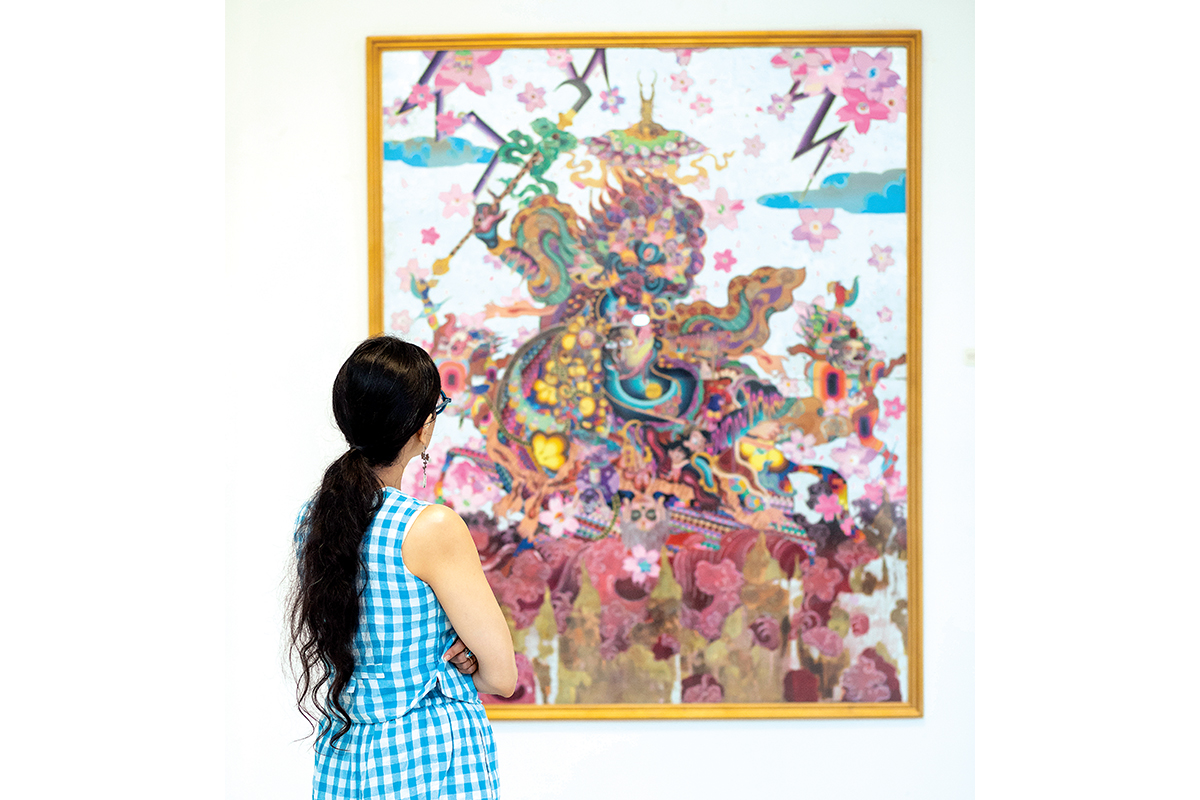
Her recent exhibition, Antardrishti: An Inner Vision, continues this exploration of emotional awareness and introspection. The exhibition brings together paintings and ceramic works that encourage viewers to pause and engage with their inner landscapes.
Interestingly, individual artworks in the show remain untitled. Sangee deliberately avoids assigning fixed meanings to each piece. “The absence of titles allows viewers to interpret the works freely,” she explains. Instead, the title Antardrishti, meaning inner vision, refers to the overall experience of the exhibition rather than to a specific work.
The approach reflects her belief that art should remain open to interpretation. Each viewer carries different memories and emotions into the gallery space, and the artwork becomes a mirror for those inner reflections. “Spending time with art can untangle emotional knots that people carry within themselves.”
Some works in the exhibition also stem from deeply personal experiences, including the loss of her mother. The process of painting and sculpting became a way to confront grief and gradually transform it into something tangible.
Geometry continues to play a central role in her visual vocabulary. Rectangular structures and polygonal shapes repeat across canvases, sometimes forming fragmented faces or abstract figures.
The shapes can appear rigid at first glance, yet they often float against soft colour fields reminiscent of mist, distant horizons or the fading light of sunrise.
The contrast creates a quiet tension between structure and vulnerability. It mirrors the emotional layers that people carry beneath controlled outward appearances.
Alongside painting, ceramics forms another significant dimension of her practice. Using hand building techniques and natural clay, Sangee creates sculptural forms that emphasise touch and patience. “The physical process of working with clay can be deeply meditative and healing,” she says. The act of shaping earth by hand introduces a slower rhythm that contrasts with the conceptual intensity of painting.

Looking back at the early years of her career, she remembers a time when pursuing art in Nepal was rarely seen as a sustainable profession. Creative work was often dismissed as a passion rather than a livelihood. Building a long-term practice required persistence.
Yet she remained committed to the discipline, continuing to experiment, exhibit and participate in workshops in Nepal and abroad. Over the years that dedication has led to participation in more than 300 exhibitions and artistic events.
For young artists entering the field today, her advice centres on discipline and honesty. Recognition may take time, she says, but commitment to the work itself must remain constant. “Artists must learn to critique their own work, stay focused on their purpose, and continue creating even when recognition or financial stability feels uncertain.”
It is a practical perspective shaped by decades of practice rather than romantic ideas about art. For Sangee, creativity is not a moment of inspiration but a lifelong process of questioning, observing and making. And perhaps that is where her work ultimately returns. To the quiet act of looking inward, and inviting others to do the same.