
In an education culture that often rewards memorisation over curiosity, Krish Yadav is asking uncomfortable but necessary questions. The 18-year-old creator, researcher and media host believes that the most important skill young people in Nepal can develop is the ability to think critically.
Recognised as the Glocal Teen Hero 2025, an initiative by Glocal, Krish represents a growing group of young voices attempting to shift how conversations around learning, society and public discourse unfold. Through his work with The Nepali Comment, he produces debates, documentaries and youth focused research that encourage audiences not just to consume information but to question it.
For Krish, the motivation behind his work stems from a simple observation about the way knowledge is often treated in Nepal. “I often reflect on what I see as a cultural flaw in our society,” he says. “The way we are taught not to question our elders.” While respect for elders remains a deeply rooted value, Krish believes it has unintentionally shaped classrooms and public discourse in ways that discourage critical thinking.
“I believe respect and critical inquiry are not mutually exclusive,” he explains. “Yet this mindset extends into our education system and beyond, creating an environment where disagreement and questioning are subtly discouraged.”
That concern is what led him to begin examining education more closely through his independent research initiative, Project Bibek. The project surveyed more than 480 students across 14 schools to understand how young learners perceive education, opportunity and the future. The findings were revealing. “Apart from completing homework, most students study only right before exams,” Krish says.
The pattern highlights a deeper issue within the structure of assessment. If students can succeed academically through short bursts of memorisation, the system may be rewarding recall rather than intellectual engagement. “It is clearly time to reevaluate the questions themselves,” he adds, pointing to how exam patterns influence learning behaviour.
Krish encountered another surprising insight during the survey. Nearly 70 % of the students he interviewed did not know their family’s income. For him, the statistic reflects more than just a gap in financial awareness. It hints at how disconnected many students remain from the realities that shape their own lives and futures.
Even more striking was another response within the research. When students were asked whether they believed they could achieve the life they wanted while staying in Nepal, only 14 % said yes. “These findings reveal both gaps in the education system and a pervasive sense of pessimism among students,” Krish says.
For a country where the majority of the population is young, that sense of uncertainty raises important questions about how schools nurture ambition and confidence. Krish believes the problem goes beyond individual institutions. It reflects a wider cultural relationship with knowledge and intellectual inquiry.
“Interestingly, the current generation in Nepal is the first in which almost everyone receives formal education,” he explains.
Historically, intellectual traditions in many societies developed over centuries as access to education expanded. In Nepal, that process is still unfolding. “Many of the ideas about discourse and the value of intellect that prosperous civilisations cultivated centuries ago are now within our reach,” Krish says.
For him, the internet has accelerated that transition. The vast availability of knowledge online has democratised access to ideas that were once confined to academic spaces. His own path into media reflects this influence. During the Covid lockdown, he began experimenting with YouTube content, launching a channel called Science with Krish where he explained topics such as relativity and electromagnetism.
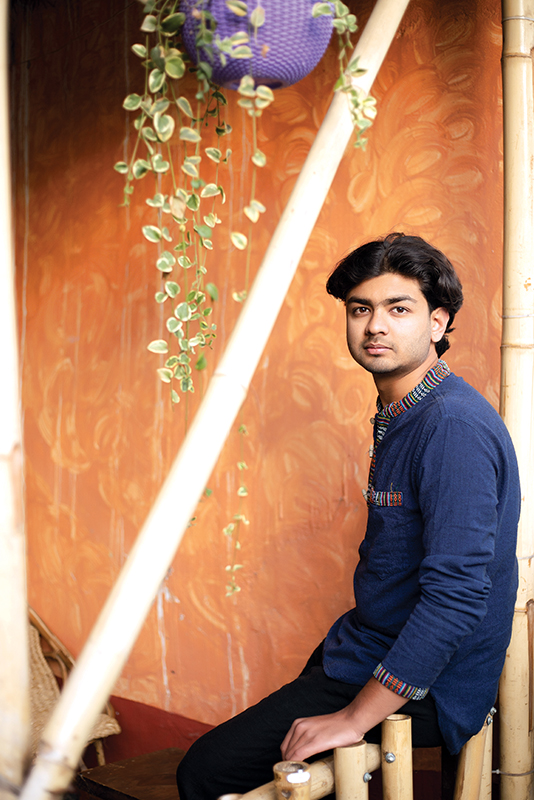
“There is a long running joke that every guy goes through a phase where he wants to become a YouTuber,” he says with a smile. “I definitely had mine during the Covid lockdown.” Inspired by educational creators such as VSauce, Veritasium, 3Blue1Brown and Numberphile, Krish initially focused on science communication. Over time, however, his curiosity moved beyond physics and mathematics towards social questions.
“These days, if you ask me what I want to do, I will probably just say, “I want to understand society.” That curiosity eventually found its outlet at The Nepali Comment, a platform known for long form socio political documentaries and debate driven programmes that explore contemporary issues in Nepal. For Krish, the challenge of producing such content lies in balancing accessibility with depth. Simplifying ideas too much risks distorting them, yet complex discussions must still remain engaging for audiences online.
“Sometimes you just give your audience the ‘4’, sometimes you give them ‘2 and 2’ and leave it to them to make 4 out of it,” he explains. The philosophy reflects his belief that content should invite thinking rather than dictate conclusions.
One example of this approach is TNC Debates, a show designed to present multiple perspectives on contentious issues. Instead of offering definitive answers, the format creates space for dialogue and disagreement. “The idea there is to get people talking,” Krish says. “Personally, I love seeing people engage in the comments, whether they agree or disagree.”
For a young creator whose work now reaches large audiences, that engagement also carries responsibility. At The Nepali Comment, discussions about bias form an important part of the editorial process. “At The Nepali Comment, we talk a lot about biases,” he says
Recognising personal assumptions is the first step towards producing fair and balanced content. For Krish, this awareness is particularly important given his age and evolving perspective. “At this stage of life, both my knowledge and experience are limited,” he says. “So, identifying rigidly with any set of beliefs does not make sense to me.”
Instead, he actively challenges his own viewpoints and seeks perspectives outside his intellectual comfort zone. “I make it a point to challenge and deconstruct each of my ideas so that I do not get trapped in a bubble of my own making.”
Alongside media work, Krish also helps organise national level academic Olympiads in Nepal, which he describes as the intellectual equivalent of sporting competitions. The initiative identifies talented students and prepares them to represent Nepal at international events. Yet participation often comes with financial challenges.
“Participants often struggle to fund their journey, unlike their peers abroad,” he notes. Despite such obstacles, Krish believes the effort is worthwhile. Encouraging intellectual curiosity among young people, he says, is one of the most meaningful investments a society can make.
Ultimately, his message to students and young creators remains simple. “Read more, experience more.” For Krish, the purpose of media, research and dialogue is not to provide final answers. It is to provoke thought.
Text: Kreenjala Pyakurel
Photo: Sanjay Maharjan