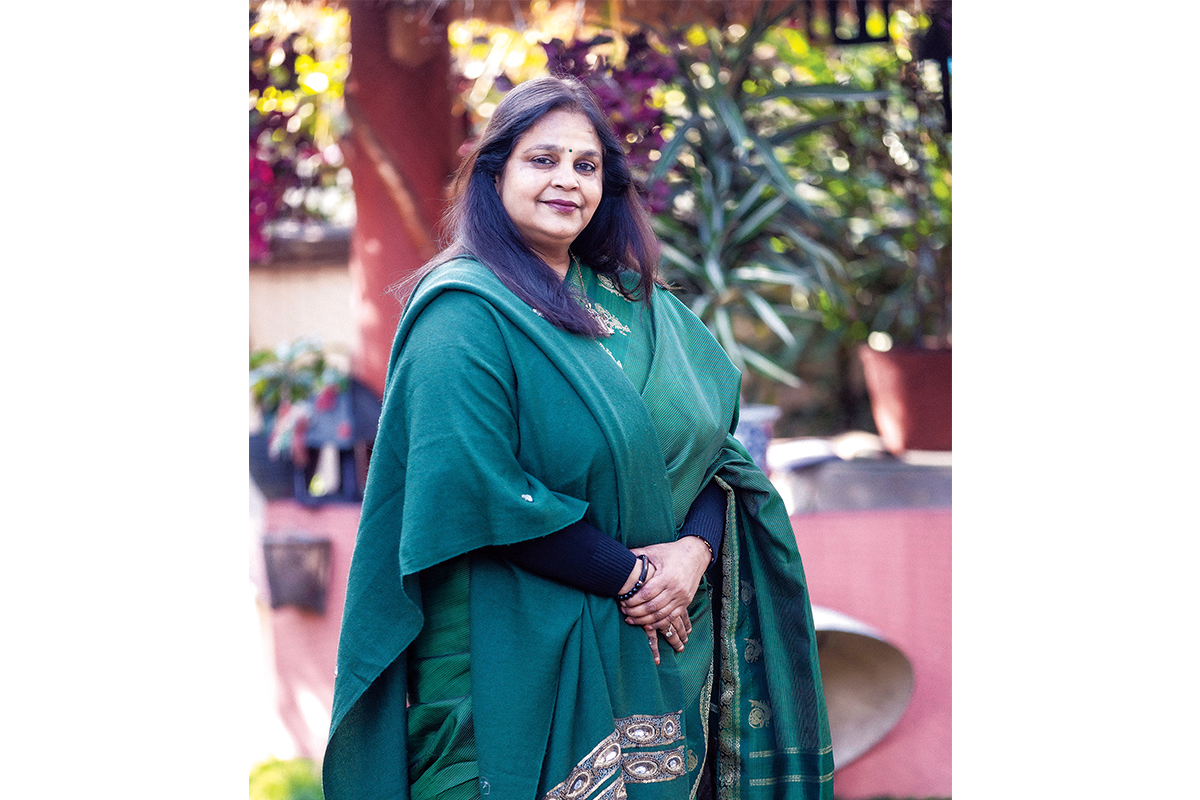
REKHA KHETAN
In a world that often equates leadership with volume, loud declarations, quick wins and constant visibility, Rekha Khetan believes in something quieter, and far more lasting: commitment, continuity and care.
As the current President of Marwari Mahila Manch, one of Kathmandu’s oldest and most respected women-led organisations, Rekha’s leadership is rooted in lived experience. She is not stepping into the role as an outsider with a new agenda, she has been part of the organisation for over two decades, watching it grow, adapt and serve, while remaining deeply anchored to its founding purpose. “This organisation raised me as much as I helped build it,” she says with humility.
Founded to uplift women and strengthen community bonds, Marwari Mahila Manch has long been recognised for its consistent social work, particularly its annual sponsorship of children’s education. For Rekha, this continuity matters just as much as innovation. “Service has always been at the heart of what we do,” she says. “That cannot change.”
When Culture Becomes a Celebration
Under Rekha’s leadership, the organisation has witnessed a renewed cultural energy, most visibly through the Saree Premier League, a one-of-a-kind event that placed Marwari women centre stage, celebrating femininity, talent and tradition with pride and joy.
“When we celebrate femininity and talent through the Saree Premier League, we are not merely talking about fashion,” Rekha explains. “We are celebrating the strength of women, their confidence, and their creativity.” The event was never about competition or perfection. It was about reconnection. About rediscovering a cultural language that many women had slowly drifted away from. “Beauty exists in every form – whether it is jeans and a t-shirt, a gown, or the traditional saree,” she says. “Yet the saree carries a distinct grace and a story of its own which is what makes it truly special.”
For many participants, the Saree Premier League marked the first time in years that they had draped a saree not out of obligation but out of choice. The atmosphere is emotional, celebratory and deeply affirming. “That is why I chose the saree,” Rekha adds. “Because the femininity, confidence and expressive power that resides within every woman can be portrayed most beautifully through it.” In an era dominated by fast fashion and fleeting trends, Rekha’s approach reframes tradition not as nostalgia but as empowerment.
Reviving Rajasthani Heritage, Meaningfully
Rekha’s vision for her tenure is clear. She wants to bring the richness of Rajasthani culture back into the spotlight while ensuring it remains inclusive, relevant and alive. One of her key goals is to celebrate Gangaur, one of the most significant festivals in Rajasthani culture on a much larger scale as part of Rajasthan Mahotsav. “We want to celebrate Gangaur with the pride it deserves,” she says. “I am also planning to have a huge Ghoomar dance during the Mahotsav.”
For Rekha, these cultural moments are not performances. They are bridges between generations, allowing younger women to experience traditions they may only know through stories, while giving older women a renewed sense of belonging and pride. “Culture should be lived,” she says firmly. “Not archived.”

Leadership That Looks Beyond Boundaries
While Rekha is deeply invested in highlighting Marwari identity, she is equally clear that service must extend beyond community lines. “I want to highlight the culture of the Marwari community and also serve the larger Nepali society we live in,” she says.
One of her most ambitious initiatives focuses on healthcare access in Nepal’s remote areas. During her tenure, Rekha aims to prioritise breast cancer awareness programmes along with facilitating free treatment for women who need it. “As women, we often put ourselves last,” she reflects. “Awareness can save lives. Early support can change futures.”
For Rekha, compassion must translate into action. Impact must be tangible. Health, she believes, should never be a privilege.
The Reality of Leading as a Woman
Heading a large community organisation is not without its challenges, especially as a woman. “At time, it does get challenging to make yourself heard,” Rekha admits candidly. “But it is not impossible.”
Her leadership style is firm yet empathetic. She listens closely, but she does not hesitate to act. Years of involvement have given her both credibility and confidence, allowing her to lead with quiet authority rather than confrontation.
Strengthening Families From Within
Beyond culture and healthcare, Rekha is also addressing an issue often discussed in hushed tones, family stability. “I am working towards reducing divorce rates in the community, as far as it can be sorted through counselling,” she says.
Her approach is rooted in dialogue, not judgement. By encouraging counselling and open communication, Rekha hopes to create safe spaces where problems can be addressed before relationships reach breaking point. “Not every issue has to end in separation,” she adds gently. “Sometimes people just need guidance and understanding.” For her, strengthening families is inseparable from strengthening society.
“We must not only educate our sons and daughters,” Rekha emphasises, “but also teach them the values of culture, balance and responsibility. At the same time, the upbringing of children should not be seen as a burden but as a duty we willingly embrace.”