Power in South Asia has rarely been neutral terrain for women. Even when women rise to the highest offices, their authority is often examined through a different lens. Their decisions are scrutinised alongside their appearance, their tone of voice, even the way they walk into a room.
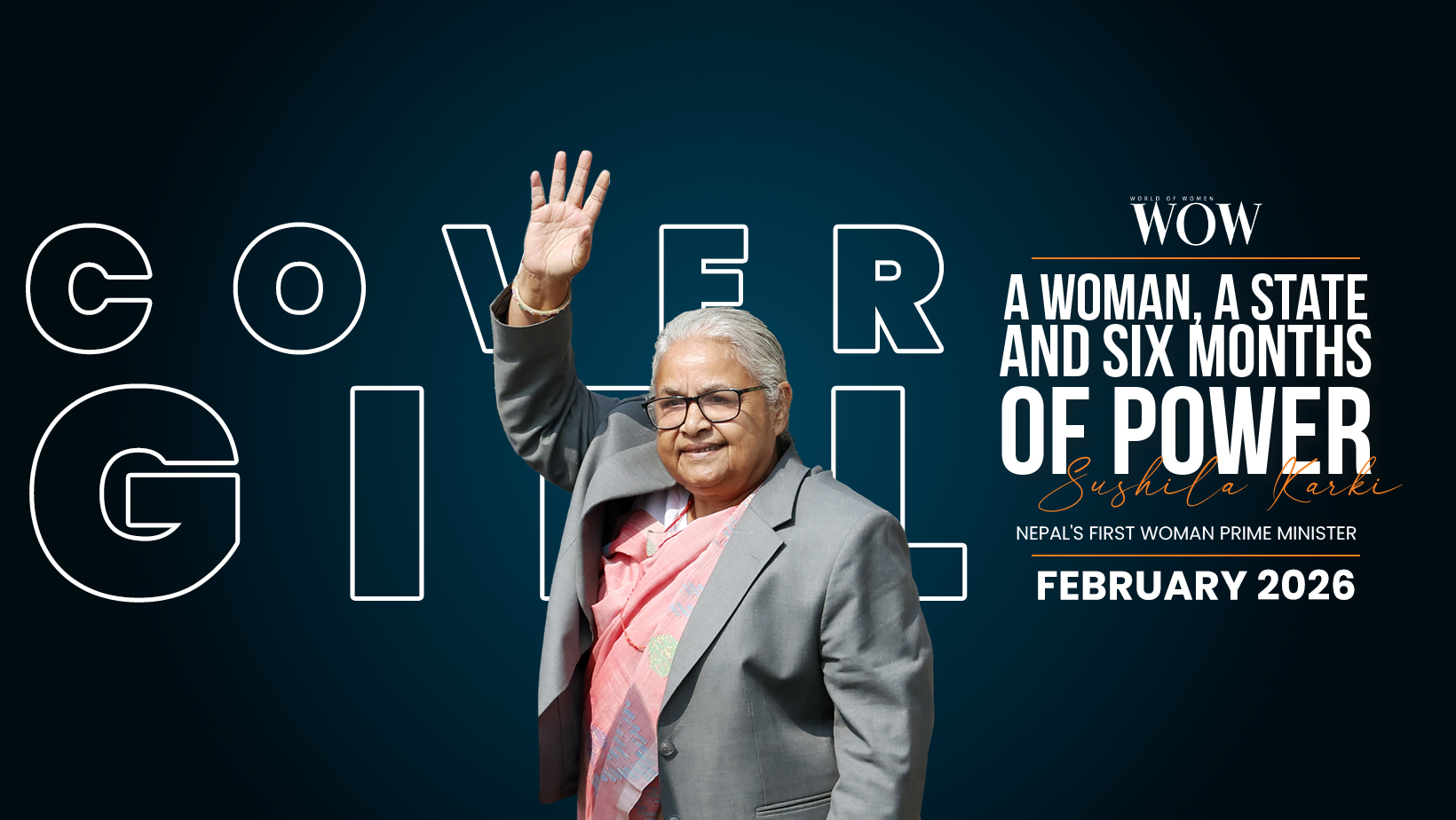
For Sushila Karki, 73, Nepal’s first woman Prime Minister, that scrutiny was immediate. Her appointment did not come through a political campaign or years of party leadership. It arrived during a moment of national crisis, when the Gen Z protests had shaken public confidence in Nepal’s political establishment and the country needed a transitional government to take charge, restore peace and conduct elections. For six months, Sushila found herself at the centre of that storm.
The former Chief Justice had spent most of her life in courtrooms, not campaign rallies. Yet in a country struggling to stabilise itself, the judiciary’s most recognisable female figure became an unexpected political anchor.
Across Nepal, many people call her Aama, a word that carries the warmth of affection and the weight of expectation. “I have carried out my duties with a deep sense of responsibility towards my motherland,” Sushila says in an exclusive email interview with WOW magazine. “This was not achieved by me alone. It became possible through the collective effort of my Cabinet, the Secretariat, the Election Commission, the security agencies, civil servants and the unity and support of the Nepali people.” The statement reflects a pattern that has defined her public life. Sushila rarely centres herself in the narrative of power. Instead, she frames leadership as responsibility.
Entering rooms that were never designed for women
Long before she entered politics, Sushila had already spent decades navigating institutions that were not built with women in mind. Nepal’s legal and political structures, like many across South Asia, have historically been dominated by men. When Sushila rose through the judiciary, she did so in an environment where women rarely occupied positions of authority. Her appointment as Nepal’s first female Chief Justice was historic. But it also revealed how fragile institutional acceptance could be.
She spent a long period serving as Acting Chief Justice before being formally confirmed. Even after reaching the highest judicial office, she faced an impeachment motion. “I was kept as Acting Chief Justice for a long time instead of being formally appointed Chief Justice,” she recalls. “Even after becoming Chief Justice, an impeachment motion was filed against me.” For many women in power, such moments are familiar. Progress often arrives with resistance. Sushila does not frame these experiences as personal battles, but they shaped her understanding of authority and accountability.
“Integrity and sincerity are a person’s greatest strengths,” she says. “Moral courage is the greatest power of all.”
The protest that made her PM
The chain of events that eventually led to Sushila becoming Prime Minister began far from the corridors of government. She had gone to a hospital to visit young protesters injured during the Gen Z movement, a youth led wave of demonstrations that exposed deep frustration with corruption, unemployment and political inertia.
Witnessing the injuries and listening to the voices of young people compelled her to speak publicly against the government of the time. Her statement instantly became a national headline. What began as a moral response from a retired judge quickly became a political moment. As the crisis deepened and the possibility of elections became uncertain, Sushila’s name emerged as a figure capable of leading a transitional government. Even she had not imagined it. “I have always said that I never had the desire to govern,” she says. “But the injustice inflicted upon those young children and the grave situation the country was facing made my conscience tell me that I could not step away from responsibility.” It was less ambition than obligation that pushed her into office.
Power under a microscope
When Sushila Karki became Prime Minister, she entered one of the most politically sensitive moments Nepal had experienced in years. Her government had only six months to stabilise the country and conduct elections.
The pressure was immediate and intense. “There were many challenges when we took leadership,” she says. “Even I wondered whether we would be able to accomplish the task.”
Political parties resisted the transitional government. Some factions of the Gen Z movement accused it of taking over their cause. International observers quietly questioned whether the administration could survive long enough to organise elections. “There was no large organisation or strong support base behind us,” she explains. “Only a handful of people formed the government.” But perhaps the most revealing pressure came in subtler forms.
As Nepal’s first woman Prime Minister, Sushila found that public commentary often extended beyond politics. “People criticised my clothes, my bangles, even the way I walked,” she says. The remark captures a familiar dynamic faced by women leaders around the world. Authority is frequently filtered through gendered expectations.
Sushila chose not to respond publicly. “I heard such things through one ear and let them pass through the other,” she says. “I did not stop working.”
The discipline of leadership
Despite the constant political noise, Sushila approached her role with the same methodical discipline that defined her years in the judiciary. Her schedule was relentless. “Sometimes I held as many as 14 meetings in a single day,” she recalls. “On several occasions we worked until two or three in the morning.” The central objective remained clear: ensure a peaceful election.
During early preparations, she delivered a simple instruction to the country’s security agencies. Not a single drop of blood should be shed. The message reflected both moral conviction and political calculation. After months of protests, any election violence could have further destabilised the country. “When one pursues a goal with unwavering commitment,” she says, “the necessary environment and support gradually begin to take shape.”
Listening to a new generation
For Sushila, the Gen Z movement was not merely a political crisis. It was a signal of generational transformation. “Nepal is a country of young people,” she says. “The nation must now move forward through the vision and energy of its youth.”
Yet she acknowledges that the generational divide is real. “Those of us who learned our alphabets with a simple reed pen cannot fully grasp the emotions, pace and momentum of a generation that has grown up with smartphones from birth.”
The youth movement itself eventually fractured into numerous groups with competing demands. Some called for structural constitutional changes. Others proposed new models of executive leadership. “We were caught in the middle of all these pressures,” she says. The election results later revealed a dramatic shift in Nepal’s political landscape. New parties gained strong support, while older political structures appeared weakened. Sushila views the outcome as an expression of generational change. “The results reflect the voice of the youth and the impact of the Gen Z movement. It is also a sign of the desire for change.”
Women in Politics
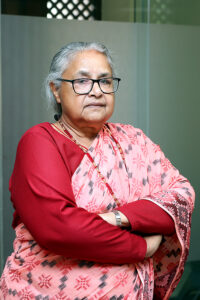
In Nepal’s legal and political systems, where decision making spaces have long been male dominated, women often encounter additional scrutiny and expectations. Sushila’s answer is not to retreat from those spaces but to expand them.
“Women must continue to strengthen their capabilities,” she says. “They should never stop striving or asserting their rightful place.”
For meaningful change, she believes structural reform is also necessary. One possibility, she suggests, would be creating mechanisms within the electoral system that encourage more women to contest and win parliamentary seats. “To increase women’s representation in Parliament, certain seats within the direct election system could also be reserved for competition exclusively among women candidates.”
Her perspective reflects a broader understanding of how representation works. Visibility alone is not enough. Women must be present where laws are written, where policies are negotiated and where institutions are shaped.
After decades in the judiciary and a brief but consequential chapter in politics, Sushila remains convinced that Nepal’s democratic institutions will become stronger only when women participate in them fully. Not as exceptions, but as equals.
A different relationship with power
Colleagues often describe Sushila’s lifestyle as austere. Her approach to power reflects a similar philosophy. “If one is free from personal ambition and self-interest,” she says, “great wealth, power and position are not necessary.”
For her, leadership is not an identity but a responsibility. “One does not need to hold office to do good work. Wherever we are placed, we must fulfil our duties with sincerity within our sphere.” This perspective distinguishes her from many political figures who build entire careers around holding office. “Unnecessary attachment to power, wealth and position corrupts individuals,” she adds. “It becomes a source of arrogance and despair.”
The woman behind the office
While Sushila’s public life has unfolded in courtrooms and government buildings, her private life has remained remarkably understated. During her tenure, her husband Durga Subedi became Nepal’s first First Gentleman. Yet he has largely stayed away from public attention. Durga lives quietly and has never shown interest in political visibility.
Their relationship itself began with an unconventional decision. It was Sushila who proposed marriage. Durga initially hesitated, believing he was not prepared for family life. After many conversations, he agreed. They married despite resistance from both families. The morning after the wedding, Sushila returned to court to argue cases. Durga, a former Nepali Congress youth leader, managed the household.
For decades, that quiet arrangement has remained unchanged. While she built a public career, he stood firmly behind her decisions, himself a political activist and author.
Moments that stayed
with her
Even someone accustomed to institutional battles can be shaken by human grief. For Sushila, the most difficult moment of her premiership came when the families of those who had died during the Gen Z protests came to Baluwatar. “They cried before me,” she says. “It felt as though I might suffer a heart attack.” For a leader often described as highly composed, the encounter revealed a different dimension of grief and responsibility. She says softly, “that was especially painful.”
Beyond the office
With the election successfully completed, Sushila sees her role as done. The responsibility now passes to the next government, which must address the deeper issues behind the protests. “The main demands were good governance, control of corruption and employment opportunities,” she says.
Nepal’s economic challenges remain urgent, particularly for young people seeking opportunities at home. “The economic situation must improve and corruption must be controlled.”
She also believes reform within the country’s bureaucracy is essential. “I have seen that many of the biggest problems originate inside Singha Durbar,” she says. “Decision making is often unnecessarily delayed.” Without institutional reform, she warns, progress will remain difficult.
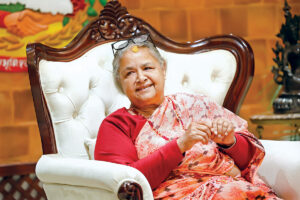
Leaving power behind
Unlike many political leaders, Sushila speaks about leaving office without hesitation.
“I have completed the responsibility entrusted to me during a difficult period,” she says. “Now I will return to my ordinary private life.” Speculation about future roles, including the presidency, does not interest her. “I have no such ambition.”
Instead, she returns to a sentiment that has guided much of her public life: a quiet commitment to the country she has served. “When such a beautiful country as Nepal exists,” she says, “why would one wish to go anywhere else?”
For Sushila Karki, leadership was never about occupying the centre of power. It was about stepping into it when the moment demanded it. And stepping away when the task was done.
Text: Ankita Jain
Photos: Keshav Thapa/ PM Secretariat