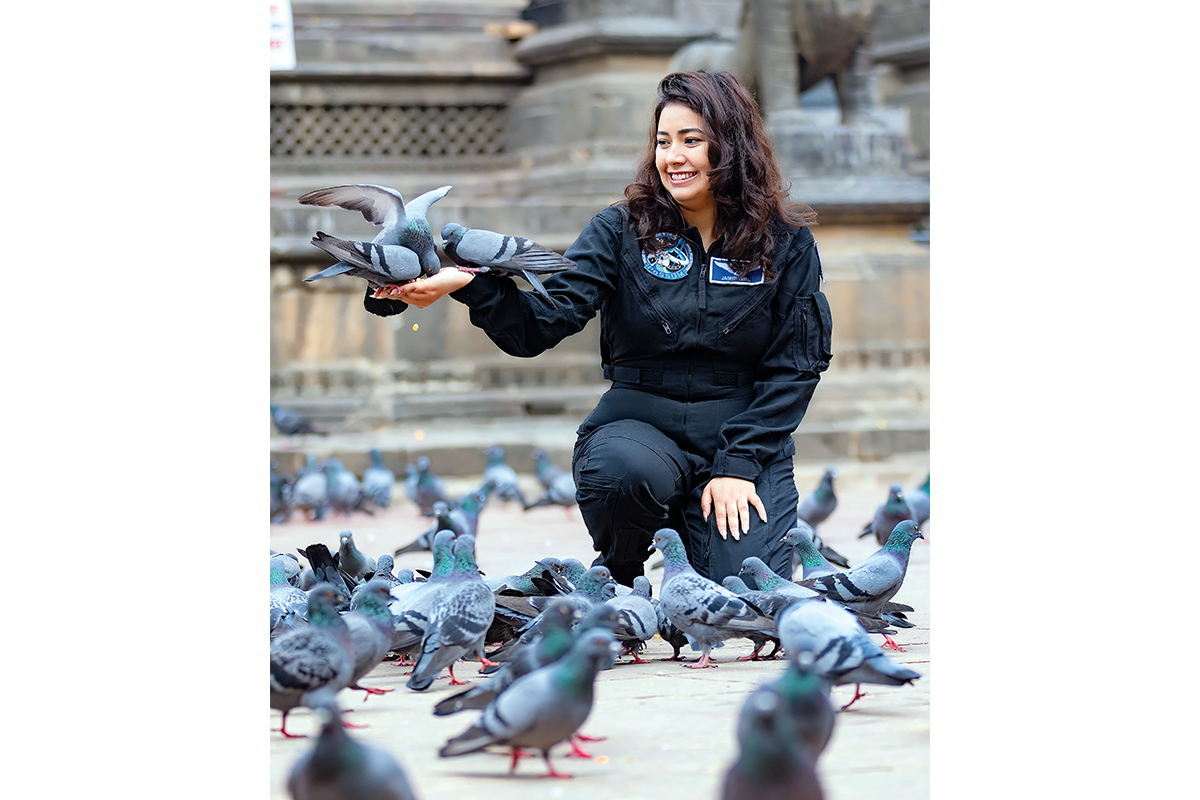
In a world obsessed with altitude, Jagriti Luitel’s work is rooted in something quieter: grounding. At just 23, the Nepal-born aerospace innovator approaches space not as an escape, but as a responsibility. Now based in Canada, she moves between continents, disciplines and orbits with a clarity of purpose that feels quietly radical. Her work in aerospace innovation and human spaceflight research is inseparable from questions of equity, memory and Earth itself. This is not a story about reaching for the stars, but about returning to what matters below.
Before aerospace became a profession, it was a way of paying attention. Growing up in Nepal, Jagriti learned early that scarcity sharpens perception. “When resources were limited, imagination had to do the heavy lifting,” she says. Curiosity was something precious, even vulnerable, in an environment where ambition often required restraint. Yet she protected it fiercely. Meaning always came first; understanding why something mattered before thinking about how far it could go.
Her first encounter with space was accidental. At seven, playing outside her home, she saw a rocket cut across the night sky. “It emotionally moved me,” she recalls. “Like proof that human imagination could take physical form.” Soon after, an encyclopedia image of an astronaut floating freely against Earth lodged itself in her consciousness. Space shifted from spectacle to something intimate. She filled notebooks with questions, challenged her teachers, watched Cosmos and moon-landing documentaries, and stargazed every night before dinner. What sustained this curiosity was belief at home. “My parents took my curiosity extremely seriously. That gave me permission to take myself seriously too.”
That seriousness was tested in 2015. The 7.8 magnitude earthquake that struck Nepal changed her understanding of stability and scale. “April 25 is etched into my body,” she says. Fear lingered long after the ground stopped shaking. Her family slept outdoors, uncertain if their home would still be standing by morning. The sky became the only constant. “I remember looking at the stars and thinking, you are so small. That thought didn’t diminish me. It grounded me.”
Years later, working across North America’s space sector – at the Canadian Space Agency, within Wyvern’s hyperspectral satellite startup, at the MIT-affiliated Aurelia Institute, and in space policy with Space Canada – that memory resurfaced with new clarity. Satellite imagery could assess damage, guide rescue teams and restore communication. Space was no longer abstract. “Technology is not neutral,” she says. “It either reaches people when they need it most, or it doesn’t.” The earthquake transformed fascination into commitment. Space became a tool for Earth.
Her career already includes moments that invite awe: training as a citizen-scientist astronaut candidate, completing a zero-gravity research flight that carried Nepali identity into microgravity, and leading a 103,000-foot high-altitude balloon mission for climate research and public engagement. Yet she speaks most candidly about the internal work behind these milestones. “The most transformative work I have done hasn’t been in outer space. It’s been in inner space,” she says. Entering a male-dominated field as a young immigrant woman required psychological resilience alongside technical skill. Therapy, journaling and movement became essential. External recognition followed but alignment came first.
Living between Nepal and Canada has created a sense of in-betweenness that she no longer resists. “I don’t try to resolve the tension. I inhabit it,” she says. Moving between the Global South and Global North, Earth and orbit, analytical and intuitive thinking has become her strength. Identity, for her, is not hierarchical but conversational, a dialogue she carries daily.
That dialogue was present in microgravity. Floating weightless, carrying a rhododendron as a symbol of home, memory took on gravity. She thought of the women who came before her: a great-grandmother married at seven, a grandmother who lost six of her nine children to poverty and illness. “Their lives were shaped by constraints rather than choice,” she reflects. In that moment, weightlessness carried responsibility. Opportunity felt inherited.
Today, even at 23, her focus increasingly turns back to Nepal. Advising SEDS-Nepal, supporting the United Nations Office for Outer Space Affairs Space4Women initiative, and mentoring young people – especially girls – she works to make possibility visible. “You can’t become what you can’t see,” she says. The aim is not to manufacture ambition but to expand what feels imaginable. To loosen the quiet pressure to conform. To stop engineering smallness into life.
When she thinks about legacy, it isn’t framed by missions or milestones. “I think about making my eight-year-old self and my eighty-year-old self proud,” she says. Staying curious. Staying awake. If others feel inspired, it is a by-product, not the goal. “If someone comes away less impressed by what I have done and more curious about themselves, then I have done what I came here to do.”
In many ways, it aligns with her name. Jagriti. Awakening. Not upwards alone, but inward, and always back toward Earth.
Text: Ankita Jain
Photo: Ripesh Maharjan