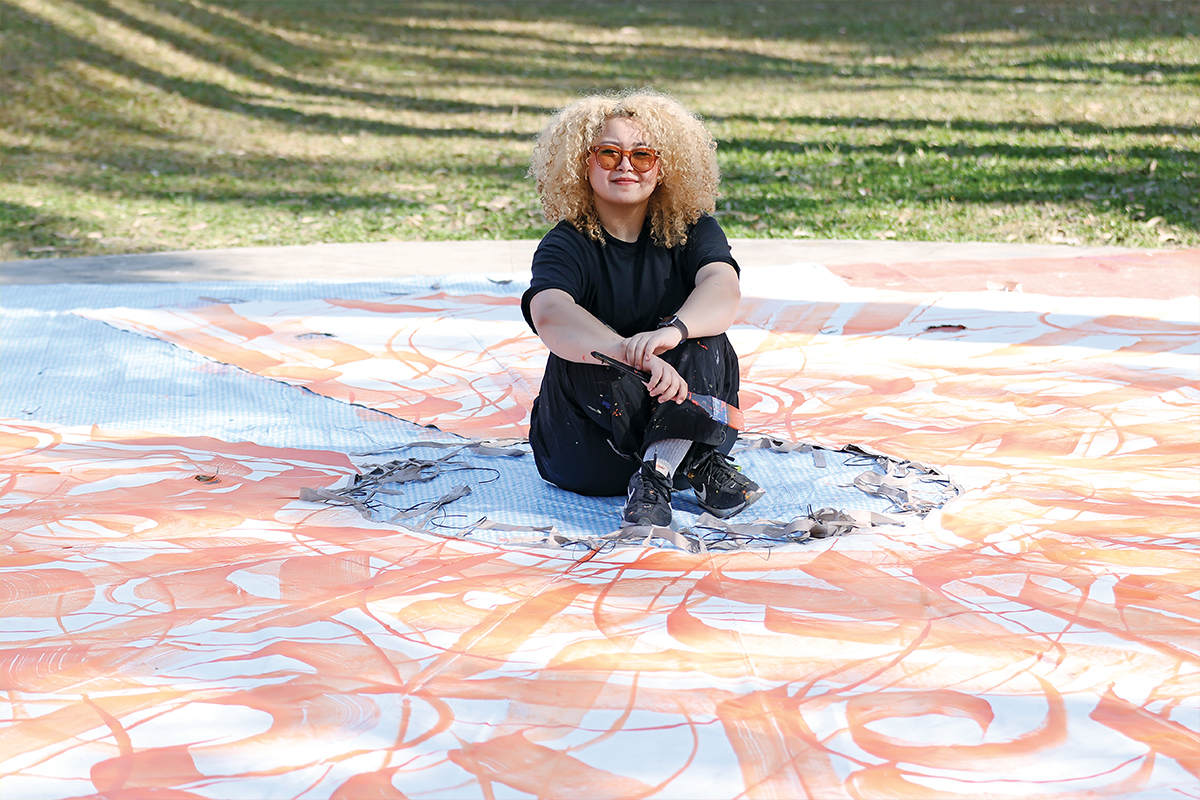
Sneha Shrestha, also known as IMAGINE, is a Nepali artist whose work moves between languages, geographies and modes of making. Rooted in the Devanagari script and shaped by the visual language of graffiti, her practice reflects a life lived between Kathmandu and the United States, and a deep interest in how memory, ritual and community travel across time and place.
Her distinctive style emerged from reconciling two visual worlds that shaped her at different moments in life. Devanagari was the script she grew up reading and writing in Kathmandu, embedded in everyday rituals and cultural memory. After immigrating to the United States, graffiti became a way for her to claim space and visibility in public realms. She says, “Bringing these two languages together felt instinctive; less a deliberate fusion than a natural response to lived experience.” Through this synthesis, Sneha bridges tradition and street culture, allowing ancestral forms to exist within contemporary urban contexts.
Themes of memory, ritual and immigration run consistently through her work.
“Living in the diaspora sharpened my awareness of how cultural practices are carried forward; sometimes preserved, sometimes adapted, and sometimes improvised in new environments,” says Sneha. This ongoing negotiation between continuity and change finds powerful expression in The Travelling Chautaris: Spaces for Reflection and Conversation, a collaborative project that reimagines the traditional Nepali chautari as a mobile, contemporary space.
Traditionally, chautaris are resting places beneath trees where travellers pause, gather and exchange stories. In this project, that communal structure is transformed into itinerant architectural sculptures that invite rest, dialogue and reflection. As Sneha puts it, “The chautaris reflect my interest in how shared spaces can hold memory while making room for new conversations, particularly across cultures and borders.”
The project emerged through an international collaboration led by the T.NUA Collective, an artist-led and self-funded initiative dedicated to interdisciplinary and community-centred projects. The collaboration began when Italian artist Namsal Siedlecki introduced T.NUA to Sangeeta Thapa, founder of Siddhartha Arts Foundation, following their interest in developing a project in Nepal.
From there, the network expanded organically. ABARI Studio and its Founder, Nripal Adhikary, joined the project, bringing architectural expertise rooted in sustainable, vernacular practices. Sneha was invited following a recommendation from curator and art adviser Lindsay Aveilhé, whose familiarity with her work aligned with the project’s vision.
Two chautari-inspired pavilions were created: a larger ten-metre structure that will travel across Nepal, including Kathmandu, and a smaller seven-metre pavilion that will travel to Milan, Italy.
Crafted from bamboo by ABARI Studio, the structures reflect deep knowledge of local materials, sustainability and traditional building techniques. Suspended within the bamboo trusses are Sneha’s painted works, rendered in her signature visual language inspired by the Devanagari script and sacred architectural motifs. “Together, the architecture and paintings create a contemplative environment centred on mindfulness, continuity and collective presence,” says the T.NUA Collective.
As the chautaris move between locations, they are designed to connect with each community in distinct ways. In collaboration with Siddhartha Arts Foundation, the pavilion in Nepal will be activated throughout the year with talks, workshops, lectures and informal gatherings. Programming in Italy will follow, responding to local contexts and audiences. The T.NUA Collective adds, “While the impact of each iteration may differ, the intention remains constant: to offer an open, welcoming space where anyone can pause, participate or simply be.”
This sensitivity to place and audience is central to Sneha’s broader practice. Having created murals and installations in cities around the world, she understands how meaning shifts depending on context. She reflects, “In public spaces, my work is often encountered unexpectedly, prompting instinctive reactions of movement, gathering or quiet reflection.” Sneha further adds, “In museums and galleries, engagement tends to be more contextual, guided by architecture, text and cultural references.” Both experiences are equally important to her, revealing how art lives differently depending on where and how it is encountered.
Sneha navigates institutional and public art with distinct considerations. Institutional projects often require close attention to architectural history and curatorial frameworks, while public works must communicate without explanation and remain accessible to diverse audiences. Regardless of setting, she avoids overly didactic gestures, instead inviting slow looking and presence. This approach is evident in Dwarpalika, now housed at the Harvard Art Museums, where the arched form, lattice patterns and use of the Devanagari script engage South Asian architectural histories while encouraging viewers to notice material and symbolic details at their own pace.
Beyond the physical structures and artworks, The Travelling Chautaris emphasises lived experience. The spaces are not only meant to be seen but inhabited, activated through conversation, rest and shared moments. Even after the sculptures move on, the hope is that the relationships and memories formed within them will remain as lasting traces, demonstrating how art and architecture can support reflection and community building. The project also invites ongoing connections, encouraging visitors to become part of T.NUA’s expanding international network.
Reflecting on her own journey, Sneha offers grounded advice to young Nepalis who aspire to become artists. She emphasises that there is no single path and that the goal should not be to follow in her footsteps. Instead, she says, “Artists should draw strength from their own backgrounds, languages and experiences. Learning from mentors and role models is important but the real challenge is to go further, finding one’s own voice and trajectory.”
Through her evolving practice and collaborative projects such as The Travelling Chautaris, Sneha continues to create spaces, both physical and symbolic, where tradition and contemporaneity meet, and where art becomes a shared pause for reflection, dialogue and connection.
Text: Kreenjala Pyakurel