For centuries, women were discouraged and even banned from competitive sports. In many societies, sports were seen as unfeminine, and women were expected to stay away from public arenas. At the beginning of the 20th century, however, women began breaking barriers and entering sports despite limited opportunities, lack of facilities and cultural stigma. Women were not allowed to run an Olympic marathon until 1984 because officials feared they could not handle the distance. At the 1900 Paris Olympics, when women were first permitted to compete, they made up only 2.2% of athletes. In contrast, the 2024 Paris Olympics marked the first time in history that the Games achieved 50 50 numerical gender parity on the field.
Over the span of a century, both the world and Nepal have witnessed significant changes and achievements in women’s sport. Historically, women in Nepal have faced a double burden, both socio cultural and economic. It has been reported that many female athletes had to hide their training or involvement in sport from family members and neighbours to avoid scrutiny and gossip. Most female athletes in Nepal still cannot live off sporting salaries alone and often need to finance their own participation in competitions.
Erica Gurung recently made history by winning a silver medal at the 19th Asian Games in karate, one of the highest honours in Nepali sporting history. Similarly, Sunmaya Budha won silver in the long trail race at the World Mountain and Trail Running Championships in Spain, a feat yet to be achieved by any Nepali man. Despite hurdles and structural barriers, Nepali women athletes have consistently performed and brought home medals.
In this article, I speak to five women who have represented Nepal internationally, either as team players or individual competitors. I hope their journeys will inspire young women who aspire to become athletes and encourage those in authority to invest more in women’s sport so that they may continue to bring pride to the country.
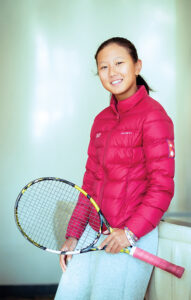
Shivali Gurung, National Tennis Player
We all have different strengths and styles. Women bring their own specialties which make the game unique. We do not need to play like men. We need to play in our own style.
Shivali Gurung was just 13 when she played one of her toughest matches against a Bangladeshi opponent in Bangladesh. The battle lasted nearly four and a half hours, and she emerged victorious with a score of 7 to 6, 6 to 7, 7 to 6. Shivali likes to believe that her performance was so impactful that the International Tennis Federation decided to upgrade four countries to the next category level instead of three, allowing Nepal to compete in Malaysia.
She began playing tennis at the age of six and, in her eight-year career, has competed in India, Pakistan, Bangladesh, Sri Lanka, Malaysia, Thailand, Germany, France and Belgium, alongside numerous tournaments in Nepal. She has won almost all national competitions and currently holds the number one ranking in Nepal’s under 14 category, while ranking fourth in Asia in the same division.
During our hour-long conversation, Shivali recounted the many tournaments she has played while representing Nepal. Although she has not won every international match, she has already established herself on the global stage. Her training has now taken her to Australia, where she will compete in the Australian Open 2026. On the evening we met, she was preparing to fly to Malaysia for training. She has also secured a yearlong fellowship with the prestigious Mouratoglou Academy in Malaysia.
Currently ranked 736 in the world, Shivali aspires to break into the top 200 to qualify for more international tournaments. To achieve this, she must continue competing both abroad and at home to steadily improve her ranking.
Having travelled extensively, Shivali has seen world class facilities and wishes Nepal’s infrastructure matched international standards. She is disheartened by the condition of courts and equipment in her home country. “We could do so much better and organise many more games and tournaments,” she says. “That would support national players who could compete at home without worrying about travel and its costs.”
Her journey has largely been supported by well-wishers and the network her father, himself a former tennis and football player, helped her build. She hopes that in the future, athletes representing Nepal will be able to rely on structured state support rather than personal connections.
As a young woman, Shivali has not faced overt sexism, but she recognises societal biases that favour male athletes. She reflects, “We do not need to view men’s games and women’s games as the same. We all have different strengths and styles. Women bring their own specialties which make the game unique. We do not need to play like men.We need to play in our own style.”
Having played intensively in recent years, she understands the importance of mental health. She has experienced fatigue and loss of focus when competing back-to-back. Her advice to young girls aspiring to play tennis is simple: “Work hard but enjoy the game and enjoy the feeling of being on the court.”
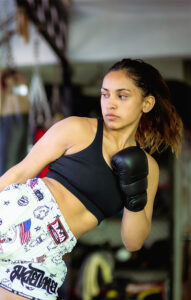
Yugeen Sharma, National Kickboxing and MMA Player
No matter your goal, you can learn kickboxing or martial arts. It will keep you fit and prepare you to tackle anything life throws at you. You will learn how to throw punches and how to dodge, when necessary, both literally and metaphorically.
Yugeen Sharma and I met at Rage Fitness in Naxal, where she was training before our scheduled interview. It is where she works with her coach, who not only guides her as a Mixed Martial Arts fighter but also encourages her personal growth. Yugeen credits her coach for shaping her into both a stronger athlete and a grounded individual. She was 16 when she began boxing and soon discovered that Mixed Martial Arts offered more possibilities than specialising in a single discipline. Now 20, she competes
professionally. Yugeen explains, “There are many limbs in the body. We can make use of all of them.” As an MMA fighter, she must train in boxing, wrestling and jiu jitsu, among other disciplines. Her ultimate aim is to compete in the Ultimate Fighting Championship and become the first Nepali fighter to do so. However, she acknowledges the structural limitations. “Sports like MMA and Muay Thai are still new in Nepal. Many people are not informed about them, and we do not yet have government support. Sponsorship is also a challenge.”
Yugeen also emphasises transparency in sports governance. “Competitions should be transparent and free from corruption. Athletes deserve undivided support from the
authorities.” Despite the challenges, she has no regrets. Training has helped her manage stress, cope with anxiety and build confidence. Last month, she travelled to Sri Lanka to compete in a kickboxing competition, and won.
Her message to women is empowering: “No matter your goal, you can learn kickboxing or martial arts. It will keep you fit and prepare you to tackle anything life throws at you. You will learn how to throw punches and how to dodge, when necessary, both literally and metaphorically.”
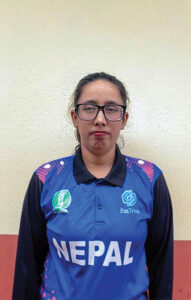
Gita Poudel, National Captain of Nepal’s Blind Women’s Cricket Team
“We need to keep working and moving forward rather than dwelling on challenges.”
Gita Poudel lives in Butwal with her husband and five-year-old child. She runs a shop while also serving as captain of Nepal’s blind women’s cricket team. Under her leadership, Nepal became runners up in the first Women’s T20 World Cup Cricket for the Blind in 2025.
Nepal lost only to India and set a world record by bowling out the United States team for 16 runs and chasing the target in 0.4 overs, winning by 10 wickets. Yet this achievement received little recognition.
Gita has played cricket for 18 years. She is a middle order batter and wicketkeeper. Since her first international matches in 2014 against England, opportunities have been
limited. Reflecting on this, she says, “With more practice and resources, we could have brought the cup home.”
Blind cricket has adapted rules, including underarm bowling and sweeping strokes, but the passion remains the same. According to Gita, there are no allowances or
remuneration. Despite injuries and deteriorating vision, she remains hopeful. She acknowledges disparities in recognition between male and female cricketers but believes in perseverance. “We need to keep working and moving forward rather than dwelling on challenges.”
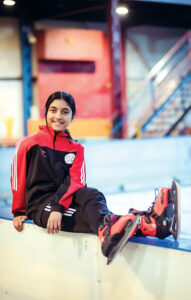
Paree Guragai, National Ice Skater
I believe that with functioning infrastructure and international standard equipment, Nepali athletes could not only participate but also win.
Paree Guragai had just returned from Dehradun after competing in Nepal’s first international ice-skating competition. It was her first time representing Nepal globally. We met at Fun Land in Bhadrakali, once home to Nepal’s only ice rink, which is currently nonoperational. Paree explains, “We only practised on roller skates before leaving for India. I hope we get the ice rink back so we are better prepared next time.” Without proper facilities, Nepal was unable to secure a position. “Other players had been practising for long hours on ice with proper equipment,” she says.
Introduced to skating in grade four, Paree is now in grade seven and still dreams of representing Nepal again. She believes that with functioning infrastructure and
international standard equipment, Nepali athletes could not only participate but also win.
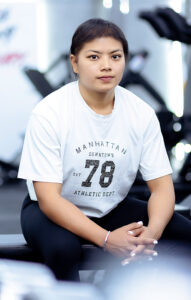
Poonam Chaudhary, National Powerlifting Player
It is usually people with limited knowledge who make noise. It is more important to educate them than to be angry.
Poonam Chaudhary won gold for Nepal at the World Powerlifting Championship. We met at her gym, Gymbahal, where she is preparing for the Iconic Clash Deadlift Championship 2026.
Powerlifting involves three lifts: squat, bench press and deadlift, with total weight determining results. Poonam previously won the Asian Powerlifting Championship
2025 in the under 58 kg category.
Her participation in the World Championship in Sri Lanka was uncertain due to financial constraints. Through connections in Nepal’s riding community, she secured support to compete. She reflects, “I could tell my parents I was building connections that supported my dream.”
Before competing, she struggled to make weight in the under 58 kg category, undergoing extreme measures to qualify. “It was one of the most stressful days of my career,” she says. “But with support from the team, I not only competed but became world champion.”
She has since resolved not to attempt extreme weight cuts again. Addressing criticism of women in strength sports, she says, “It is usually people with limited knowledge who make noise. It is more important to educate them than to be angry.”
Her advice to young women is clear: “Everyone is a beginner at first, but with practice and hard work we can achieve what we set out to do. If I had not challenged myself, I would not have won two gold medals for my country in the same year.”
These five women represent more than medals and rankings. They represent resilience, determination and the promise of what Nepali women can achieve when given
opportunity and support.