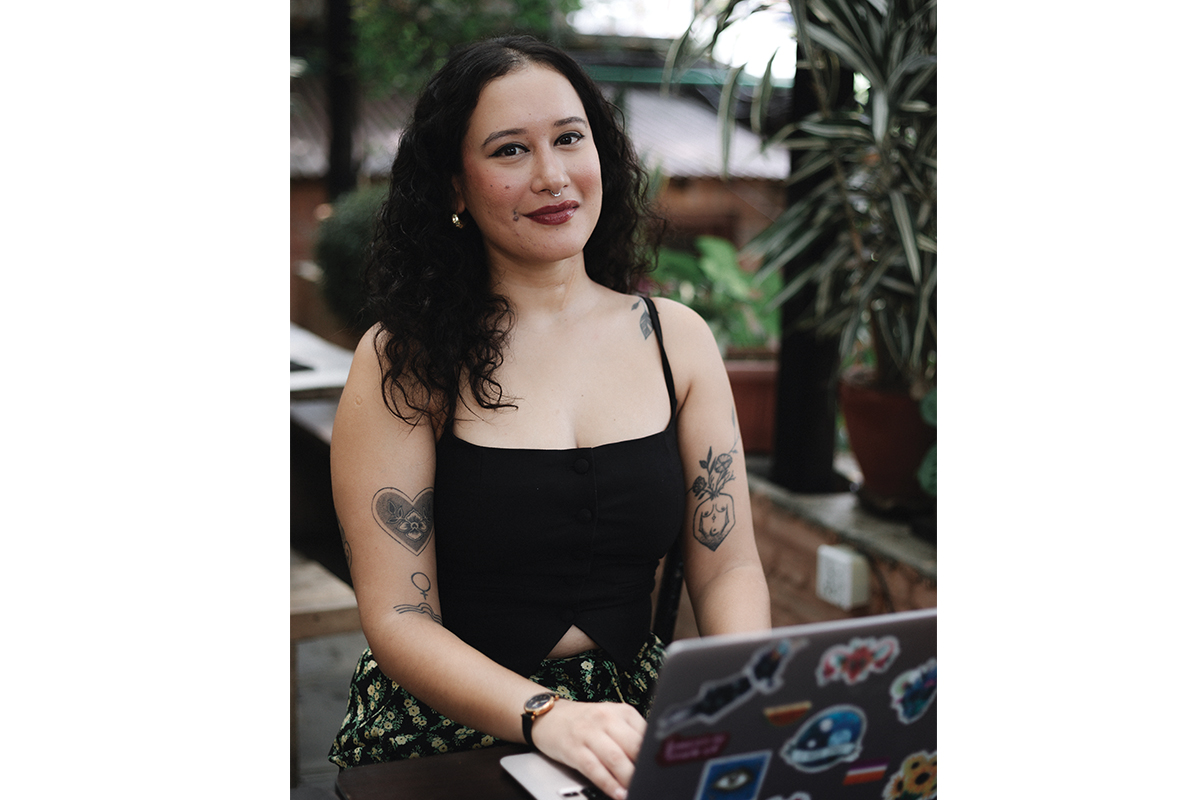
NIRVANA BHANDARY
To call a woman unsanskari in South Asian culture is to attempt to shrink her. It is a word heavy with judgement, discipline and warning, often used to push women back into silence. Nirvana Bhandary chooses to do the opposite.
With her debut book Unsanskari: A Feminist Life, the Nepali feminist writer, independent filmmaker and digital activist turns a shaming label into a declaration of selfhood. “Unsanskari is a word that I created,” she says. “The fact that it comprises both English and Nepali is an absolute reflection of my identity. I am a woman that walks the line between both worlds.”
The word sanskari, she explains, has followed women like an unspoken rulebook for generations. “Since I was a little girl, I have always heard this word sanskari attached specifically to women. A woman should be sanskari if she wants to be respected,” she says. But respect, in this context, often demands silence and submission. Through her essays, Nirvana asks why women are expected to be the obedient carriers of culture when that culture is deeply patriarchal. “Why should we be the silent, subservient bearers of traditions that do not serve us,” she asks, dismantling the moral authority behind those expectations.
For Nirvana, being unsanskari is not about rejecting culture entirely, but about choosing oneself. “Being unsanskari means rejecting the parts of our patriarchal culture, society and traditions that do not serve us and prioritising our personal joy and liberation,” she says. That belief runs through the book, which explores love, desire, ambition and rebellion through the lens of millennial Nepali women who are constantly negotiating between tradition and autonomy.
While many know Nirvana through her visual storytelling, from founding the feminist platform The Feminism Project to directing the documentary Moti, Dubli, Kali, Gori: Nepali Women Reclaim Their Bodies, writing has always been her most intimate language. “Before I got into filmmaking and activism, I was first and foremost a writer,” she says. She began journalling at the age of nine, developing a style that was raw and unguarded. “Journals developed my writing style to be very vulnerable and honest, because what they hold are our innermost feelings that we do not feel courageous enough to share with another human.”
What began as private catharsis slowly found a public audience. “From writing only for myself, I realised this style of vulnerable writing resonated with many other women too,” she says. Knowing her words gave voice to shared experiences encouraged her to keep writing in the same way. Unsanskari is the natural culmination of that journey.
Publishing such personal reflections, however, comes with emotional risk, something Nirvana is no stranger to. Since becoming active on social media in 2020, she has faced criticism for her unapologetic feminism. “Each new post and mini essay I shared, I took an emotional risk,” she says. “Many times, it was met with negative backlash from people who did not understand the ‘radical’ feminism I espoused.” Yet she never stopped. “A strong community of like-minded women built around me, who showed me that these emotional risks were not in vain. They were fuel to an ever-growing flame of feminist solidarity.”
Despite writing against deeply ingrained norms, Nirvana does not fear being misunderstood. She knows exactly who she is writing for. “I know my audience very well by now, feminists between the ages of 18 and 40,” she says. “I am a niche writer and I am very happy with that.” Her focus, instead, was on clarity and nuance, especially in a cultural landscape where feminism is often misrepresented. “It was very important for me that my book clarified the fact that feminism is not something to be feared,” she adds.
One of the most compelling aspects of Unsanskari is how it balances political anger with emotional tenderness. This, Nirvana says, has come with time and craft. “It is an intentional method in my writing that reflects what I believe at my core,” she explains. “It is possible to hold both political anger and personal tenderness as a feminist.” Choosing softness, empathy and self-love in the face of misogyny, she believes, is itself an act of resistance. “Life is full of greys,” she says, “and I attempt to shed light on that through my writing.”
For young Nepali women choosing unconventional paths, courage often lives in that grey space. Nirvana defines it as the difficult work of unlearning. “There is enormous courage in firstly unlearning the expectations forced onto us and then asserting our right to self-autonomy,” she says. From narratives about beauty and strength to taboos around menstruation, marriage and motherhood, she urges women to question everything they were taught as girls. “I have deep faith in the strength, intelligence and courage of young Nepali women,” she adds.
Unsanskari does not offer tidy conclusions or prescriptive answers. Instead, it leaves readers with questions that linger. “Am I a feminist. Am I queer. At what point in my girlhood did I lose my voice. What are things about my culture that I want to discard,” Nirvana lists. The discomfort these questions provoke is intentional, meant to spark self-reflection rather than certainty.
At its heart, the book centres Nepali women telling their stories on their own terms. Nirvana hopes it opens conversations within families, friendships and feminist spaces about patriarchal practices, beauty standards and the importance of solidarity. In reclaiming a word once used to shame, she offers a powerful reminder that being unsanskari might simply mean being honest, free and unapologetically oneself.
Text: Ankita Jain