
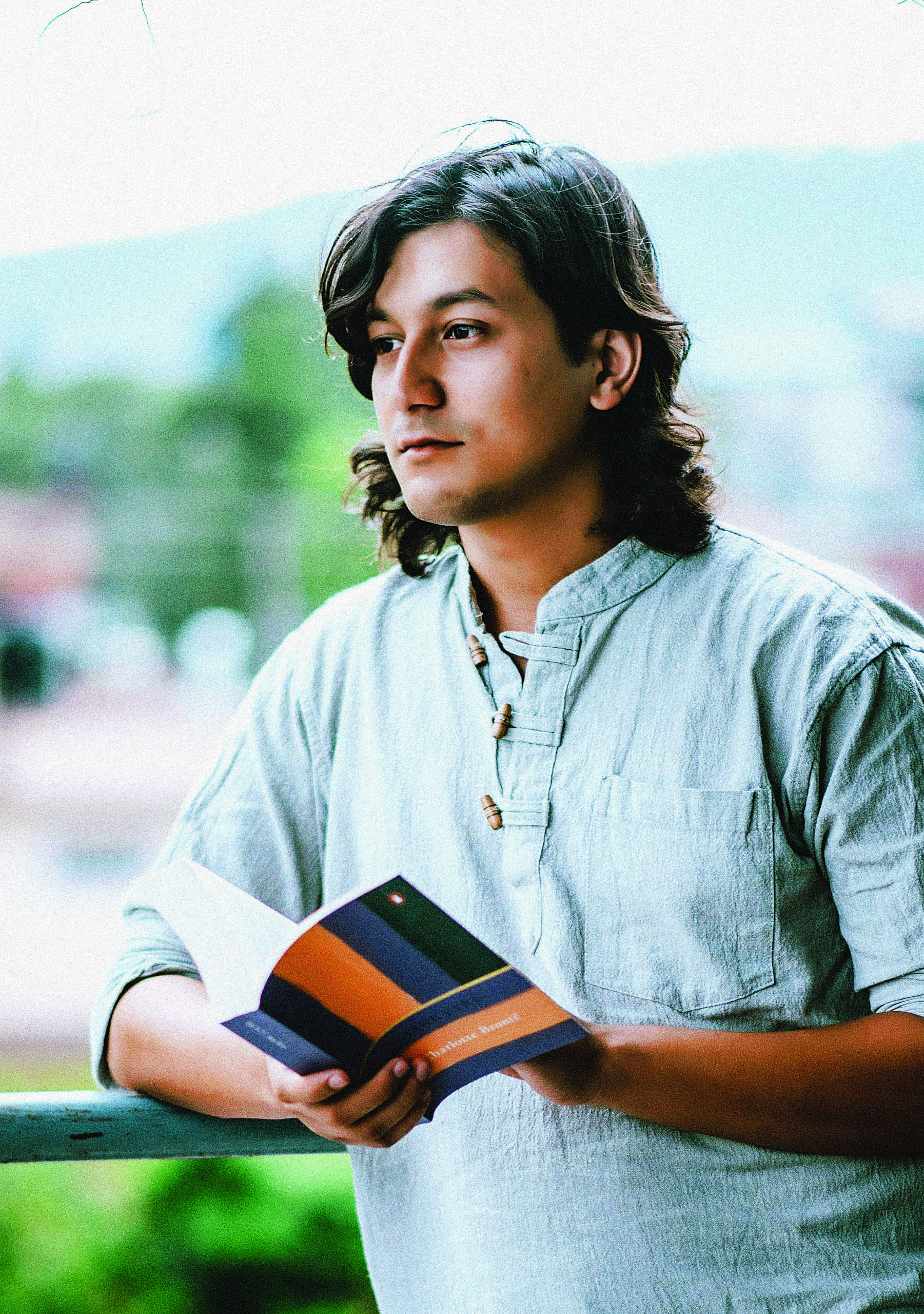
In an age where speed defines success, Iih chooses to walk. Slowly, deliberately, and purposefully – across mountains, plains and borders. From the bustling alleys of Kathmandu to the farthest reaches of South Asia, his journey is more than about covering distance; it is about discovery of self, society and the systems that shape both.
A wanderer, activist and thinker, Iih’s path has been one of questioning convention, challenging complacency, and walking quite literally toward truth and change.
Among other things, he staged a 108-minute protest outside the Lalitpur Metropolitan City office in December 2023, opposing the removal of sidewalk traders without adequate alternative arrangements. He also led a 199-hour foot-path protest, forcing municipal authorities to negotiate terms for street vendors and reclaim seized goods. His story reminds us that sometimes, to change the world, one must first learn to change with it, even if it is a step at a time.
What were you like as a child? Were there any early signs you would grow up to challenge systems and walk your own path?
My formative years were spent in the heart of Kathmandu in the late 90’s and early 2000’s. Even though my familial circumstances were far from ideal, just by the virtue of being present in the city I was broadly shielded from the turmoil of the conflict years, received private education, and never had to struggle for fundamental necessities. And thus, I view my childhood as one of relative privilege.
I remember being a curious and imaginative child. I was hooked on television programmes that focused on history, science and nature, and took notes during commercial breaks. I skimmed through countless bulky books and internalized scattered ideas that were beyond my years. I spent many hours on the internet browsing Wikipedia relishing the process of following links to new revelations. Social and negotiation skills were not my strong suit though. Often, instead of taking the bus, I went to school and back home walking, experimenting with routes and entering new neighbourhoods. Doing so gave me great joy.
At school, and in other facets of life, I resolutely objected to all that did not offer satisfactory reason. I was never interested in field sports, for example; the bullying and shaming that followed only solidified my resistance against it. I put exceptional effort into subjects and assignments of interest or where teachers could cultivate it, and floundered in others. Walking out of classes and skipping school became regular at a point, and I eventually lost interest in it. In my hyper-imaginative, egoic, teenage mind, I felt that I was too good for institutional education. At the age of 14, only months into the tenth grade, I wrote a resignation letter to the principal, which was unsurprisingly viewed with bewilderment, and then I left school to pursue politics. Shortly thereafter, I left home too.
You walked 6,000 kms across Nepal, and mostly alone. Were you looking for Nepal, or for yourself?
Walking, discovering new spaces, and engaging with diverse circumstances inundates me with life. It is in as best of an alignment as can be with my inner voice or calling or sense of reason. Trying to quantify or explain it has been an effort largely in vain for me. For communicational convenience, I am compelled to quantify it in terms of a measure of time or distance. Say, “Walked 15,000 kms across all geographical variations in South Asia over the past decade.” Firstly, the default presumption is that I might have hitchhiked and not actually walked. Secondly, it is not a tangible quantity. Like, most people can fathom the idea of walking 5 kms under the sun, or three on snow, or a five-day trek, as they have lived experiences to relate to. Thirdly, the logistics, passion, and lack of convenience defy comprehension. It seems like something that is too good to be true. Almost all the time, it is just something that flies over the listener’s head. And, while I might have the passion to walk great distances, I do not have the same to market or hail it. What I can say with certainty is, walking enables interactions with environments and people that travelling on a vehicle can never permit.
When one walks across glacial terrain for example, one feels the texture of the silty, sandy soil compressing beneath one’s feet, cool breeze on one’s face, and a smell akin to that of petrichor in the air.
One is vulnerable while walking and can be engaged with any curious passerby. There have been times when people have just come to me, hugged me and cried.
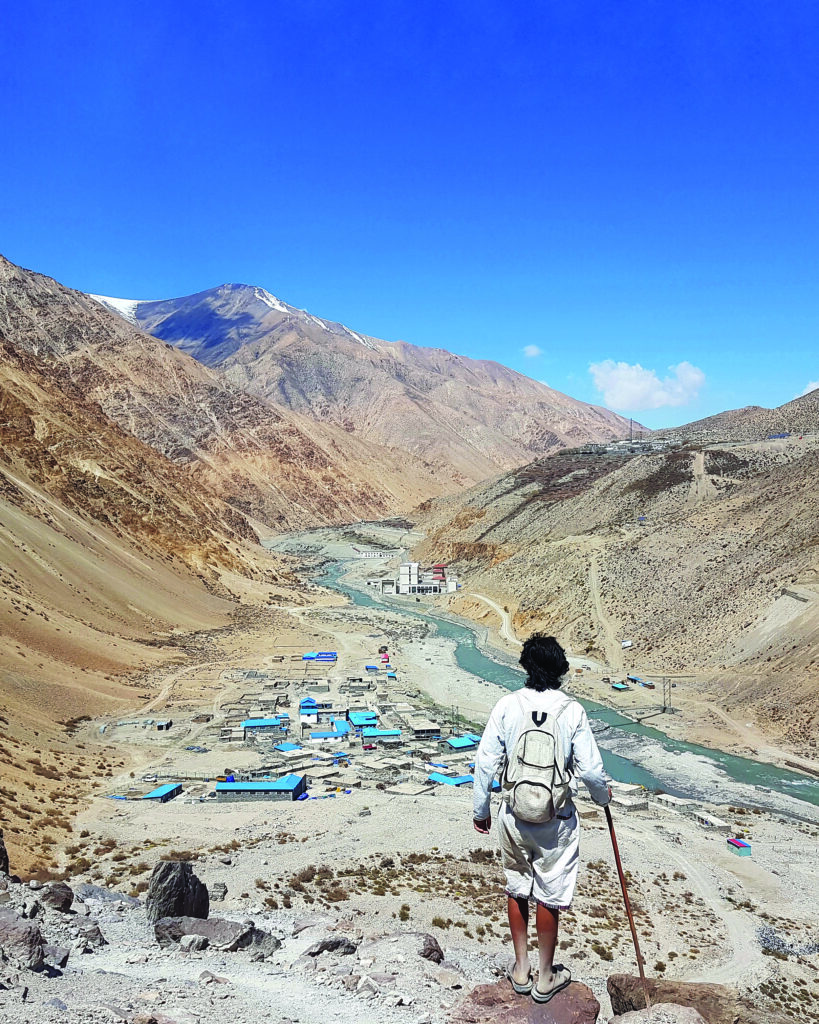
An inexplicable sense of connection and catharsis! At other times, it has required me to learn phrases from a new language to create an environment of trust and ease with locals. As a walker, one constantly has intersectional interactions and engagements across human made boundaries, and thus the privilege of gaining a more wholesome understanding of the world.
As for why Nepal and then South Asia, circumstances led to it. I just went with the flow – took things a day at a time. As for why in slippers in the early days, I had worn them for years leading up to the long walks and it only seemed natural for me, well right up until an ankle ligament injury made sticking to slippers impossible. Like life, the walks have been my teacher and shown me the way.
You travelled carrying almost nothing. What did letting go of things teach you about holding on to what matters?
It made sense to keep the bag under three kilograms. My modus operandi, after a bunch of trials and errors, became carrying as light of a bag as possible which liberated me enough to be able to walk even 24 hours straight, when needed to get from one settlement to another, instead of camping out. I am not a luddite, the light bag is a product of optimization; it still has essentials like a power bank, a poncho raincoat, and basic medication. I guess it is not about letting go or holding on. It is just that when the direction is clear, i.e. to walk as much and effortlessly as possible, everything else starts aligning towards it.
You stood up for the rights of street vendors, Covid 19 mismanagement with your ‘Enough is Enough’ campaign and hunger strikes. In a country full of injustice, why did these in particular causes move you to act?
It would probably take an hour’s worth of conversation to adequately enunciate upon the interventions mentioned. To keep it short, those were glaring issues that were hurting the most vulnerable among us, and with gross apathy in face of populist momentum on both occasions, I felt that the least I could do was use the privilege and whatever shred of credibility I had to amplify common sense solutions and generate activating discourse.
Throughout the 2010s, I relentlessly advocated for issues ranging from environmentalism to heritage conservation, from justice to gender rights, and that history, along with the walks, lent me a vantaged position to effectively intervene on those matters. The fact that I am not tempted by prospects of public office or am part of any organization liberates me to take up unpopular stances. I am aware of my limitations too, as an individual without institutional association or significant resources, an effective pariah in this society. At this point in time, I do not see value in performative engagements. I engage publicly on issues only when I have clear understanding and am sure that I can make a tangible difference. It has to come from the heart and have sufficient rational value.
You dream of walking beyond borders. If you could carry just one lesson from Nepal to the world, what would that be?
I am not in a rush. I am not ambitious. At 30, I am aware of my strengths, as well as my limitations. Pushing boundaries, one step at a time, and trusting life has worked wonders for me. I am more appreciative than ever of life and my support systems and do my best to give back quietly wherever and however possible. Each day, I learn something new. I am content with and grateful for that.
Text: Kreenjala Pyakurel