

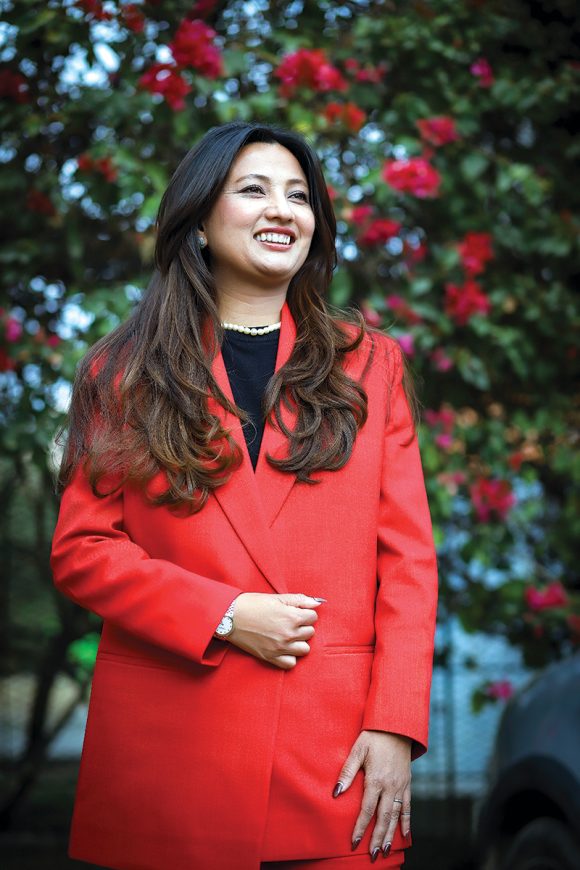
Prajuna KC is a dynamic leader with a passion for creating a more equitable world. With a Master’s in Public Administration from Syracuse University and over 15 years of experience across the private and development sectors, she brings a unique perspective to addressing complex social and economic challenges. Her diverse background enables her to blend market-driven strategies with development expertise, fostering innovative solutions that bridge inequalities and drive lasting impact. In her current role at iDE, she applies this unique thinking to advance the organization’s mission of ending global poverty. iDE works to connect underserved communities with essential products and services, empowering individuals to climb the economic ladder and improve their lives. Operating across 12 countries in Latin America, Africa, and Asia, iDE focuses on sustainable, context-specific solutions in agriculture, WASH, and nutrition, positively impacting over 44 million lives to date.
Through her leadership, Prajuna is helping to shape a future where economic empowerment and social equity go hand in hand.
How has iDE’s work empowered entrepreneurs in Nepal?
For over three decades, iDE Nepal has empowered rural entrepreneurs—particularly smallholder farmers, women, and marginalized communities—to build resilient livelihoods. iDE’s approach goes beyond business creation; it’s about fostering resilience, innovation, and unlocking pathways to prosperity. Focusing on agriculture, nutrition, water, sanitation, and hygiene, iDE addresses four key challenges: access to information, technology, finance, and markets.
A key driver of iDE’s success is its network of over 1,100 Community Business Facilitators (CBFs)—local entrepreneurs who connect farmers to agricultural inputs, mechanization services, non-collateral loans, and affordable technologies. These trusted advisers are transforming how farmers access resources and markets, driving productivity and profitability. To bridge knowledge gaps, iDE trains these ‘last-mile agents’ to provide hands-on guidance, enhancing adoption through community trust and collaboration.
Rather than directly providing resources, iDE strengthens supply chains by working with local businesses, wholesalers, and service providers, ensuring essential products and services are available and affordable for those who need them most. Collaborating with banks and financial institutions, iDE has facilitated approximately $3.2 million in loans, empowering over 8,000 enterprises and farmers to access financing, grow their businesses, and improve their livelihoods. As a result, nearly 714,000 households have increased their annual incomes by an average of $691.
By de-risking and creating incentives for all market ecosystem players to invest in rural entrepreneurs, iDE enables private-public partnerships that drive sustainability. Through partnerships with the private sector and government entities, iDE strengthens market linkages, promotes climate-smart agricultural techniques, and ensures entrepreneurship is accessible to everyone, especially those in rural areas. iDE’s model continues to create resilient, inclusive markets where everyone has the opportunity to succeed.
How has iDE’s first female country director influenced the organisation’s direction?
It’s an honour to be the first female and first Nepali to lead iDE Nepal in its 32-year history. But for me, it’s less about titles and more about bringing my experiences to the table. My journey – from development to the private sector and back – taught me that real impact comes from building systems where good ideas can thrive.
From day one, my focus has been on creating a culture rooted in trust, respect, and collaboration. From the outset, I prioritised creating an inclusive, supportive environment where everyone feels comfortable in their own ability. I have encouraged open dialogue, strengthened relationships through retreats and celebrations, and focused on well-being. At the same time, I have been committed to setting clear standards and policies to ensure consistency and accountability across our work. Having these structures in place creates a strong foundation that allows everyone to thrive.
Being a Nepali woman adds depth to my leadership. I understand the nuances of our communities because I grew up here. That insight shapes how we build partnerships – with the private sector, government entities, and rural entrepreneurs. At the end of the day, my role is about empowering my team and our partners to bring their best selves forward. When people feel valued, supported, and motivated, real change happens.
What unique challenges did iDE Nepal’s first female country director face?
I have certainly faced my share of challenges. One of the most significant is the constant need to prove that my leadership is based on vision and impact, not gender. Whether intentional or not, biases exist, especially in a sector where leadership has traditionally been male-dominated. And coming from the private sector only added another layer of scrutiny. For instance, when I introduced management strategies like setting key performance indicators for each job category, my actions were met with scepticism by some. I understand why—it was a new way of thinking, and not everyone was comfortable with it. But when people saw how these tools could boost efficiency and drive real impact, the value became obvious.
I’d be lying if I said imposter syndrome never crept in. That feeling of questioning whether I truly belong here, or that my achievements were somehow less legitimate. It’s a weight many women in leadership carry. But instead of letting those feelings hold me back, I use them as fuel to work harder, to demonstrate that good leadership transcends gender.
Another challenge is balance – juggling work and family life. As a mother to a six-year-old, the idea of achieving perfect balance is a myth. Some days, work demands more of me; other days, family does. Many women feel this, whether they are CEOs, professionals, or smallholder farmers. And that’s okay, because leadership isn’t just about setting ambitious goals, it’s about creating an environment where people can thrive both professionally and personally. That’s why I am committed to building a culture at iDE where it’s okay to make time for family, whether that’s through flexible work hours, working from home, or just having a workplace that genuinely values well-being.
At the end of the day, I don’t see myself as a “female leader”, I just see myself as a leader. I am someone who’s focused on making an impact and supporting others to do the same.
How does the private sector contribute to sustainable development in Nepal?
At iDE, we believe sustainable development demands the involvement of the private sector from the start. Our role is to de-risk investments in innovation, facilitate market entry, and build trust between communities and market actors. But true sustainability only happens when businesses see the value in serving rural markets and recognise their untapped potential.
Why? Because development benefits everyone. When consumers have higher incomes, their purchasing power grows, boosting local economies and increasing demand for products and services. The private sector stands to gain immensely from this dynamic, creating a win-win scenario where business growth and community resilience go hand in hand.
We collaborate with agribusinesses, tech companies, and financial institutions to introduce new products and services, demonstrate their value, and connect communities to formal markets. For example, when introducing hermetic storage technology – airtight bags designed to safely store grains and seeds after harvest – we partnered with private companies to bundle essential services for farmers, including loans, crop insurance, and product aggregation. This helped the communities understand the technology better and reap economic benefits by using it the right way, while also opening a new market for the private sector.
This integrated approach was made possible through iDE-trained community business facilitators – trusted, commission-based entrepreneurs within the community, whom we often refer to as honest brokers. They not only demonstrate new technologies but also connect farmers to markets, financial services, and buyers. By making these resources accessible, they build trust and ensure farmers have the support, protection, and opportunities needed to thrive.
Our work with partners like Muktinath Bikas Bank, Siddhartha Premier Insurance and local agribusinesses has shown that when the private sector sees the value in serving rural communities, they actively invest in building relationships, providing accessible financing, and ensuring technology reaches even the most marginalised farmers.
Without buy-in from market actors, our interventions would remain isolated development projects rather than building blocks of systemic change and economic clusters. The question isn’t whether the private sector has a role to play in sustainable development. The question is how quickly market actors can be brought to the table to co-create solutions that truly endure. Because when the private sector becomes part of the solution, development is no longer a temporary fix, it’s a sustainable reality.
How does iDE support women entrepreneurs in Nepal?
iDE supports women entrepreneurs in Nepal by creating an enabling environment where women can thrive as business leaders and change-makers. Through tailored training, mentorship, and market linkages, we empower women to build profitable, resilient businesses that contribute to their families’ well-being and community growth.
As more men migrate for work, women have increasingly become the backbone of smallholder farming in Nepal. But they face unique challenges, including juggling farming with household duties. iDE addresses these barriers by designing user-friendly agricultural tools and providing training on small tilling machines to boost productivity.
To further reduce time poverty, especially for women with young children, we connect them to childcare centres, allowing them to find time to focus more on their businesses. We also promote accessible skills like making pasta sauce, pickles, and noodles—turning these skills into viable enterprises. And because producing a product is only the beginning, we facilitate entrepreneurs’ access to markets by connecting them with resources for branding, packaging, supply chains, and marketing. Additionally, we bridge financial gaps by facilitating loans and providing financial literacy training.
Ganga Devi Magar, a single mother from Basgadhi Municipality, Bardiya, embodies a powerful example of our work. After years of working as a migrant labourer in the Middle East, Ganga returned to Nepal determined to build something meaningful at home. Recognising a need in her community, she established a small dairy in March 2021.
With iDE’s support, Ganga secured a subsidised loan of Rs 195,000 from a cooperative, which she invested in dairy machinery to expand her enterprise. Today, the dairy generates an annual profit of approximately Rs 195,000 from an initial investment of Rs 299,000. Beyond her own success, Ganga’s dairy has become a local aggregation point for other farmers, providing them with a convenient market space to sell their milk and strengthening the local supply chain.
Ganga’s vision continues to grow as she plans to diversify her product line, enhance branding, and reach larger markets. Her journey shows how, with the right support, women entrepreneurs can transform their own lives while uplifting their communities.